
Last Updated: November 13, 2026
Quick Summary
Waterproof camping chairs are worth it only if you expect waves, standing water or all-day wet use, since genuinely waterproof fabric with sealed seams copes where water-resistant chairs leak. For most beach trips, a quick-drying, draining chair is the better compromise.
- Water-resistant fabric sheds splashes, but seams and stretched areas still let moisture through.
- PU, PVC or TPU coatings block liquid water, usually with taped or welded seams.
- Mesh and open-weave fabrics drain fast and dry in minutes, though they are not waterproof.
- Aluminium frames resist salt-air corrosion better than steel, which rusts faster.
- Rinse with fresh water after each beach trip and dry fully before folding.
Table of Contents
- What Waterproof Actually Means on a Beach Chair
- Camping Chair Materials Explained: Fabric and Frame
- Choosing a Chair for Different Beach Conditions
- Waterproof Camping Chairs Compared: Comfort, Weight and Packed Size
- How to Clean a Camping Chair After Sand and Saltwater
- How to Prevent Rust on Camping Chairs
- Camping Chair Storage Tips for the Off-Season
- Picking Your Beach Chair at Budget Roo
- Frequently Asked Questions
What Waterproof Actually Means on a Beach Chair
Most "waterproof" camping chairs sold today are not waterproof at all. They are water-resistant, which is a different claim entirely.
Water-resistant fabric sheds light rain and splashes. Waterproof fabric keeps water out under sustained pressure, like a wave breaking over the seat. For beach use, that distinction decides whether your chair survives a season or a single summer.
Waterproof vs water-resistant fabric
A waterproof fabric has a coating or laminate that blocks liquid water from passing through, even when weight presses on it. A water-resistant fabric has a surface treatment that makes water bead up, but seams, stitching and stretched areas still let moisture through.
Watch out: a chair labelled "waterproof" with exposed stitching and no seam sealing will leak at every stitch line.
The three real categories you will meet
In practice, beach chairs fall into three groups, and the label rarely tells you which one you are buying.
- Water-resistant (most common): a durable water repellent (DWR) finish on polyester or nylon. It beads light spray and dries fast, but pressure and seams let water through.
- Waterproof (less common): a PU, PVC or TPU coating or laminate that blocks liquid water, usually with taped or welded seams. Heavier, stiffer and less breathable.
- Quick-drying and drainage (often the best beach compromise): open-weave or mesh fabric that lets water pass straight through and dries in minutes. Not waterproof, but it never holds a puddle against you.
For many beachgoers, the third category is a practical choice. A chair that drains and dries fast can be more comfortable than a stiff waterproof seat that traps water and heat.
What to look for in the construction
Labels are marketing; construction is fact. Check these points in order.
- Coating or laminate: PU is lighter and more flexible; PVC is heavier and more durable; TPU is flexible and resistant to oils and abrasion.
- Seam treatment: taped, welded or sealed seams are the difference between a waterproof fabric and a waterproof chair.
- Hydrostatic head (if stated): the water pressure a fabric resists before leaking, in millimetres. Higher is more waterproof.
- Drainage: mesh panels, grommets and open weaves let water out. A sealed seat with no drainage holds water against the user.
- Drying time: a chair that holds water stays heavy and grows mildew.
- Hardware and seams under stress: look for reinforced or bar-tacked stress points.
What waterproof does not mean
A waterproof chair is not a flotation device and should never be treated as one. It is not designed to keep a person afloat, and a chair in moving water is a hazard, not a safety aid.
Waterproof also does not mean corrosion-proof. A waterproof seat on a rusting steel frame is still a failing chair. Judge the fabric and the frame separately.
Matching the fabric to your exposure
- Occasional spray and damp towels: water-resistant fabric with quick-drying properties is enough.
- Wet swimmers and repeated splashes: choose drainage and fast drying over full waterproofing.
- Waves, standing water or all-day wet use: only genuinely waterproof fabric with sealed seams will cope, and you will pay in weight and breathability.
A concise way to decide: buy waterproofing for the water you expect to sit in, and buy drainage and drying speed for the water you expect to meet by accident.
Camping Chair Materials Explained: Fabric and Frame
Fabric and frame choice matters more than any marketing badge. The right pairing depends on how much salt, sand and sun the chair will meet.
Fabric Types and Weather Resistance
- Polyester with PU coating: common, affordable, handles splashes well
- Oxford nylon: light and quick-drying, good for packability
- PVC-coated fabric: genuinely waterproof, heavier and stiffer
Steel vs Aluminium Frames and Corrosion Resistance
Steel frames are stronger and cheaper but rust faster in salt air. Aluminium frames resist corrosion better and carry less weight. Powder coating helps either metal, but chips expose bare metal to salt. If your chair lives near the coast, aluminium is the safer long-term pick.
Choosing a Chair for Different Beach Conditions
Match the chair to the beach, not the brochure. Soft dry sand, wet tidal sand, wind-exposed shoreline and rocky ground each punish a chair differently, and features that help in one condition often hurt in another.
Soft dry sand: spread the load
On soft, dry sand the chair sinks because the load is concentrated on four small leg ends. The fix is to increase the contact area, not to buy a heavier chair.
- Wide feet or sand pads: broad, flat feet or clip-on sand pads lower the pressure on the sand and stop the legs disappearing.
- Splayed leg geometry: legs that angle outward create a wider base and resist tipping. Straight vertical legs sink faster.
- Low seat height: a low-profile chair puts the load closer to the ground, so there is less leverage to tip it, and it keeps you out of the wind.
A lightweight chair with wide feet can handle dry sand better than a heavy chair with small feet, because the heavier chair is more likely to sink.
Wet sand and tidal zones: prioritise corrosion resistance and drainage
Wet sand is firmer, so sinking is less of an issue, but the chair is now sitting in salt water and grit. This is where frame material and fabric drainage matter most.
- Aluminium over steel: salt water accelerates steel corrosion, especially at welds, rivets and folding joints. Aluminium is generally more resistant to corrosion than steel.
- Drainage, not just coating: mesh panels and open-weave fabrics let water pass through and dry quickly. A fully waterproof PVC seat holds a puddle against your legs.
- Sealed or capped leg ends: open tube ends trap salt water and grit inside the frame.
Watch out: a chair that is genuinely waterproof on the seat but has an untreated steel frame will still fail at the joints after repeated wet-sand use.
Windy, exposed beaches: stability beats height
Wind is the most underrated beach hazard for chairs. A tall, lightweight chair with a large fabric sail area catches gusts and tips or blows away.
- Low profile and low back: less sail area means less wind load. A low beach chair is markedly more stable in a crosswind than a tall recliner.
- Weighted or anchored base: use sand-anchor loops, bury the rear legs slightly, or weight the base with a bag.
- Braced frame: cross-braced or X-frame designs resist twisting better than single-pivot frames.
Uneven ground and rocky shorelines: self-levelling and footprint
Rocky platforms, pebbly beaches and sloping dunes test a chair differently from flat sand.
- Independent or self-levelling legs: some chairs adjust each leg independently, which helps on uneven ground. Fixed-leg chairs rock and concentrate stress on one joint.
- Wider stance: a wider footprint is more stable on slopes and pebbles.
- Reinforced feet: hard ground and rock chew through thin plastic feet. Look for replaceable or reinforced feet.
Family and group use: comfort and capacity
For family picnics and group trips, the priorities shift toward comfort, weight capacity and easy setup rather than minimum packed size.
- Weight capacity: check the stated limit and leave headroom. A chair rated close to the user's weight will flex and wear faster.
- Padded seats and armrests: comfort matters for long sits, but padding holds water. Choose quick-drying padding or a removable cover.
- Cup holders and side pockets: useful on sand, but they collect grit. Look for drain holes.
For a full breakdown of how weight and packed size trade off, see our guide to alternatives to heavy camping chairs for hiking. If comfort features like footrests are your priority, our roundup of the best camping chairs with footrest covers specific models worth comparing.
A quick condition-matching checklist
Before you buy, run through these questions in order:
- What is the ground like where you sit most, soft sand, wet sand, rock or mixed?
- How far do you carry the chair from the car or campsite?
- How windy and exposed is the beach?
- Will the chair get wet from waves, spray or wet swimmers?
- How long do people sit in it at a time?
- Does the frame material suit salt exposure?
- Are the feet and joints serviceable or replaceable?
Answering these honestly will narrow the field faster than any star rating.
Waterproof Camping Chairs Compared: Comfort, Weight and Packed Size
No single chair wins every category. Here is how the main types stack up.
| Chair Type | Comfort | Carry Weight | Packed Size | Best For |
|---|---|---|---|---|
| Low-profile beach chair | Basic | Light | Small | Sand and surf |
| Padded folding chair | High | Moderate | Medium | Family picnics |
| Reclining lounger | High | Heavy | Large | All-day lounging |
| Lightweight aluminium chair | Moderate | Very light | Small | Hiking and festivals |
| Heavy-duty steel chair | High | Heavy | Large | Fishing trips |
A common mistake is buying a heavy-duty steel chair for beach trips, then dreading the carry from the car park. Most beachgoers are happier with a lightweight aluminium or low-profile chair that dries fast and carries easily.
How to Clean a Camping Chair After Sand and Saltwater
Rinse the frame and fabric with fresh water after a beach trip, then dry fully before folding, as salt and damp can lead to corrosion and mildew.
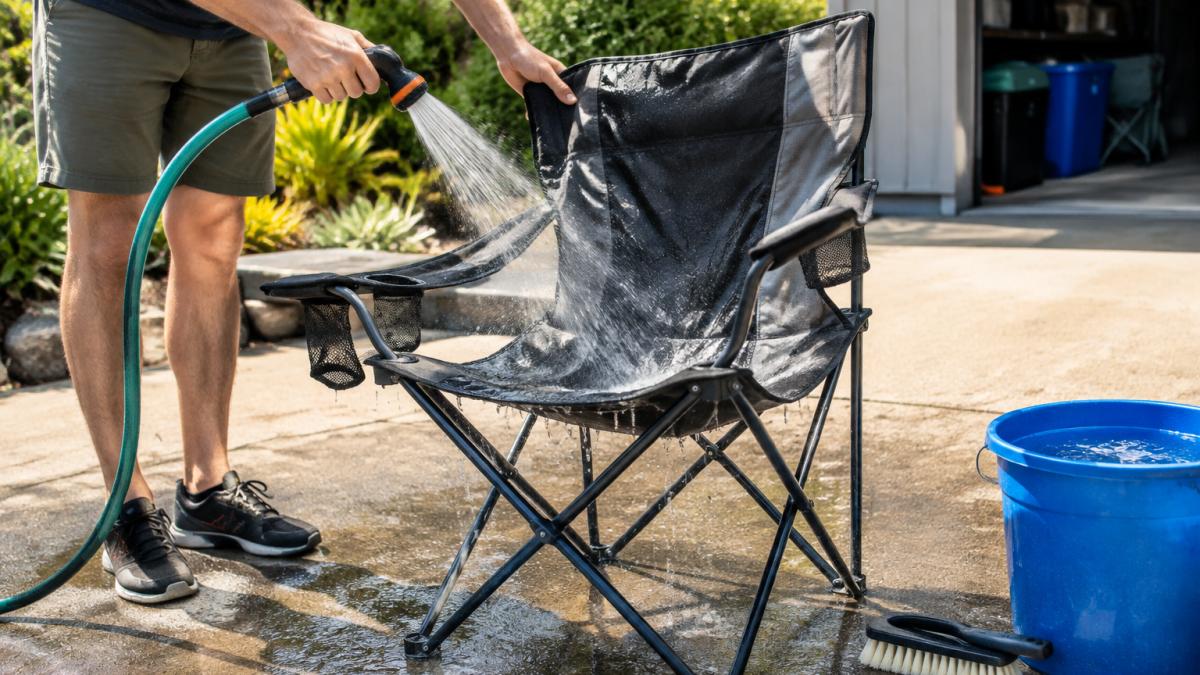
Here is the routine we recommend:
- Shake out loose sand while the chair is still unfolded
- Rinse the frame, legs and fabric with fresh water
- Wipe joints and hinges with a soft brush
- Dry completely in shade before folding
- Check seams and coating for wear
For a broader inspection routine, our guide on how to test camping gear quality walks through the checks worth doing before and after each trip.
How to Prevent Rust on Camping Chairs
Rust prevention generally comes down to dry storage and coating care. Salt can accelerate corrosion, so it is best not to store a damp chair.
- Dry the frame fully before storage, especially folding joints
- Touch up chips in powder coating with a matching paint
- Store away from damp sheds and wet ground
Watch out: folding a wet chair and leaving it in the carry bag is the fastest way to rust a steel frame. The trapped moisture has nowhere to go.
Camping Chair Storage Tips for the Off-Season
Store chairs clean, dry and loosely folded in a ventilated space. Compressing a chair tightly for months creases the fabric and traps moisture against the frame.
Hang lightweight chairs if you can. Keep heavy-duty models off concrete floors, which hold damp. Our light-packing guide pairs well with these storage habits if you are reorganising gear between trips.
Picking Your Beach Chair at Budget Roo
Choosing waterproof camping chairs for beach trips comes down to matching fabric, frame and weight to how you actually use the chair.
Budget Roo offers camping and outdoor gear with a focus on affordability and value. If you are ready to compare models, our budget camping chair guide is the place to start.
The right chair makes a beach day easier, and the wrong one makes the walk back to the car feel twice as long.
Frequently Asked Questions
Are camping chairs waterproof or just water-resistant?
Most waterproof camping chairs are really water-resistant: the fabric sheds light rain and spills but will soak through in sustained downpours or if water pools on the seat. True waterproofing usually comes from a coated or laminated fabric with sealed seams. For beach trips, water resistance plus quick-drying fabric matters more than full waterproofing, because salt and sand are the bigger threats to the frame and stitching.
What material is best for a camping chair at the beach?
Look for solution-dyed synthetic fabric such as polyester or nylon with a quick-drying, water-resistant finish, paired with an aluminium frame. Aluminium resists corrosion far better than steel in salt air, and synthetic mesh dries fast after a splash. Padded cushions are comfortable but hold water and sand, so mesh or thin padded seats suit beach use better.
How do you stop a folding camping chair from rusting?
Rinse the frame with fresh water after every beach trip to remove salt, then dry it fully before folding. Check hinge points and leg inserts, which trap moisture, and apply a light coat of silicone spray or a thin film of oil to steel parts. Store the chair open or loosely folded in a dry spot rather than sealed in a damp bag, and never leave it outside in the rain for long periods.
How should you dry and store a camping chair after a beach trip?
Shake out sand, rinse with fresh water, and wipe the frame dry with a cloth. Leave the chair open in shade with good airflow until the fabric is completely dry, which usually takes a few hours. Then fold it loosely, keep it in a breathable carry bag rather than a sealed one, and store it somewhere dry and out of direct sun. Damp storage is what causes mildew and rust.
