

Table of Contents
- Why Packing Light Matters: The Weight-to-Utility Framework
- Lightweight Camping Gear Essentials: What You Actually Need
- How to Test Sleeping Bag Warmth Before You Leave
- The Minimalist Camping Checklist: Pack by Function, Not Fear
- How to Pack Light for Camping in Specific Climates and Seasons
- Budget-Friendly Lightweight Hacks and Post-Trip Gear Audits
- How to Pack Light for Camping: Your Step-by-Step Routine
- Frequently Asked Questions
Last Updated: September 10, 2026
Why Packing Light Matters: The Weight-to-Utility Framework
Packing light for camping means carrying only gear that earns its place, measured by value per gram. This guide shows how to pack light for camping without sacrificing safety or comfort.
The weight-to-utility framework asks one question: does this item solve a problem I will actually face? A 100-gram titanium pot that boils water passes. A third backup torch that duplicates your headlamp fails.
Calculating Your Base Weight
Base weight is your pack's total weight excluding consumables like food, water, and fuel. For lightweight camping, aim for a base weight under 9 kilograms; ultralight enthusiasts target under 4.5 kilograms (rei.com).
Weigh everything, using kitchen scales for small items. Record each weight in grams, then sort by category: shelter, sleep system, clothing, cooking, and miscellaneous. The heaviest categories offer the biggest reductions.
A common mistake is replacing one heavy item while ignoring small ones: five 200-gram "essentials" add up to a kilogram you never needed to carry.
Lightweight Camping Gear Essentials: What You Actually Need
Lightweight camping gear essentials fall into three categories: shelter and sleep, cooking and water, and clothing and safety. Anything outside them must justify its inclusion.
The goal is deliberate selection, not deprivation: each item should serve multiple purposes where possible, and every gram should earn its place.
Shelter and Sleep Systems
Your shelter and sleep system is usually the largest portion of pack weight: a lightweight tent, tarp, or bivy protects you from weather, a quilt or bag keeps you warm, and a ground pad insulates you from the cold earth.
For solo campers, a tarp paired with a bivy sack can weigh under 1 kilogram combined; couples may prefer a lightweight tent that splits weight between two packs.
Packability matters as much as weight: a compression sack reduces volume, letting you carry a smaller pack.
Cooking and Water Management
Cooking gear should be minimal and multipurpose: a single pot, small stove, and lighter cover most trips. Where fires are permitted, you may not need a stove at all.
Water filtration is non-negotiable: a filter or purification tablets protect you from contaminants without adding significant weight. Carry only the water you need between sources, saving 2 kilograms or more on a full-day hike.
How to Test Sleeping Bag Warmth Before You Leave
Testing sleeping bag warmth before your trip prevents cold, sleepless nights. Set up your bag in a cool room, wear your planned sleep layers, and note how quickly you feel warm. If you feel cold within 20 minutes, adjust your bag or layering.
Treat the temperature rating as a guide, not a guarantee: ratings assume a base layer and an appropriate ground pad. A bag rated to 0°C may feel cold at 5°C if your pad lacks insulation (rei.com).
Sleeping bag warmth depends on three factors: the fill (down or synthetic), the loft (how much it puffs up), and how well you seal out drafts. A sleeping quilt with a strap system often beats a mummy bag on warmth-to-weight because it eliminates insulation compressed beneath you.
The Minimalist Camping Checklist: Pack by Function, Not Fear
A minimalist camping checklist organises gear by function, not by fear of what might go wrong: each category has a clear purpose, and you pack only what serves it.
Use this framework:
| Function | Essential Items | Weight Target |
|---|---|---|
| Shelter | Tarp, bivy sack, or tent; pegs; guy lines | 1-2 kg |
| Sleep | Sleeping quilt, ground pad, inflatable pillow | 1.5-2.5 kg |
| Cooking | Pot, stove, lighter, utensil | 0.5-1 kg |
| Water | Filter, 1-2 litre bottles | 0.3-0.5 kg |
| Clothing | Base layer, insulation layer, rain shell, spare socks | 1-1.5 kg |
| Safety | Headlamp, first aid kit, essential medications, repair kit | 0.5-0.8 kg |
The 5-4-3-2-1 Rule for Camping
The 5-4-3-2-1 rule simplifies packing decisions: five clothing items, four sleep items, three cooking items, two water items, and one safety kit. It forces you to prioritise.

Five clothing items: quick-dry base layer, moisture-wicking mid-layer, synthetic insulation jacket, rain shell, spare socks. Four sleep items: sleeping quilt, ground pad, pillow, compression sack. Three cooking items: pot, stove, lighter. Two water items: filter and bottle. One safety kit: headlamp, first aid, medications, repair tape.
Adjust quantities for trip length and conditions, but keep the ratios.
How to Pack Light for Camping in Specific Climates and Seasons
Most packing guides treat climate as a footnote, but it is the single variable that changes what earns its place in your pack. A kit that works in a humid coastal forest can be dangerous in an alpine frost hollow or wasteful in arid country. Below is a climate-specific starting point, then a rule for adjusting it.
Cold and alpine conditions
Cold is a weight problem disguised as a warmth problem. The trap is packing one heavy item for the worst moment instead of a layered system you can tune. Aim for a base weight of 8-10 kg for a three-season alpine trip, with the sleep system and insulation layers doing most of the work.
Priorities:
- Sleep system: a quilt or bag rated at least 5°C below the forecast overnight low, paired with a pad rated R4 or higher. Ground conduction, not air temperature, is what wakes most cold campers.
- Layering: one moisture-wicking base layer, one active mid-layer (fleece or light synthetic), one static insulation layer (down or synthetic jacket), one wind/rain shell. That is four garments covering a wide temperature band.
- Shelter: a four-season or three-plus-season tent with a solid inner. Tarps save weight but demand site-selection skill and a bomber pitch.
- Extras that earn their grams: a warm hat, gloves, a dry bag for the sleep system, and a spare pair of socks.
Hot and arid conditions
Heat changes the maths because water becomes the heaviest consumable you carry. One litre weighs one kilogram, so a two-day dry stretch can add 4-6 kg before you pack any gear (the CDC).
Priorities:
- Shelter: a well-ventilated tarp or single-wall tent. Condensation, not rain, is the enemy.
- Clothing: loose, light-coloured, quick-dry long sleeves and trousers. Coverage beats sunscreen for weight and reliability.
- Water: carry capacity for the longest dry stretch plus a 20% buffer, and cache or resupply where you can. A filter is useless if there is no water to filter.
- Sleep: a lighter quilt is fine, but do not skip the pad. Desert nights cool quickly and the ground pulls heat.
Wet and humid conditions
Wet climates punish optimism. The goal is not to stay dry but to keep your sleep system and insulation dry, because a wet quilt or down jacket loses most of its insulating value.
Priorities:
- Waterproofing: a pack liner plus individual dry bags for sleep system, insulation, and electronics. A pack cover alone is not enough in sustained rain.
- Shelter: a double-wall tent or a tarp with a beak. Ventilation matters as much as waterproofing in humidity.
- Clothing: synthetic insulation over down, because synthetics retain warmth when damp. Quick-dry fabrics throughout.
- Footwear: trail runners that drain, paired with wool or synthetic socks. Waterproof boots trap water once it gets in.
Shoulder season and variable conditions
Shoulder season is the hardest packing problem because the forecast is unreliable. Pack for the range, not the average: add one insulation layer and one spare dry layer beyond the forecast, and accept a slightly higher base weight for safety margin.
The climate adjustment rule
Start with your standard three-season kit, then apply these adjustments:
| Condition | Add | Remove |
|---|---|---|
| Cold/alpine | Warmer quilt, extra insulation layer, warmer pad | Lightweight summer quilt, tarp |
| Hot/arid | Water capacity, sun coverage, electrolyte supply | Insulation layers, rain shell (swap for emergency shell) |
| Wet/humid | Dry bags, synthetic insulation, spare dry layer | Down insulation, single-wall shelter |
| Shoulder season | One extra insulation layer, one spare dry layer | Nothing, accept the weight |
If you camp across multiple climates in one trip, pack for the coldest and wettest night you expect, not the average. Cold and wet are the failure modes that end trips.
Budget-Friendly Lightweight Hacks and Post-Trip Gear Audits
Lightweight camping has a reputation for being expensive, but most weight savings come from decisions, not purchases. The two habits below, budget hacks and a structured post-trip audit, will do more for your pack weight over a season than any gear upgrade.
Budget-friendly lightweight hacks
Repackage everything. Toiletries, sunscreen, insect repellent, and cooking oil come in car-camping-sized containers. Decant into small squeeze bottles or contact-lens cases: a typical toiletry kit drops from 400-600 g to under 150 g. minimalist wardrobe tips.
Use what you already own. A travel compression sack doubles as a quilt stuff sack, a folded closed-cell foam mat works as a sit pad and pack frame stiffener, and a plastic grocery bag inside a stuff sack is a functional dry bag for low-stakes items.
Share gear with your partner. One stove, one filter, one repair kit, one first aid kit between two people removes 1-2 kg from each pack. Agree in advance who carries what so nothing is duplicated.
Buy second-hand and last-season. Lightweight gear depreciates fast because enthusiasts upgrade constantly. A two-season-old quilt or tent performs identically to a new one at a fraction of the price.
Make your own. A soft-drink-can alcohol stove weighs under 30 g and costs nothing, and a trekking-pole tarp pitch replaces a tent for solo trips in benign conditions. These are legitimate lightweight techniques, not compromises.
Skip the stuff sacks. Soft items like clothing and quilts can go straight into your pack liner. Stuff sacks add weight, cost, and volume.
The post-trip gear audit
The single most effective habit for reducing pack weight over time is a structured audit after every trip. Most campers notice they did not use something and forget it by the next trip; a written audit fixes that.
How to run the audit:
- Lay everything out. Unpack completely, including items still in stuff sacks. You cannot audit what you cannot see.
- Tag each item. Mark it as used, not used but glad I had it, or never touched.
- Weigh the 'never touched' pile. This is your reduction opportunity. A typical first audit finds 1-2 kg of unused gear.
- Interrogate the 'glad I had it' pile. Was it genuinely safety-critical, or insurance against a scenario that did not occur? Safety gear stays; comfort insurance can often go.
- Record the result. Keep a running list of item weights and audit outcomes. After two or three trips, patterns emerge: the same items keep showing up as unused.
- Remove one item per trip. Do not strip everything at once. Remove one 'never touched' item, see how the next trip feels, then remove another. This builds confidence that you can go lighter without going unsafe.
The weight-to-utility calculation
Once you have audit data, you can make packing decisions mathematically rather than by feel. For each item, calculate its utility score: distinct problems solved, multiplied by how likely those problems are on this trip, divided by weight in grams.
A 100 g titanium pot that boils water, doubles as a bowl, and nests your stove solves three likely problems. A 300 g backup torch that duplicates your headlamp solves one unlikely problem. The pot wins on both numerator and denominator.
You do not need precise numbers, the point is to force the comparison. When two items compete for the same slot, ask which solves more problems per gram. Asked consistently, that question separates a light pack from a heavy one.
How to Pack Light for Camping: Your Step-by-Step Routine
Packing light for camping follows a repeatable routine that takes about 30 minutes once you know your gear.
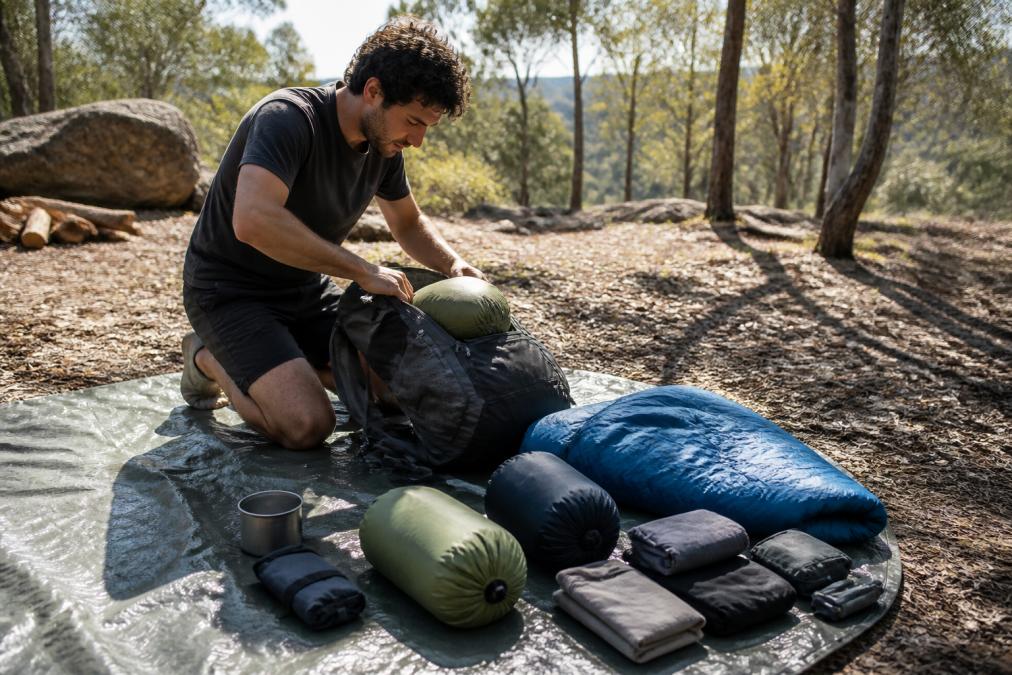
- Lay everything out on a tarp. Seeing all your gear at once reveals duplicates and unnecessary items.
- Weigh your base weight. Use a kitchen scale for small items and a luggage scale for your loaded pack.
- Sort by function. Group items into shelter, sleep, cooking, water, clothing, and safety.
- Apply the 5-4-3-2-1 rule. Reduce each category to its essentials.
- Pack heaviest items closest to your spine. This improves load distribution and reduces fatigue.
- Use compression sacks for soft items. Sleeping quilts and clothing compress significantly.
- Place frequently used items on top. Your rain shell, headlamp, and water filter should be accessible without unpacking.
- Weigh your pack again. Compare against your target base weight and adjust.
For campsite comfort without the weight, an inflatable pillow like the KILIROO Inflatable Camping Travel Pillow weighs almost nothing and packs down to pocket size. Budget Roo Pty Ltd stocks this pillow for $14.95 in two colours, an easy addition that does not compromise your weight goals.
For longer trips where you need to recharge devices, a foldable solar charger replaces heavy power banks. The CHOETECH SC004 14W USB Foldable Solar Powered Charger weighs far less than equivalent battery capacity and folds flat for packability.

Frequently Asked Questions
What is the 5-4-3-2-1 rule for packing when camping?
The 5-4-3-2-1 rule is a simple packing framework: five pairs of socks and underwear, four tops, three bottoms, two pairs of shoes, and one hat. For camping, adapt it to your trip length and laundry options. A weekend trip needs far less. The rule works because it forces you to commit to a fixed number instead of packing 'just in case' items that add weight and bulk without getting used.
How do I choose lightweight camping gear essentials to save space?
Start with the big three: shelter, sleep system, and pack. These account for most of your base weight. Choose a tarp or bivy sack over a heavy tent, a sleeping quilt over a bulky bag, and a pack sized to your actual volume. For smaller items, pick multipurpose gear like an inflatable pillow that doubles as lumbar support. Weigh everything, then cut the heaviest items that serve only one purpose.
Is it better to use compression sacks for camping gear?
Compression sacks help for bulky items like sleeping bags and quilts, reducing pack volume significantly. They do not reduce weight, only space. Use them for soft, compressible gear. Avoid compressing items that need loft, like down jackets, for long periods because it can damage insulation over time. For clothing, a simple stuff sack or packing cube often works just as well without the extra straps and buckles.
How do I balance comfort and weight when camping?
Use the weight-to-utility ratio. Weigh each item against how much comfort or safety it provides. A quality sleeping pad adds warmth and better sleep for modest weight, so it earns its place. A folding camp chair is heavy and serves one purpose, so leave it unless car camping. Test your setup on a short overnight trip first. If you slept poorly or got cold, adjust one item at a time rather than adding everything back.
Packing light for camping is a skill you build trip by trip. Start with the framework, audit your gear honestly, and let experience tell you what you actually need. Budget Roo Pty Ltd stocks lightweight essentials including inflatable pillows, solar chargers, and camping gear designed for packability without the premium price tag. Shop now and get your pack trail-ready for your next adventure.