

Table of Contents
- Why Heavy Camping Chairs Don't Work for Hiking
- Camping Hammocks: The Lightweight Sleep Solution
- Ultralight Camping Stools for Trail Rest Stops
- Hiking Sit Pads: Minimal Weight, Maximum Comfort
- Inflatable Camping Seats: Compact and Versatile
- Comparison: Weight, Cost, and Use Cases
- How to Choose the Right Alternative for Your Trip
- Conclusion
- Frequently Asked Questions
Last Updated: October 9, 2026
Why Heavy Camping Chairs Don't Work for Hiking
Traditional camping chairs weigh between 2-4 kg and take up significant backpack space. For day hikes or short trips, they're impractical. For multi-day treks, they become a burden that outweighs the comfort they provide.
The real issue isn't comfort, it's that heavy camping chairs force you to choose between sitting support and mobility.
Budget Roo Pty Ltd specialises in outdoor gear that balances practicality with affordability. We've helped thousands of hikers find alternatives to heavy camping chairs for hiking that actually work for trail conditions.
Australian Hiking Federation guidelines on pack weight
Camping Hammocks: The Lightweight Sleep Solution
A camping hammock is a suspended fabric bed that hangs between two anchor points, typically trees. Hammocks eliminate the need for a traditional chair entirely, they provide both seating and sleeping in one ultralight package.

The best camping hammocks weigh under 1 kg and pack down to the size of a water bottle. The Green Camping Hammock at $42.95 is our most affordable entry point. For hikers who need built-in mozzie protection, the Camping Hammock with Mosquito Net at $69.95 adds a full mesh enclosure. The Black & Grey Camping Hammock at $82.95 offers the same durability in a premium finish.


All three hammocks accommodate up to 200 kg and pack into attached carry bags. Setup takes under two minutes once you've found suitable trees.
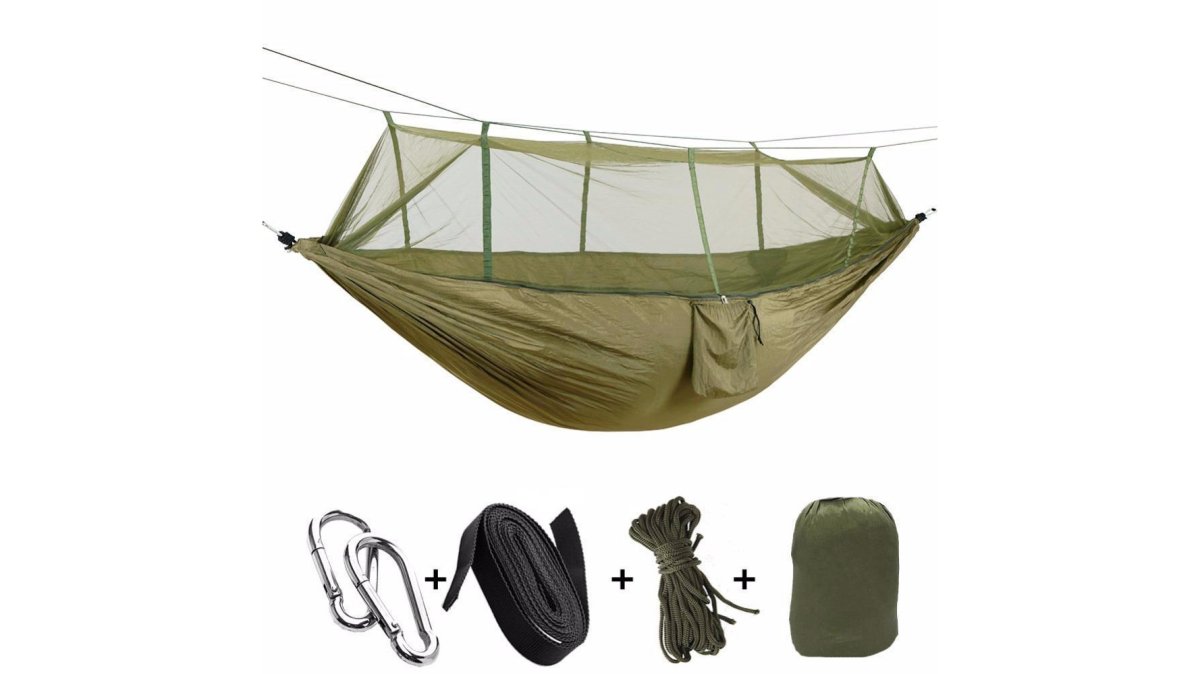
Built-in Mosquito Protection
Mozzie bites disrupt sleep and can cause infections in warm, humid conditions. A hammock with integrated mosquito netting solves this without adding weight.
The Camping Hammock with Mosquito Net features a full-coverage mesh that zips closed. You sleep inside the netting while suspended above ground, doubly protected from insects below and above. This is particularly valuable in coastal and tropical regions where mozzie pressure peaks at dusk and dawn.
Setup and Packability
Hammock setup requires two trees spaced 4-6 metres apart. The included tree straps distribute your weight safely without damaging bark. Once positioned, the hammock hangs at a gentle angle that reduces strain on your back and shoulders.
Pack-down is equally straightforward. Fold the hammock into its carry bag, clip the straps to the exterior, and attach it to your backpack. The entire bundle occupies less space than a sleeping bag.
Ultralight Camping Stools for Trail Rest Stops
An ultralight camping stool is a three- or four-legged seat weighing 300-600 grams that collapses flat. Unlike hammocks, stools require no anchor points, they work anywhere you need a rest break.
Stools are ideal for day hikes where you don't need sleeping accommodation. They're quick to deploy at lunch stops, viewpoints, or when your legs need a break on steep terrain.
The trade-off is that stools don't replace a sleeping solution. You'll need a separate lightweight sleeping pad or hammock for camp.
Hiking Sit Pads: Minimal Weight, Maximum Comfort
A hiking sit pad is a thin foam or inflatable cushion that weighs 100-200 grams. You sit on the ground and place the pad beneath you to insulate from cold earth and moisture.
Sit pads are the lightest alternative to heavy camping chairs. They pack into a pocket and weigh almost nothing. For short breaks on day hikes, they're sufficient.
The limitation is that sit pads offer no back support. They work best for hikers with good core strength or those who only need brief seated rest.
Inflatable Camping Seats: Compact and Versatile
An inflatable camping seat is a lightweight air-filled cushion that provides back support when inflated.
Inflatable seats bridge the gap between sit pads and traditional chairs. They offer back support like a chair but weigh a fraction as much. You inflate them by mouth or with a small hand pump, no batteries required.
The trade-off is durability. Inflatable seats are puncture-prone on rocky terrain or sharp vegetation. They also take 2-3 minutes to inflate and deflate, making them slower to deploy than sit pads or stools.
Camping Hammock with Mosquito Net →
Construction Types and What They Mean in Practice
Not all inflatable seats are built the same way, and the construction dictates where and how long they last:
- Single-chamber. One air bladder does everything. Lightest and cheapest, but a single puncture deflates the whole seat and there is no redundancy.
- Twin-chamber. Separate base and backrest chambers. If one fails you still have a usable cushion, and you can tune firmness front to back. Slightly heavier and more expensive.
- Self-inflating foam core. An open-cell foam layer inside the bladder draws air in when the valve opens. Slower to inflate fully but far more resistant to catastrophic deflation and warmer to sit on in cold conditions.
- Nested or laminated shell. A tougher outer shell over a lighter inner bladder. The outer shell takes abrasion; the inner bladder holds air. This is the most puncture-resistant arrangement and the easiest to repair.
Puncture Risk, Repair and Field Fixes
Punctures are the defining weakness of any air-filled seat, and the risk is not uniform:
- Highest risk: sharp granite, spinifex and other spiky vegetation, shell grit, and any surface with broken glass or wire.
- Lower risk: established campsites, grassy flats, sand, and forest floors with leaf litter.
- Field repair: most seats ship with a patch kit. Clean the area, apply the patch, and let it cure. For a slow leak you cannot find, inflate the seat, submerge it in water, and watch for bubbles.
- Valve failure: a gritty or cross-threaded valve is a common cause of slow leaks. Rinse the valve, check the O-ring or seal, and avoid over-tightening.
Cold, Altitude and Comfort Behaviour
Air-filled seats behave differently from foam in the cold:
- Cold. Air inside the seat cools and contracts, so the seat feels softer overnight or at dawn. Top it up rather than over-inflating when warm, which stresses seams.
- Altitude. Lower ambient pressure means a seat inflated at low elevation will feel firmer higher up. Bleed a little air after climbing.
- Insulation. Air alone is a poor insulator against cold ground. A thin foam layer or a sit pad underneath makes a meaningful difference on frosty mornings.
- Back support. The backrest angle is fixed by the seat's shape. If you need adjustable lumbar support, an inflatable seat will not give it to you, that is a genuine limitation, not a marketing detail.
Long-Term Ownership Costs
An inflatable seat is cheap to buy but has a shorter expected service life than a stool or a hammock:
- Expected life. With regular use on mixed terrain, expect a season or two before a patch or valve service is needed. Stored clean and dry, and used mostly on soft ground, it can last considerably longer.
- Maintenance. Store deflated and open, away from heat and UV. Sweat and sunscreen degrade bladder materials over time, wipe the seat down after trips.
- Repairs. Patch kits are inexpensive and worth carrying. Valve replacements are usually possible but depend on the manufacturer offering spares.
- Replacement. Because the failure mode is a puncture rather than a worn-out frame, the practical cost is a patch kit plus occasional replacement, not a full rebuild.
Comparison: Weight, Cost, and Use Cases
| Alternative | Weight | Price Range | Best For | Setup Time |
|---|---|---|---|---|
| Camping Hammock | 0.7-0.9 kg | $42.95-$82.95 | Overnight trips, all-day comfort | 2 minutes |
| Ultralight Stool | 0.3-0.6 kg | $30-$60 | Day hikes, lunch breaks | 30 seconds |
| Sit Pad | 0.1-0.2 kg | $15-$40 | Minimalist hikers, brief stops | Instant |
| Inflatable Seat | 0.4-0.8 kg | $40-$80 | Car camping, established sites | 3 minutes |
Hammocks offer the best balance of weight, comfort, and versatility for multi-day hiking trips. Stools suit day hikes. Sit pads appeal to ultralight purists. Inflatable seats work for car-based camping where weight is less critical.
Leave No Trace principles for campsite selection
How to Choose the Right Alternative for Your Trip
Start by answering three questions: How many nights? How much weight can you carry? Do you need back support?
For overnight trips (2+ nights): A camping hammock is your best choice. It replaces both a chair and a sleeping pad.
For day hikes: An ultralight stool or sit pad handles rest stops effectively. Choose a sit pad if you're willing to sit on the ground.
For car camping: An inflatable seat offers comfort without the weight burden of a traditional chair.
Regional considerations: Mozzie pressure varies across the country. Coastal and tropical regions benefit from hammocks with integrated netting.
Safe hammock camping practices and anchor point assessment
Conclusion
Heavy camping chairs have no place on a hiking trail. They're designed for stationary use at established campsites, not for mobile outdoor adventures. Alternatives to heavy camping chairs for hiking, hammocks, stools, sit pads, and inflatable seats, deliver the comfort you need without the weight penalty.
For most hikers, a camping hammock is the single best investment. Budget Roo Pty Ltd's Camping Hammock with Mosquito Net at $69.95 combines mozzie protection, durability, and affordability. Shop Now and discover why thousands of hikers have ditched heavy chairs for lighter, smarter gear.
Frequently Asked Questions
What can I use instead of a camping chair when hiking?
Camping hammocks, ultralight stools, sit pads, and inflatable seats are all practical alternatives to heavy camping chairs for hiking. Hammocks work best for overnight trips and offer mosquito protection. Ultralight stools provide quick rest stops without the weight penalty of traditional chairs. Sit pads and inflatable seats are the lightest options, weighing under 500 grams, making them ideal for multi-day treks where every gram counts. Choose based on trip duration and whether you need sleeping accommodation or just rest-stop seating.
Are sit pads comfortable enough for camping?
Sit pads offer surprising comfort for short to medium rest stops on hiking trails. They provide insulation from cold ground and cushioning against rocks and roots. However, they're best suited for breaks lasting under 30 minutes. For longer camps or overnight trips, a camping hammock or ultralight stool provides better back support and comfort. Many hikers carry a sit pad for daytime breaks and a hammock for sleeping, combining minimal weight with comfort across different situations.
Are ultralight camping stools worth carrying?
Ultralight camping stools are worth carrying if you spend significant time sitting during your hike, such as lunch breaks or camp setup. They weigh between 400 and 800 grams and offer back support that sit pads cannot provide. They're also more durable than sit pads for rough terrain. However, if your hike involves frequent short stops, a sit pad is lighter and sufficient. For base camps where you'll sit for several hours, an ultralight stool justifies the extra weight by providing proper seating posture and comfort.
How much should a hiking chair weigh?
For hiking, aim for seating options under 1 kilogram. Camping hammocks typically weigh 0.7 to 0.9 kilograms, ultralight stools range from 400 to 800 grams, and sit pads weigh 200 to 500 grams. Inflatable camping seats fall between 300 and 600 grams. The right weight depends on your trip length and terrain. Day hikes benefit from the lightest options like sit pads, while multi-day backpacking trips justify slightly heavier hammocks or stools that provide better sleep or sitting comfort over extended use.
What is the difference between a sit pad and a folding stool?
Sit pads are flat, lightweight cushions that weigh 200 to 500 grams and provide ground insulation and minimal cushioning. They're compact, pack into your backpack easily, and are ideal for short breaks. Folding ultralight stools weigh 400 to 800 grams, have a frame and seat, and offer back support and higher seating position. Stools are more comfortable for longer sits and uneven terrain but take up more pack space. Choose a sit pad for weight-conscious day hikes and a stool if you'll spend extended time seated at camp or on rest stops.