

Table of Contents
- What makes a camping chair with footrest worth buying
- How to choose a camping chair that suits your needs
- Camping chair weight capacity guide for different users
- Key features to look for in camping chairs with footrests
- Best budget camping gear in Australia for 2026
- Comparing footrest mechanisms and their impact on comfort
- Durability, repairability and long-term value
- Frequently Asked Questions
Last Updated: October 2, 2026
What makes a camping chair with footrest worth buying
A camping chair with footrest reduces lower back strain and improves circulation during long trips. Budget Roo Pty Ltd stocks durable camping chairs.
The real value lies in durability. A quality camping chair with footrest handles repeated packing, unpacking, and transport across rough terrain.
Balance weight with comfort: an 8 kg chair becomes burdensome over distance. The best camping chairs with footrest models prioritise pack-down size over shaving grams.
How to choose a camping chair that suits your needs
Choose a camping chair with footrest based on your use case: weekend car camping and backcountry hiking demand different features.
Weight capacity and durability essentials
Weight capacity reflects durability: 180 kg rated chairs use heavier materials and reinforced geometry, preventing backrest sag and footrest collapse under sustained load.
In Australian coastal and desert conditions, powder-coated steel and UV-resistant ripstop fabric outlast cheaper alternatives by years.
Look for chairs with reinforced stress points, especially where the backrest meets the frame and where the footrest connects to the main structure.
Portability and pack-down size
Pack-down size matters more than weight: a 7 kg chair compressing to 60 × 20 × 20 cm is more portable than a 6 kg chair that doesn't compress.
Detachable footrests let one chair serve backpacking and car camping without compromise.
Check carry bag construction: reinforced stitching and sturdy handles prevent failure during transport.
Camping chair weight capacity guide for different users
Weight capacity tables ignore real-world stress: a 100 kg person on a 120 kg chair has only 20 kg margin before movement and uneven ground eliminate it.
| User Type | Recommended Capacity | Why This Matters |
|---|---|---|
| Solo backpacker (60-80 kg) | 100-120 kg | Lighter materials acceptable; easier to carry |
| Family camper (80-100 kg) | 140-160 kg | Durability prioritised; frequent use demands robustness |
| Larger adult (100+ kg) | 180+ kg | Heavy-duty frame essential; reinforced stress points critical |
| Multi-person use | 200+ kg | Shared chairs need maximum durability; frame won't flex |
Higher weight capacity reflects thicker steel and more cross-bracing, creating a stiffer, more stable seat for all users.
Key features to look for in camping chairs with footrests
Comfort in a camping chair with footrest depends on backrest angle, seat depth, armrest height, footrest adjustment, and padding density working together.
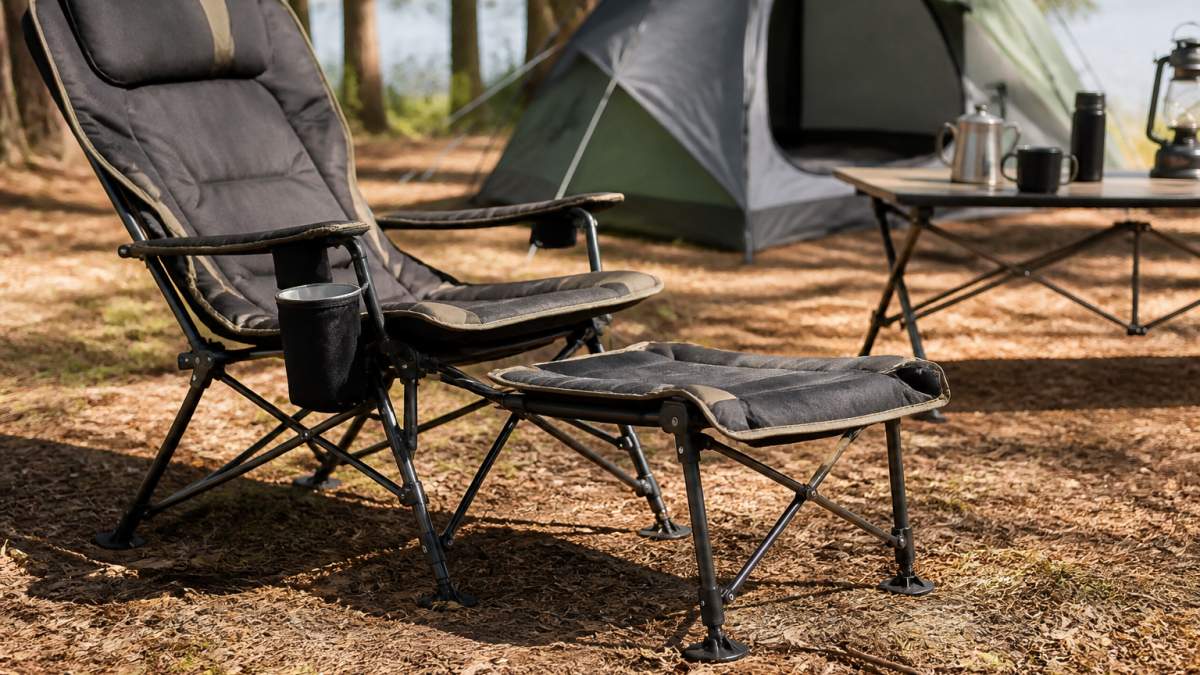
Comfort and ergonomic design
Choose 3-5 preset backrest positions over infinite recline: preset positions stay locked, while infinite recline drifts constantly.
Optimal seat depth is 45-50 cm: shallow seats leave thighs unsupported, deep seats restrict blood flow.
Armrest height should align with your elbow position when seated. Detachable armrests offer flexibility to remove or reposition.
Material quality and weather resistance
UV-resistant coatings extend fabric life 2-3 years in Australian conditions; uncoated fabrics fail within one season.
Powder-coated steel resists rust better than paint because the coating bonds molecularly and covers crevices where rust starts.
All-terrain feet (rubber or plastic) grip uneven ground better than metal feet, which sink or slide and risk tipping.
Setup and assembly ease
Snap-together frames and pre-attached footrests set up in 90 seconds, versus 5 minutes for screw-together designs.
Verify the chair arrives fully assembled or with clear instructions and all hardware included.
Best budget camping gear in Australia for 2026
Budget camping chairs often match more expensive models on core features; the difference is brand markup and finish details.
Budget Roo Pty Ltd delivers camping chairs with footrest models featuring powder-coated steel, UV-resistant fabric, and detachable footrests, the features that matter for Australian conditions.
Durability beats cheap replacement.
Comparing footrest mechanisms and their impact on comfort
Footrest mechanisms determine whether legs stay supported or collapse. The design affects the weight-to-comfort ratio, support gained versus additional weight carried.
Footrest mechanism types and their real-world performance
Snap-together footrests attach in 30 seconds and are genuinely modular, but snap connections develop wobble under sustained weight and loosen after 50-100 cycles.
Zero-gravity recliners synchronise backrest and footrest movement, adding 1-2 kg. Worth the weight for 4+ hours daily use; overkill for occasional camping.
Weight-to-comfort ratio matrix for different use cases
The real decision framework isn't which mechanism is "best", it's which mechanism suits your actual usage pattern and vehicle storage constraints.
| Use Case | Ideal Mechanism | Total Chair Weight | Footrest Weight | Pack-Down Size | Why This Matters |
|---|---|---|---|---|---|
| Solo backpacking (1-2 nights) | Detachable snap-on | 5-6 kg | 1.2 kg | 50 × 18 × 18 cm | Remove footrest to save 1.2 kg; snap connection reattaches in 20 seconds at car park |
| Car camping (3+ nights) | Detachable bolt-on | 6-8 kg | 1.8 kg | 65 × 22 × 22 cm | Bolt connection won't loosen; extra rigidity justifies assembly time since you're not packing/unpacking repeatedly |
| Vehicle touring (van/campervan) | Integrated or zero-gravity | 7-9 kg | Built-in | 60 × 25 × 25 cm | Space is limited; integrated footrest eliminates separate ottoman; zero-gravity suits long daily use |
| Fishing trips (stationary, 6+ hours) | Zero-gravity or bolt-on | 8-10 kg | 2+ kg | 70 × 25 × 25 cm | Comfort prioritised over portability; synchronised recline prevents leg fatigue; weight irrelevant since chair stays at one spot |
| Family camping (shared chair, multi-user) | Bolt-on with reinforced hinge | 9-12 kg | 2.5 kg | 75 × 28 × 28 cm | Shared use demands maximum rigidity; bolt connection handles repeated stress cycles; heavier frame distributes load safely |
Adjustment range and real-world comfort
Footrests with 3-5 preset angles (75°-120°) accommodate different leg lengths; single 90-degree angles suit only narrow body proportions.
Users 160-175 cm need 105-110 degrees; users over 180 cm need 120+ degrees.
Preset positions stay locked without drift; infinite recline requires constant micro-adjustments as weight shifts.
Failure modes and longevity
Snap connections develop wobble after 50-100 cycles ($8-15 to replace). Bolted connections fail from corrosion ($2-5 to replace). Integrated footrests fail at hinges with no replacement parts available. Zero-gravity linkages fail when cables stretch ($20-40 to replace).
Footrest angle adjustment mechanisms
Angle adjustment is controlled by one of three systems:
-
Pin-and-hole adjustment, The footrest hinge has 3-5 pre-drilled holes. You move a pin to change the angle. This is simple, reliable, and rarely fails. Setup takes 10 seconds.
-
Ratchet or lever lock, A lever on the hinge tightens to lock the footrest at any angle within a range (typically 75-130 degrees). This offers infinite adjustment but requires you to find the "sweet spot" by trial and error. Some users find the lever hard to operate when tired.
-
Friction adjustment, The hinge uses friction alone to hold the angle. No lock, no lever. This is the cheapest mechanism but gradually drifts under your weight. After 30 minutes of sitting, you'll notice the footrest has dropped 5-10 degrees. Annoying, not catastrophic.
Pin-and-hole adjustment is the best balance of simplicity, reliability, and ease of use. Ratchet systems work well if the lever is easy to operate (avoid cheap designs with stiff levers). Avoid friction-only systems for regular use.
Durability, repairability and long-term value
A $200 chair lasting 8 years delivers better value than a $120 chair failing after 3 years. True value is cost per year of use, not initial price.
Cost-of-ownership calculation: why cheap chairs cost more
Budget chair at $120 fails at 2.5 years ($96/year). Quality chair at $200 with $28 replacement panel lasts 8.5 years ($27/year). Quality costs 3.5× less per year.
Parts that fail first and their replacement costs
Camping chairs fail in predictable sequence.
Footrest failure (year 2-5): Bolt-on/snap replacement $8-20.
Armrest damage (year 1-3): Replacement $12-25 if available, else $120-250 new chair.
Frame corrosion (year 3-6 coastal): Not repairable; requires new chair.
Padding compression (year 2-4): Replacement $30-50 if available, else $120-250 new chair.
Repairability scorecard: which brands support long-term ownership
Before buying, ask: Are replacement fabric panels available? Can you buy spare footrest components? Are armrests sold separately? What's the warranty period (2 years = durability confidence; 12 months = expected failure)?
Budget Roo Pty Ltd stocks replacement parts: fabric panels, footrest hinges, armrests, padding kits.
Frame construction and joint durability
Welded joints (15-20% stronger, not repairable) suit main frame connections. Bolted joints (fully repairable) suit modular connections. Riveted joints (cheap, not repairable) suit single-season use only.
Best chairs use welded main joints (strength) with bolted modular components (serviceability), maximising durability while preserving repairability.
Australian climate and material degradation
Australian UV intensity is 25-40% higher than temperate climates. Standard fabric fails in 12-18 months; UV-resistant ripstop lasts 3-4 years; premium lasts 5+ years.
When calculating long-term value, factor in climate-specific degradation. A $150 chair with standard fabric might need replacement within 2 years in tropical or coastal regions, whereas a $200 chair with UV-resistant ripstop and powder-coated frame lasts 5+ years.
Frequently Asked Questions
What weight capacity should a camping chair with footrest have?
Most quality camping chairs with footrests support 100-150 kg comfortably. Choose a chair rated 20-30 kg above your body weight to ensure stability and frame longevity. Heavier-duty models with reinforced steel frames and ripstop fabric handle higher loads without sagging or losing support over time. Check the manufacturer's specifications before purchasing to match the chair to your needs.
How do I choose a camping chair that will be comfortable for long trips?
Prioritise ergonomic lumbar support, adjustable backrest angles, and a seat width of at least 50 cm. Look for padding thickness (typically 5-10 cm) and breathable mesh panels to prevent heat buildup. Test the armrest height and footrest position if possible, your feet should rest flat, not dangle. A chair with zero-gravity or reclining mechanisms lets you adjust your position throughout the day, reducing fatigue.
Are camping chairs with footrests heavy to carry?
Most quality models with footrests weigh 3-5 kg and pack down to roughly 60-80 cm when rolled. Check the pack-down size and carry bag design, shoulder straps and compact storage make transport easier. If weight is critical for backpacking, choose lightweight aluminium frames over steel. For car camping or established campsites, portability is less of a concern, so heavier, more comfortable options are practical.
What should I look for in best budget camping gear in Australia for 2026?
Focus on durability over features. A powder-coated steel frame, ripstop or UV-resistant fabric, and sturdy footrest mechanism offer excellent value without premium pricing. Verify weight capacity matches your needs, check setup time (under 30 seconds is ideal), and confirm the chair includes a carry bag. Read customer reviews for real-world feedback on comfort and weather resistance in local conditions before committing.
Choosing the right camping chair with footrest comes down to matching features to your actual use case, not chasing the cheapest option or the most features. A quality camping chair with footrest from Budget Roo Pty Ltd delivers the durability, comfort, and portability you need for Australian camping conditions. Shop now to find the model that suits your next adventure, and enjoy the comfort difference that proper leg support brings to every camping trip.