

Last Updated: November 23, 2026
Quick Summary
To store winter jackets during summer, clean and fully dry each one, then choose a cool, dark, dry spot with airflow. Hang structured coats on padded hangers and fold puffers and wool knits into breathable bags or bins. Never seal damp gear in plastic, which is a common cause of mildew and musty smells.
- Clean every jacket first, since body oils and food traces turn yellow over time.
- Wash puffers on a gentle cycle and tumble dry low with two or three dryer balls.
- Use breathable garment bags for wool, blazers and down; vacuum bags crush loft.
- Aim for 45-55% relative humidity and a steady 15-20°C.
- Keep jackets off bare concrete floors, which wick moisture upward.
Table of Contents
- How do I store winter jackets during summer?
- Clean and dry every jacket before it goes away
- Vacuum storage bags vs breathable garment bags
- Preventing moth damage in wool coats
- Hang or fold? Match the method to the jacket
- Control humidity, temperature and airflow
- Storage ideas for small homes and tight wardrobes
- Pack your winter jackets away with Budget Roo
- Frequently Asked Questions
How do I store winter jackets during summer?
To store winter jackets during summer, clean and fully dry each one, then choose a cool, dark, dry spot with airflow. Hang structured coats on padded hangers and fold puffers and wool knits into breathable bags or bins. Never seal damp gear in plastic. Sealing damp gear in plastic is one of the most common causes of mildew, musty smells and fabric damage.
People often pull a jacket out of a vacuum bag and find it flat, creased or smelling like a cupboard corner. The jacket wasn't worn out. It was stored badly.
Below, we'll show you exactly how to store winter jackets so they come out next season ready to wear. The steps suit puffer jackets, wool coats, leather, synthetics and technical shells.
Clean and dry every jacket before it goes away
Dirt and body oils attract pests and set stains over time, so clean first. A common mistake is storing a "barely worn" jacket without washing it. Skin oils and food splashes are invisible now but turn yellow by next winter.
- Check every pocket for tissues, receipts and snacks
- Brush off loose dirt and salt marks
- Follow the care label exactly
- Dry completely, inside and out, before storage
Watch out: one damp zip or cuff hem is enough to start mildew in a sealed bag. If you're unsure, give it another day of air drying. A layering guide helps you work out which pieces need the most care before they go away.
How to clean puffer jackets before storage
Wash puffer jackets on a gentle cycle with a small amount of mild detergent, then tumble dry low with two or three clean dryer balls. The balls break up clumped down insulation. Skip fabric softener entirely, because it coats the down and reduces loft.
Hang the jacket in shade until it's bone dry. Squeeze a handful of the baffles: if it feels cool or clammy, keep drying. Store puffers loose, never compressed for months.
Vacuum storage bags vs breathable garment bags
Breathable garment bags win for most jackets. Vacuum bags save serious space, but they crush down insulation and trap any moisture left inside. Use them only for clean, bone-dry items and never for wool or down long term.
| Storage method | Best for | Watch out for |
|---|---|---|
| Breathable garment bag | Wool coats, blazers, down | Takes more hanging space |
| Vacuum storage bag | Bulky synthetics, short-term | Crushes loft, traps moisture |
| Cotton pillowcase | Folded knits, light jackets | Little structure or protection |
| Opaque plastic bin | Folded puffers, family gear | Needs airflow and dry contents |
A simple rule: if the jacket has loft or natural fibres, let it breathe.
Preventing moth damage in wool coats
Moths target wool, cashmere and fur trims, and they do it quietly. Protect wool coats by cleaning them first, then storing them in breathable covers with cedar blocks or lavender sachets. Check the coat every few weeks through summer for tiny holes or webbing.
- Clean before storage, since moths feed on body oils and food traces
- Use acid-free tissue paper in the shoulders and folds
- Avoid sealed plastic, which traps humidity and smells
- Shake and air coats monthly
Our guide on cleaning and storing gear to stop mildew shows a routine you can adapt for wool coats and jackets.
Hang or fold? Match the method to the jacket
Hang structured coats and blazers. Fold puffers, down jackets and chunky wool sweaters. The jacket's shape decides the method, not your wardrobe space. The decision below is based on three things: whether the garment has structured shoulders, whether it relies on loft for warmth, and whether the outer fabric creases permanently.
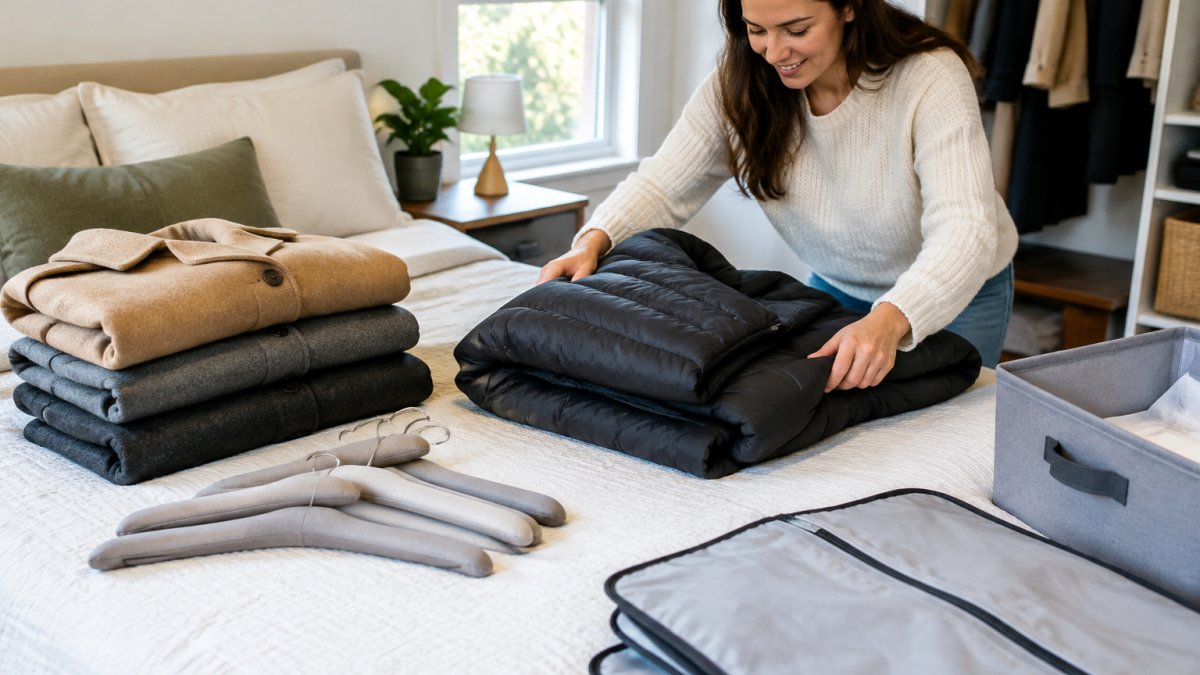
Hang when the jacket has structured shoulders, a tailored waist or a stiff outer fabric that creases if folded. That covers blazers, trench coats, leather jackets, wool overcoats and anything with shoulder pads or a fused front. Hanging keeps the shoulder line and the drape intact.
Fold when the jacket relies on loft for warmth or has a soft, unstructured body. That covers puffer jackets, down jackets, synthetic-fill jackets, heavy wool knits and fleece. Loft is the air trapped between fibres, and compressing it for months in the same crease weakens the fill's ability to recover.
Fold, don't hang, heavy wool coats on thin hangers. A heavy coat on a wire or narrow plastic hanger concentrates several kilograms on two small points, stretching the shoulder seams and distorting the armholes. If you must hang a heavy coat, use a broad wooden or padded hanger rated for the weight.
Roll rather than fold down jackets and sleeping-bag-style puffers if space is tight. Rolling avoids a single sharp crease across the baffles and lets the jacket sit in a round stuff sack or bin without a hard fold line.
Leather jackets are the exception that proves the rule. Hang them on a broad hanger to avoid creasing, but keep them out of direct light and away from heat, because leather dries and cracks when it loses moisture. Don't seal leather in plastic; it needs airflow to avoid mildew on the lining.
Watch out: hanging a wet or damp jacket, even briefly, lets water pool in the shoulders and hem, which is where mildew starts first. Dry it flat or on a rack before it goes on a hanger.
A simple test if you're unsure: hold the jacket up by the shoulders. If it holds a clean line and the fabric doesn't collapse, hang it. If it slumps or the fill shifts, fold it.
Control humidity, temperature and airflow
A cool, dry, dark place with steady airflow is the ideal storage spot. The practical question is how to tell whether a space is actually dry enough. The targets below are the ones most worth aiming for, and they're easy to check with an inexpensive hygrometer from a hardware shop.
- Relative humidity: aim for 45-55%. Above 60% and mildew risk climbs quickly; below 40% and leather and wool can dry out and become brittle.
- Temperature: steady and cool, roughly 15-20°C. Avoid spots that swing more than a few degrees across the day.
- Airflow: some movement, not a sealed box. A gap of a few centimetres between bags and the wall, and between bins and the floor, is enough.
- Light: dark or dim. Direct sun fades dye and weakens fibres over a season.
How to assess a space before you commit. Put a hygrometer in the spot for 24 hours in the middle of summer. If it reads above 60%, treat the space as damp and either ventilate it or choose somewhere else. Garages and sheds swing in temperature and often sit above 70% humidity in humid months; roof spaces bake in summer and are worse. A bedroom wardrobe on an internal wall is usually the safest default.
Keep jackets off bare concrete floors. Concrete wicks moisture and holds cold, so a bag sitting directly on it can draw damp through the base. Use a shelf, a pallet or a lidded bin with a small gap underneath.
Check stored gear after heavy rain. Damp weeks are when mildew gets a foothold, particularly in garages and external cupboards. Open the bags, feel the shoulders and cuffs, and air anything that feels cool or clammy.
If a cupboard smells musty, fix that before adding jackets. Musty smells mean moisture is already there, and a jacket will absorb that smell within weeks. Air the cupboard out on a dry day, wipe down surfaces, and find the source of damp before you store anything.
Material-specific humidity notes. Down loses loft fastest in humid conditions, so keep it in the driest spot you have and check it monthly. Wool and cashmere are the most attractive to moths in warm, still air, so airflow matters as much as dryness. Leather needs moderate humidity, not bone-dry air, or it cracks; a breathable cover in a steady room is better than a sealed bag in a hot garage.
Watch out: a dehumidifier running in a sealed room can pull humidity below 40%, which is hard on leather and some wool finishes. If you use one, run it to the target range and check with a hygrometer rather than leaving it on continuously.
A simple routine: check the hygrometer monthly, air the space on a dry day, and feel a couple of jackets each time. That catches damp long before it becomes a smell.
Storage ideas for small homes and tight wardrobes
Small spaces need clever packing, not more cupboards. Use under-bed bins for folded puffers, over-door hooks for the current rotation, and vacuum bags only for short-term squeezing.
- Store folded jackets in opaque containers under the bed
- Use the top shelf for light, folded items
- Label every bin so nothing gets forgotten
- Rotate one or two jackets into easy reach
Our camping gear guide is useful if you're reorganising a whole gear cupboard at the same time. Wash and dry everything before it goes in.
Pack your winter jackets away with Budget Roo
Good storage protects the gear you've already bought, and good gear protects you when the cold returns. Budget Roo stocks insulated jackets, warm layers and cold-weather gear for camping and everyday use.
Before you pack everything away, check what needs replacing. A jacket with flattened insulation won't bounce back, no matter how well you store it. Browse our insulated jackets and cold-weather clothing to find gear that suits your needs. For current prices, visit the Budget Roo website or request a quote. If you're heading into cold weather soon, our motorcycle commuting warmth guide has tips for the ride.
Storing jackets well takes an afternoon, but it saves you from musty smells, flat insulation and moth holes next season. If your current jacket has lost its warmth, it may be time for a replacement rather than another repair. Budget Roo stocks insulated jackets, warm layers and camping clothing for families and outdoor enthusiasts, with a focus on value. Get started with Budget Roo and pack your winter gear away knowing it'll be ready when the cold returns.
Frequently Asked Questions
Should I wash my winter jackets before storing them for summer?
Yes, clean every jacket first. Body oils, sweat and food traces attract pests and can set into stains over months. Follow the care label: machine wash synthetic and down jackets on a gentle cycle with a technical wash, dry-clean wool and leather, and spot-clean structured coats. Dry completely before packing, because trapped moisture causes mildew and musty smells.
Is it better to hang or fold winter coats for long-term storage?
Hang structured coats, blazers and long wool coats on padded hangers so shoulders keep their shape. Fold bulky sweaters, puffer jackets and anything with down insulation, because hanging stretches the fill and fabric over time. Store folded items in breathable bins or cotton bags, and avoid wire hangers that leave sharp creases.
Can I use vacuum bags for down puffer jackets?
Vacuum bags save space but compress down insulation and can leave permanent creases in synthetic fills. Use them only for short trips or for bulky items you will unpack within a few weeks. For months of summer storage, choose breathable garment bags or cotton storage bags that let air circulate and keep dust off. Always store vacuum bags loosely filled, never at maximum compression.
What is the best way to protect wool coats from moths?
Clean the coat before storage, then place it in a breathable garment bag with cedar blocks or lavender sachets. Moths target protein fibres like wool and fur, especially in dark, undisturbed wardrobes. Avoid sealed plastic, which traps moisture and can encourage mould. Check stored coats every few months, brush them down and refresh the repellents.
