

Last Updated: November 8, 2026
Quick Summary
Choose charcoal for consistent heat by matching fuel to the cook: briquettes give predictable, longer-lasting heat, while lump charcoal burns hotter and faster but varies more. Uniform piece size, dry storage and sensible airflow do the rest.
- Briquettes are pressed into even pillows, producing a steadier burn and longer cook than lump.
- A full chimney of briquettes suits steady roasting at 150-180°C banked to one side.
- For long smoking, add a small chimney of lit coals every 45-60 minutes.
- Test a new bag by recording grill-level temperature at 10, 20 and 30 minutes.
- Store charcoal in a sealed container off the ground because damp fuel burns cooler.
Table of Contents
- Why Charcoal Choice Decides Whether Heat Stays Consistent
- Lump Charcoal vs Briquettes: Which Gives More Consistent Heat?
- How Much Charcoal to Use in a Grill for Your Target Temperature
- How to Arrange Charcoal for Grilling: Direct, Indirect and Two-Zone Setups
- Charcoal Burn Time and Fuel Efficiency: Planning for Longer Cooks
- A Repeatable Method for Testing Heat Consistency Before You Cook
- Troubleshooting Temperature Swings, Moisture and Weather Effects
- Stocking Up: Choosing Charcoal and Gear at Budget Roo
- Frequently Asked Questions
Why Charcoal Choice Decides Whether Heat Stays Consistent
Charcoal is the single biggest factor in whether your grill holds a steady temperature or swings wildly between scorching and lukewarm. Pick the wrong fuel and you will fight the fire all afternoon. Pick the right one and heat control becomes almost boring.
This guide covers how to choose charcoal for consistent heat, from lump versus briquettes to fuel quantity and vent settings.
Here is the core idea most guides skip: consistent heat is not about one magic product. It is about matching fuel type, piece size, quantity and airflow to the cook you are actually doing.
Lump Charcoal vs Briquettes: Which Gives More Consistent Heat?
Briquettes give more predictable, longer-lasting heat. Lump charcoal burns hotter and faster but varies more from bag to bag.
That is the short answer. The longer answer matters more.
Lump charcoal is charred wood in irregular chunks. It lights fast, reaches high heat quickly and gives a clean wood flavour. The catch is uniformity. A bag can hold fist-sized lumps and dusty fragments side by side, so burn rate changes piece by piece.
Charcoal briquettes are pressed and shaped into even pillows. Their uniform size and density produce a steadier burn and a longer cook. Many cooks find briquettes easier for low-and-slow smoking because the fuel load behaves the same way every time.
| Feature | Lump Charcoal | Briquettes |
|---|---|---|
| Heat consistency | Variable | Predictable |
| Max heat output | Higher | Moderate |
| Burn time | Shorter | Longer |
| Lighting speed | Fast | Slower |
| Ash production | Low | Higher |
| Best for | Quick grilling, searing | Long cooks, smoking |
How Size, Shape and Fines Affect Temperature Stability
Piece size drives temperature stability more than most people realise. Uniform pieces pack evenly, so air flows through the fuel load the same way across the whole bed. Mixed sizes create hot spots and cold pockets.
Watch out: small fragments and dust, often called fines, settle at the bottom of the bag and smother airflow. Shake the basket before lighting and you avoid a choked fire.
How Much Charcoal to Use in a Grill for Your Target Temperature
A full chimney starter suits high-heat grilling, while a half-filled chimney is enough for a low-and-slow cook in a kettle grill. Fuel load, not guesswork, sets your cooking temperature. The problem is that most guides stop at that sentence and leave you to guess the rest. A more reliable approach is to work backwards from the temperature and duration you actually need, then choose both the quantity and the fuel type to match.
Start with a simple decision framework based on target temperature and cook length:
- Short, high-heat cooks (under 30 minutes, 230-290°C at grill level): a full chimney of lump charcoal, spread in one even layer. Lump lights fast and reaches searing heat quickly, and you are not relying on it to hold steady for long.
- Medium-heat direct grilling (30-60 minutes, 180-220°C): three-quarters of a chimney, either all briquettes or a 50/50 mix of briquettes and lump. The briquettes carry the steady middle of the cook; the lump gives you a faster start.
- Steady roasting (60-120 minutes, 150-180°C): a full chimney of briquettes, banked to one side, with the lid vent positioned above the food. Briquettes hold a predictable burn across this window without constant topping up.
- Long smoking (two hours or more, 110-135°C): start with a full chimney of briquettes and plan to add a small chimney of lit coals every 45-60 minutes. Combining fuel types works well here: a base of briquettes for endurance, topped with a few lump pieces for a cleaner smoke profile.
- Small portable grill: one-third of a chimney, adjusted for the smaller fire bed. Portable grills lose heat faster because of their thinner walls, so err on the side of a slightly larger fuel load and control temperature with the vents rather than by starving the fire.
Weighing fuel rather than counting chimney scoops gives you a repeatable baseline you can scale up or down.
Watch out: adding unlit charcoal directly to a hot bed to extend a cook will drop your temperature sharply before it recovers. Light the top-up fuel in a chimney first, then add it already ashed over.
If you are planning fuel amounts alongside your cookware setup, our best camping cookware set review covers pots and pans that suit charcoal cooking.
How to Arrange Charcoal for Grilling: Direct, Indirect and Two-Zone Setups
Direct heat means coals spread evenly under the food for searing. Indirect heat means coals pushed to one side with food over the empty zone. Two-zone setups combine both, so you can sear then finish gently.
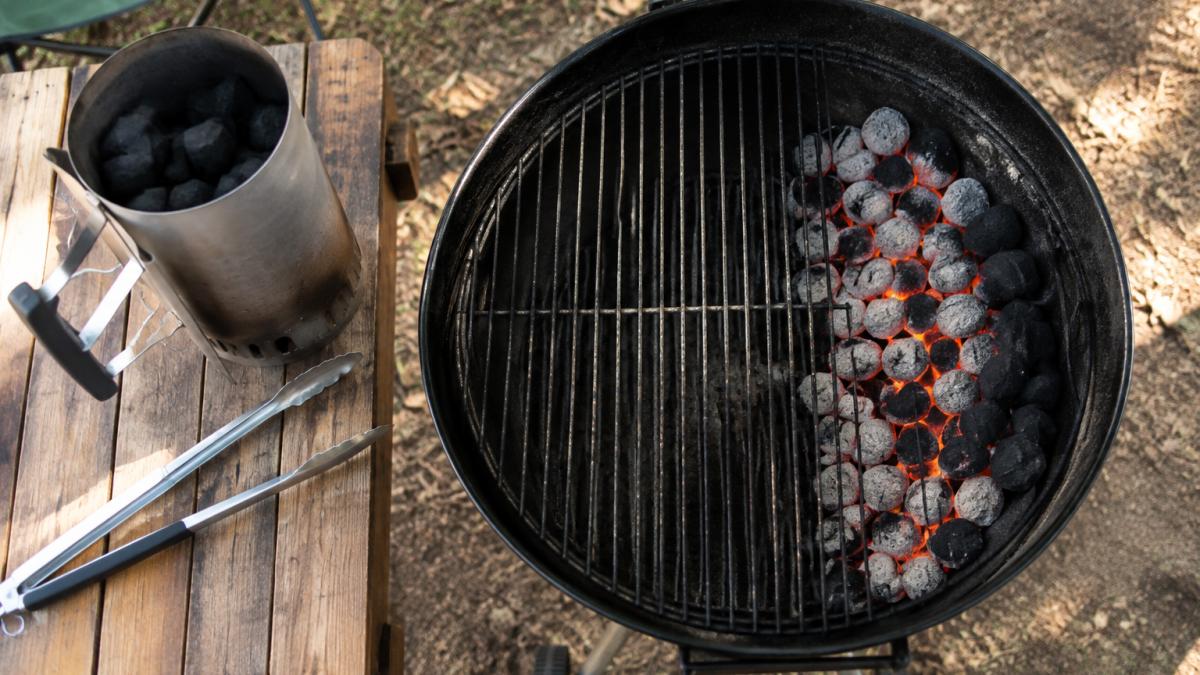
Arrange your fuel like this:
- Light a chimney starter and wait until the top coals ash over.
- For direct heat, pour coals in one even layer across the base.
- For indirect heat, bank all coals to one half of the grill.
- For two-zone cooking, keep a thin layer on the cool side for gentle finishing.
- Leave the vents open on the coal side and adjust the lid vent above the food.
A grill with proper side vents makes this far easier. Our foldable charcoal BBQ grill and smoker has adjustable air vents and a removable ashtray, so you can control airflow and clean out ash without wrestling the whole unit.

Charcoal Burn Time and Fuel Efficiency: Planning for Longer Cooks
Briquettes typically burn longer than lump charcoal, which makes them the better choice when you need steady heat across a long smoke. Lump charcoal delivers faster, fiercer heat but needs topping up sooner. Choosing between briquettes and lump charcoal also depends on how your smoker manages airflow and fuel, so Sizzle & Smoke BBQ can help connect fuel choices with the smoker that suits your cooking.
Plan your fuel around cook duration:
- Under 30 minutes: one chimney of lump is plenty
- 30 to 90 minutes: briquettes hold better without intervention
- Two hours or more: start with briquettes and add a small chimney of lit coals as needed
Ash content matters too. Heavy ash production can choke airflow over a long cook, so clear the ashtray between sessions.
A Repeatable Method for Testing Heat Consistency Before You Cook
Test any new bag of charcoal before you trust it with a long cook. The method is simple and repeatable.
- Load a known quantity, such as one full chimney, into your grill.
- Set all vents to the same position every time.
- Place a thermometer at grill level, not in the lid.
- Record the temperature at 10, 20 and 30 minutes.
- Note how much the reading swings across that window.
A steady climb to a stable plateau means good fuel. Big spikes and drops point to uneven piece size or too much dust in the bag. Repeat the test with a new bag and you build a real picture of bag-to-bag variation.
Troubleshooting Temperature Swings, Moisture and Weather Effects
Most temperature swings trace back to a small set of causes, and the fastest way to fix them is to match the symptom you are seeing to the likely cause and the corrective action. The table below is the troubleshooting map most guides never give you.
| Symptom | Likely cause | Corrective action |
|---|---|---|
| Fast spike above target, then a sharp drop | Too many lit coals at once, or a large proportion of small fragments burning hot and fast | Close the intake vent by half, spread the coals thinner, and sort out fines before the next cook |
| Temperature will not climb | Damp fuel, blocked airflow, or too few lit coals | Check the fuel is dry, clear ash from the vents, and light a fresh chimney rather than waiting |
| Early heat loss after 45-60 minutes | Fuel load too small for the cook duration, or heavy ash choking the bed | Add lit coals from a chimney, and clear the ashtray mid-cook on longer sessions |
| Uneven heat across the grill | Mixed piece sizes creating hot spots and cold pockets | Sort the fuel load so similar-sized pieces sit together, and rotate the lid during the cook |
| Heavy white smoke at startup | Moisture in the fuel or insufficient airflow during lighting | Let the fuel ash over fully before cooking, and keep the lid open until the smoke clears |
| Temperature creeping up over a long cook | Ash build-up reducing airflow resistance, or wind feeding the intake | Close the intake vent slightly and check the wind direction |
Moisture is the most underrated variable. Charcoal is hygroscopic, meaning it absorbs water vapour from the air.
Weather and grill setup can overwhelm differences between charcoal types, which is why fuel choice alone will not guarantee consistency. Wind steals heat from the lid and pulls air through the vents unevenly, so a windbreak and a sheltered spot matter more than switching brands.
Watch out: if you change fuel type and vent settings at the same time, you will not know which one caused the result. Change one variable per cook when you are troubleshooting.
For deeper guidance, our guide to cooking outdoors evenly covers airflow and setup in more detail, and our roundup of camping stove wind shields covers wind protection options.
Stocking Up: Choosing Charcoal and Gear at Budget Roo
Choosing charcoal for consistent heat comes down to matching fuel to the cook. Briquettes for steady, long burns. Lump for fast, hot grilling. Uniform pieces, dry storage and sensible airflow do the rest.
At Budget Roo, we stock practical outdoor cooking gear at prices that suit casual campers and regular grillers alike. Our range includes portable grills, camp cooking gear and outdoor essentials built for real trips, not showroom shelves. If you want a portable grill for zone cooking, the Grillz Foldable BBQ Grill is listed at $67.95.
Ready to stop fighting your fire? Get started with Budget Roo and build a charcoal setup that holds steady heat from the first sear to the last slow-cooked bite.
Frequently Asked Questions
Which type of charcoal gives the most consistent heat?
Briquettes generally give more consistent heat because their uniform size and density burn at a predictable rate. Lump charcoal can reach higher temperatures and responds faster to vent changes, but piece sizes vary, so temperatures swing more. For low-and-slow cooking or long sessions where steady heat matters, briquettes are the safer choice. For quick, hot grilling, lump charcoal works well if you manage airflow carefully.
Is lump charcoal or briquette charcoal better for steady cooking?
Briquettes are better for steady cooking. Their consistent shape packs evenly, so air flows through the fuel bed at a predictable rate and temperatures hold within a narrow band. Lump charcoal varies in size and density, which creates hot spots and faster temperature drops. If you want repeatable results for smoking or roasting, choose briquettes and arrange them in an even layer with a two-zone setup.
How do you choose good-quality charcoal?
Look for large, uniform pieces with a hard, dry feel and a clean sound when knocked together. Avoid bags with lots of small fragments and dust, which burn fast and clog airflow. Check that the bag is sealed and stored dry, because moisture reduces heat output and causes temperature swings. For briquettes, choose a brand with consistent density so each piece lights and burns at the same rate.
How much charcoal should you use for an even cook?
For a standard kettle grill, start with about 1 kg of charcoal for a direct grilling session and 1.5 to 2 kg for indirect cooking or smoking. Spread the fuel in a single even layer so air can pass through, and use a charcoal chimney to light it evenly. Adjust quantity based on cook duration and weather; cold or windy conditions call for a little extra fuel to maintain temperature.
