

Table of Contents
- Why a Camping Stove Wind Shield Matters in Windy Conditions
- Quick Comparison: 5 Best Camping Stove Wind Shields
- 1. Aluminium Folding Panel Wind Shield
- 2. Concertina-Style Wind Shield for Canister Stoves
- 3. Low-Profile Windscreen for Integrated Canister Systems
- 4. Multi-Panel Weather Shield for Group Cooking
- 5. Lightweight Foil Wind Shield for Backpacking
- How to Cook in Windy Conditions Camping: Positioning and Technique
- Frequently Asked Questions
Last Updated: September 17, 2026
Why a Camping Stove Wind Shield Matters in Windy Conditions
A camping stove wind shield is a folding panel or foil screen that blocks airflow around your burner, protecting the flame so your stove heats food instead of fighting the breeze.
Wind does three things to a gas stove, none of them good. It strips heat from the pot, pushes the flame sideways so only half the burner works, and on canister stoves it cools the canister, dropping internal pressure and weakening the flame, a failure that catches people out because the stove looks fine.
The result is longer boil times, more fuel burned, and cold dinners. A wind shield fixes all three for very little weight and cost.
This guide covers the five best camping stove wind shields for windy conditions, how to position them safely, and the mistakes that turn a good screen into a hazard.
Quick Comparison: 5 Best Camping Stove Wind Shields
| Wind Shield | Best For | Weight | Fits |
|---|---|---|---|
| Aluminium folding panel | All-round camping | Moderate | Most portable stoves |
| Concertina-style | Canister stoves | Light | Screw-on canister burners |
| Low-profile windscreen | Integrated canister systems | Very light | Jetboil-style systems |
| Multi-panel weather shield | Group cooking | Heavier | Large two-burner stoves |
| Foil wind shield | Backpacking | Minimal | Ultralight setups |
Weight matters more than most buyers expect. A shield that adds bulk gets left at home, and a shield left at home protects nothing. Match the screen to how you actually camp.
1. Aluminium Folding Panel Wind Shield
Aluminium folding panels are the default choice for most campers. They hinge open into a curved wall that wraps the burner, block wind from three sides, and fold flat when you're done.
The aluminium reflects heat back toward the pot rather than absorbing it, improving heat retention and shortening boil time. The panels stay upright in a stiff breeze without pegging down.
Where this type falls short is adjustability. Fixed-height panels suit standard pots but sit awkwardly around taller billies. Check the panel height against your usual cookware before buying.
- Pros: Durable, good wind resistance, works with most stoves
- Cons: Heavier than foil, can be fiddly to fold in cold weather
2. Concertina-Style Wind Shield for Canister Stoves
Concertina designs fold like an accordion into a compact block and are built specifically for screw-on canister stoves. The pleated panels create a tight, curved screen that hugs the burner closely.
The tight fit is the point. Canister pressure drops when the canister gets cold, and wind accelerates that cooling. A screen close to the burner keeps the canister warmer and the flame steadier, so output stays consistent.
Setup takes seconds: unfold, curve around the burner, done. The folded unit also takes less pack space than a rigid panel of the same coverage.
- Pros: Light, packs small, excellent fit for canister burners
- Cons: Limited use with larger stoves, thin panels dent if handled roughly
3. Low-Profile Windscreen for Integrated Canister Systems
Integrated canister systems, where burner and pot lock together as one unit, are engineered around a specific airflow path. Air enters low, feeds the flame, and exhausts around the pot. A full wrap-around screen blocks that path, which is why most integrated systems ship with a purpose-built low-profile windscreen or warn against adding one.
This is the area most wind shield guides skip. They treat every stove as a bare burner on a canister, then tell you to wrap a folding panel around it, advice that ranges from useless to dangerous on an integrated system.
Why the airflow path matters. The burner on an integrated system is recessed. Wrap a tall panel around the pot and you trap hot exhaust in the gap between panel and pot wall. The canister below gets radiant heat it was never designed to absorb, and internal pressure climbs, a known risk on screw-on canister stoves, and worse on an integrated system where the canister sits closer to the burner.
What a low-profile windscreen actually does. It sits below the pot seating ring and shields the burner base and air intake from crosswind. It does not wrap the pot or enclose the canister, it blocks the wind that would push the flame sideways where it is most vulnerable.
The trade-off is honest. A low screen blocks ground-level and low-angle wind but does little against gusts from above or a steep side angle. Pair it with a sheltered spot, or angle the stove so the wind hits the screen broadside. On an exposed ridge with wind from every direction, no low-profile screen fully solves it, that is a siting problem, not a product problem.
Compatibility check before you buy. Measure your pot seating ring diameter and burner base height. A low-profile screen must sit outside the burner but inside the pot footprint, and clear the locking mechanism. If it fouls the lock, the pot will not seat properly, a tip-over waiting to happen.
Never add a generic folding panel to an integrated canister system to "improve" wind performance. The system was designed with a specific airflow path, and blocking it can trap heat around the canister. If your integrated stove did not come with a windscreen, check the manufacturer's guidance before adding one.
Integrated systems need integrated wind protection. Buy a screen designed for your stove type rather than adapting a generic panel, because fit affects both performance and safety. If no purpose-built option exists, a low-profile screen that shields only the burner base is the safer compromise.
- Pros: Preserves the designed airflow path, light, fits without blocking the pot lock, reduces low-angle wind impact on the burner
- Cons: Limited coverage against overhead gusts, must be matched to the specific stove model, offers no benefit if the wind is coming from above
4. Multi-Panel Weather Shield for Group Cooking
Group cooking means bigger pots, longer cook times, and often a two-burner stove. Multi-panel weather shields use taller, wider panels to wrap larger setups, and hold up better when the wind is relentless.
These shields are heavier, and that's an honest trade-off. Cooking for a family from a vehicle-based camp, the extra weight stays in the car and the coverage is worth it. Carrying everything on your back? Look elsewhere.
Setup versatility is the strength here. Panels usually detach or reconfigure, so you can run a full wrap for a big pot or a partial screen for a single burner. That flexibility suits camps where the menu changes daily. Pairing this modular wind protection with reliable windproof lighters ensures that your ignition source remains as consistent as your cooking setup regardless of the elevation.
- Pros: Wide coverage, stable in strong wind, configurable
- Cons: Heaviest option, overkill for solo campers
5. Lightweight Foil Wind Shield for Backpacking
Foil wind shields weigh almost nothing and fold to the size of a small notebook. For backpackers counting every gram, that's the entire appeal.
The catch is durability. Foil creases, and repeated folding weakens it. Treat it as a consumable, and store it flat inside a gas stove carry case so it doesn't get crushed at the bottom of your pack.
Foil also reflects less heat than rigid aluminium, so it blocks wind well but boosts heat transfer less. For short trips and ultralight setups, the weight saving wins.
- Pros: Very light, packs tiny, cheap to replace
- Cons: Creases and wears out, less rigid in strong gusts
How to Cook in Windy Conditions Camping: Positioning and Technique
Cooking in wind comes down to four things: where you set up, how you orient the stove, how you manage airflow around the burner, and how you balance wind protection against the two risks shields introduce, heat soak and carbon monoxide.
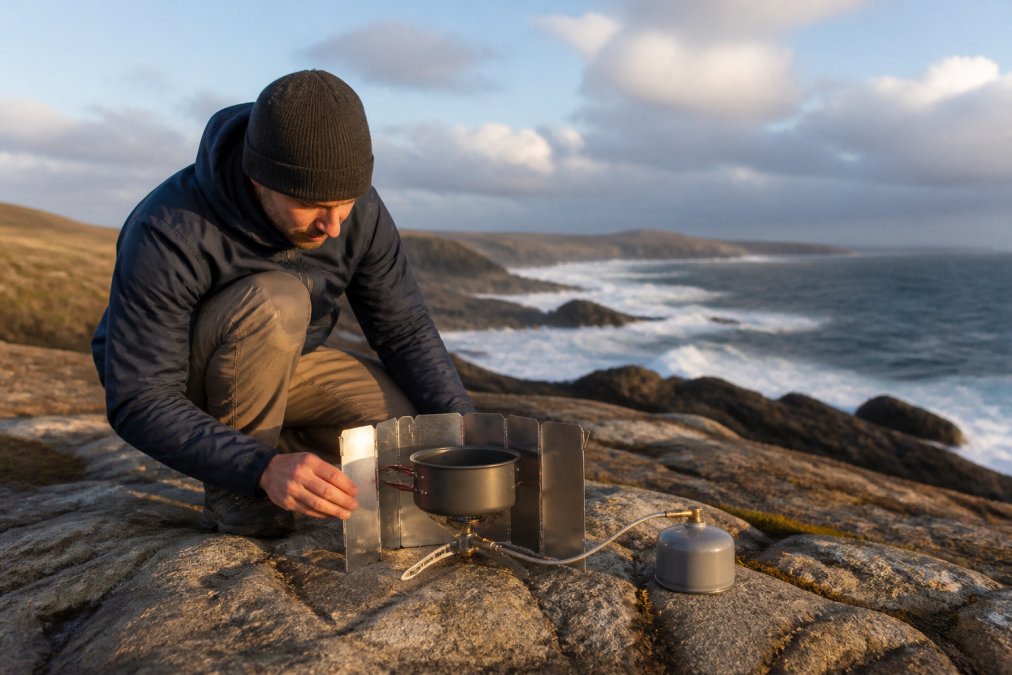
Carbon monoxide is the risk most wind shield guides ignore. A shield that improves combustion efficiency also reduces carbon monoxide output, but only when there is still airflow. Sealing a stove inside a tight screen in an enclosed space removes that airflow entirely. Never treat a wind shield as a substitute for ventilation.
Frequently Asked Questions
What is a good wind guard for a camp stove?
A good wind guard is one that matches your stove type and cooking style. Aluminium folding panels work well for most gas stoves because they block wind from multiple directions and fold flat for storage. Concertina-style shields suit canister stoves, while low-profile windscreens fit integrated systems. Look for a guard that sits close to the burner without touching the flame, is made from durable aluminium, and packs down small enough for your carry case.
How do I stop my camping stove from blowing out in the wind?
Position your stove behind a natural windbreak like a rock or log, then add a wind shield around the burner. Keep the shield close but not touching the flame, and angle the open side away from the wind. A low-profile stove with a recessed burner also helps. If wind is severe, move to a sheltered cooking spot and reduce the flame to a steady, low setting rather than a high blast.
Are aluminium folding wind shields effective for all stove types?
Aluminium folding panels work for most gas stoves, including canister and liquid fuel models, but they are not ideal for integrated canister systems where the burner and pot are one unit. For those, a low-profile windscreen designed for the specific system is better. Always check that the shield does not block ventilation around the canister, as trapped heat can increase canister pressure and cause dangerous flare-ups.
What features should I look for in a portable stove wind shield?
Look for lightweight construction, usually aluminium, with enough panels to wrap around your burner. A concertina design folds flat for compact storage. Check that the shield is tall enough to block wind but short enough to allow airflow to the burner. Field-tested models with a carry case protect the panels from bending. For backpacking, prioritise weight; for car camping, prioritise stability and coverage.