

Last Updated: October 25, 2026
Quick Summary
The best alternatives to disposable camping fuel canisters are refillable LPG bottles for car and family camping, liquid fuel stoves for cold weather and altitude, and alcohol or solid fuel stoves for ultralight backpacking and backup. Match the fuel to your stove before buying either, since each system needs its own bottle, valve or burner.
- Refillable LPG bottles refill at a gas supplier or swap at a hardware store and suit car and family camping.
- Liquid fuel stoves burning white gas or shellite perform strongest in cold weather and at altitude.
- Alcohol stoves run on methylated spirits and are the lightest option but slower in wind and cold.
- A bottle past its test date cannot legally be refilled, so check the stamp before buying secondhand.
- Never puncture or crush a canister to empty it; take it to a proper collection point instead.
Table of Contents
- Why Campers Are Moving Away From Disposable Camping Fuel Canisters
- Types of Reusable and Alternative Camping Fuels Compared
- Refillable Camping Gas Canisters: What to Know Before You Switch
- Liquid Fuel Camping Stove Systems and How They Perform
- Alcohol Camping Stove Fuel: The Lightweight Backup
- Stove Compatibility and Fuel Efficiency by Trip Type
- Camping Gas Canister Disposal and Safe Transport
- Total Cost Over Time: Disposable Versus Reusable Systems
- Frequently Asked Questions
Why Campers Are Moving Away From Disposable Camping Fuel Canisters
Disposable camping fuel canisters are single-use gas cartridges that get punctured or screwed onto a stove, burned through, then thrown away.
Because convenience has a hidden bill. Every empty canister is waste you have to carry out, and in many council areas it cannot go in the kerbside bin at all.
The shift is practical, not ideological. A refillable bottle or a liquid fuel stove costs more upfront but pays you back over a season of trips.
Types of Reusable and Alternative Camping Fuels Compared
Most pages on this topic mix disposable cartridges, refillable canisters and unrelated gasoline containers into one list, which makes it hard to see what you are actually choosing between. The table below compares only the practical non-disposable systems, so you can match one to how you camp.
| System | Fuel | Typical stove type | Cold-weather performance | Weight | Refill or resupply | Best for |
|---|---|---|---|---|---|---|
| Refillable LPG bottle | LPG (propane/butane mix) | Two-burner camp stove, oven, BBQ | Good with propane-rich mix; falls off with butane-heavy mix | Heavy; vehicle-based | Refill at gas supplier or swap at hardware store | Car, family and base camping |
| Liquid fuel stove | White gas or shellite | Pressurised liquid-fuel stove | Strong; pressure maintained by pump | Moderate | Refill from bulk bottle | Cold weather, altitude, long trips |
| Alcohol stove | Methylated spirits | Simple open burner or pressurised alcohol stove | Moderate; slower in cold and wind | Very light | Buy by the bottle at hardware or supermarket | Backpacking, solo, backup |
| Solid fuel tablets | Hexamine or similar | Folding tablet stove | Slow but reliable; wind-sensitive | Very light | Buy tablets in packs | Emergency kit, ultralight backup |
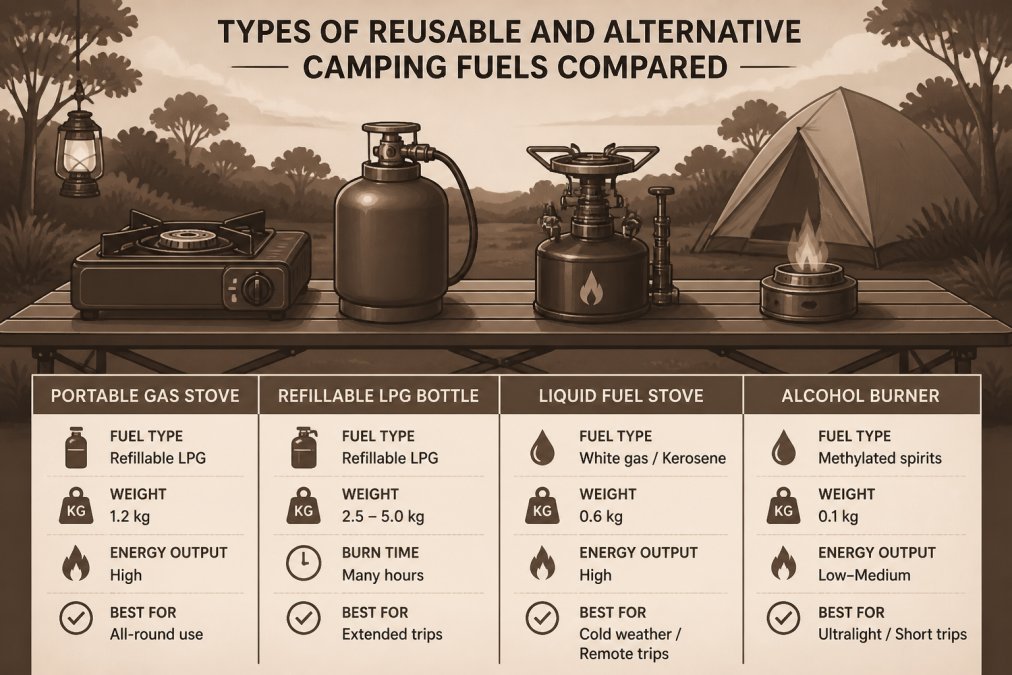
LPG and Refillable Gas Systems
LPG is the closest swap for most car campers. You buy a refillable gas bottle, connect it to a regulator and hose, and refill it at a gas supplier or swap it at a hardware store.
This is the system our THERMOMATE 2 Burner Portable Camping Oven Cooking LPG Gas Stove runs on. It connects straight to an LPG bottle and gives you two 5,300 BTU brass burners plus a 3,500 BTU oven, so you can cook a full meal rather than just boil water.

Liquid Fuel, Alcohol and Solid Fuel Options
Liquid fuel stoves burn white gas or shellite from a refillable bottle you top up yourself. They are the strongest performers in cold weather and at altitude, which is why mountaineers favour them.
Alcohol stoves are the lightest option. They run on methylated spirits, weigh almost nothing, and suit backpackers who only need to boil water.
Solid fuel tablets are the simplest of all: no liquid to spill, no pressure, just a tablet and a stand.
Refillable Camping Gas Canisters: What to Know Before You Switch
Refillable camping gas canisters are pressurised bottles you refill rather than discard, and they only make sense if you can get them filled locally. Availability is the deciding factor, not the stove. Securing a reliable supply of fuel is as essential to your kit as selecting the right coffee for camping to ensure your morning routine remains consistent regardless of your remote location.
Before you commit, check three things:
- Refill access: does a nearby supplier fill your bottle, or do you rely on swap-and-go?
- Bottle standard: many refillable systems use a specific valve, so the bottle and stove must match.
- Storage and transport: full bottles need upright storage, ventilation, and care in a hot vehicle.
Watch out: a bottle that is past its test date cannot legally be refilled. Check the stamp before you buy secondhand.
Liquid Fuel Camping Stove Systems and How They Perform
A liquid fuel camping stove burns fuel from a separate refillable bottle and pressurises it before ignition. Performance is the reason people put up with the fiddlier start-up.
These stoves keep output high in freezing conditions where gas pressure drops. They also let you carry one fuel type for cooking and lighting.
For a camper who mostly does summer beach trips, that complexity is wasted. For a snow camper, it is the difference between a hot meal and a cold one.
Alcohol Camping Stove Fuel: The Lightweight Backup
Alcohol camping stove fuel is methylated spirits, and it is the lightest, cheapest fuel per boil for simple backpacking.
It is also slow. Alcohol burns cooler than gas, so it struggles in wind and takes longer to bring water to the boil.
THERMOMATE 2 Burner Gas Portable Camping Oven Stove Combo, Grey →
The upside is safety and simplicity: spill it, and it evaporates. There is no canister to puncture, no pressure to manage, and no waste to carry out.
Stove Compatibility and Fuel Efficiency by Trip Type
Stove and fuel compatibility is where most switches go wrong. A stove built for a threaded canister will not run on a refillable bottle without the right adapter, and a liquid fuel stove will not run on gas at all.
Matching the Fuel to Your Stove
Match the fuel to the stove before you buy either. Threaded canister stoves need a screw-on cartridge. Pierceable canister stoves need a specific cartridge that gets punctured on connection. LPG stoves need a bottle and regulator. Liquid fuel stoves need their own bottle and pump.
If you are weighing up a budget stove to pair with your fuel choice, our guide to budget camping stove alternatives covers what is worth the money. Once your stove and fuel are sorted, a camping cookware set sized to your burner makes the whole setup more efficient.
Cold-Weather Performance and Burn Time
Cold weather is the great divider. Gas pressure falls as temperature drops, so butane-heavy blends fade in the cold while propane-rich blends hold up better. Liquid fuel and alcohol are less affected by temperature.
Wind matters just as much as cold. A shielded burner keeps more heat under the pot and stretches your burn time. Our roundup of camping stove wind shields shows the options for protecting an alternative-fuel setup.
Camping Gas Canister Disposal and Safe Transport
Camping gas canister disposal is the problem disposable cartridges create. An empty canister still holds residual gas, so it cannot simply go in the rubbish in most areas.
Transport rules matter too. Gas canisters and fuel bottles should travel upright, secured, and away from heat. Never store fuel in a hot car or a closed tent, and always cook with ventilation.
Watch out: never puncture or crush a canister to "empty" it. Take it to a proper collection point instead.
Total Cost Over Time: Disposable Versus Reusable Systems
The upfront cost of a refillable system is higher, but the cost per use falls sharply over a season of trips. That is the whole argument for switching, and it is worth doing the maths rather than trusting the slogan.
What Actually Drives the Cost
Four things determine whether a reusable system pays off:
- Initial equipment cost: the stove, bottle, regulator, hose and any adapters.
- Refill cost: the price per kilogram or per litre of fuel, which varies by supplier and region.
- Consumption: how much fuel a trip actually burns, which depends on burner output, wind, temperature and what you cook.
- Break-even point: the number of trips before refill savings overtake the higher upfront spend.
A Simple Break-Even Method
You do not need exact prices to see the pattern. Use this method with current local prices:
- Add up the full upfront cost of the reusable system (stove plus bottle plus regulator plus hose).
- Subtract the upfront cost of the disposable setup you would otherwise buy.
- Divide the difference by the saving per trip (disposable cartridge cost minus refill cost for the same amount of cooking).
- The result is the number of trips to break even.
A common pattern is that a refillable LPG setup breaks even within a season of regular car camping, while a liquid fuel system takes longer because the stove itself is dearer. Alcohol is the cheapest to start and the cheapest per boil, but it only suits simple boiling.
| System | Upfront Cost | Cost Per Use | Best For |
|---|---|---|---|
| Disposable canister | Low | Repeats every trip | Occasional campers |
| Refillable LPG | Higher | Falls with each refill | Car and family camping |
| Liquid fuel | Higher | Low per boil | Cold weather, altitude |
| Alcohol | Very low | Very low | Backpacking, backup |
If you want budget-friendly stove options that pair with reusable fuels, see our guide to budget camping stove alternatives. Factor in the cost of a refillable bottle and regulator, not just the stove, before you compare totals.
Frequently Asked Questions
Are camping fuel canisters universal?
No. Camping fuel canisters come in a few fitting types, and they are not interchangeable. Threaded canisters screw onto a matching valve, while pierceable canisters are punctured by a specific stove mechanism and cannot be reused once opened. Some stoves run only on LPG bottles with a hose and regulator. Check your stove's valve type and fuel blend before buying any canister or refillable system, because a mismatch means the fuel simply will not connect or burn correctly.
Can you refill disposable camping gas canisters?
Refilling disposable canisters is not recommended and is unsafe. These canisters are not built for repeated pressure cycles, and transferring fuel between containers risks leaks and fire. Instead, choose a purpose-made refillable camping gas canister or a refillable LPG bottle that is designed for reuse. If you still have disposable canisters, use them up as intended and follow proper camping gas canister disposal guidance rather than attempting a refill at home.
How do you dispose of unused camping gas canisters?
Never put gas canisters in kerbside recycling. Use the fuel fully by burning it off with your stove in a well-ventilated outdoor area, then check with your local council for household hazardous waste drop-off points that accept gas cylinders. Do not puncture or crush canisters, and store them upright away from heat until you can dispose of them. For larger refillable LPG bottles, return them to the supplier or a participating refill or swap location.
Which camping stove fuel is best in cold weather?
Liquid fuel camping stoves generally hold up best in cold conditions because the fuel is pressurised by the stove itself rather than relying on canister pressure. Standard butane canisters lose pressure as temperatures drop, so look for isobutane or propane blends if you use gas. Alcohol camping stove fuel works in cold weather but produces less heat, so it suits light cooking rather than boiling large pots. Match the fuel to the temperatures you actually camp in.
The real question is not which fuel is cheapest on day one, but which system you will actually keep using. At Budget Roo Pty Ltd, we stock gear built for that long view, including the Thermomate LPG oven and stove combo with its twin 5,300 BTU burners, 3,500 BTU oven, and folding wind-sheltering lid. Get started with Budget Roo Pty Ltd and build a camp kitchen you refill, not replace.
