

Table of Contents
- Synthetic vs Down Sleeping Bags for Camping: The Quick Comparison
- At-a-Glance Comparison Table
- Sleeping Bag Temperature Ratings Explained
- How Synthetic and Down Insulation Perform in the Wet
- Pack Size, Weight, and Warmth-to-Weight Ratio
- Choosing a Sleeping Bag for Australian Climates
- Durability, Cost, and Long-Term Value
- How to Store a Sleeping Bag to Maintain Loft
- Conclusion
- Frequently Asked Questions
Last Updated: September 30, 2026
Synthetic vs Down Sleeping Bags for Camping: The Quick Comparison
Synthetic vs down sleeping bags for camping comes down to one trade-off: down gives you more warmth per gram and packs smaller, while synthetic keeps insulating when it gets damp and costs less. This guide from Budget Roo covers how each fill performs, how to read temperature ratings, and how to pick for the conditions you actually camp in. At Budget Roo, we stock synthetic bags.
Here is the short version. Down is lighter and compresses further, but it loses loft when wet and needs careful storage. Synthetic is heavier and bulkier, but it shrugs off damp and recovers fast.
At-a-Glance Comparison Table
| Factor | Down | Synthetic |
|---|---|---|
| Warmth-to-weight ratio | Best | Moderate |
| Performance when damp | Poor | Good |
| Pack size | Smallest | Bulkier |
| Upfront cost | Higher | Lower |
| Lifespan | Long if cared for | Moderate |
| Best for | Cold, dry, ultralight trips | Wet, humid, casual camping |
Sleeping Bag Temperature Ratings Explained
A sleeping bag temperature rating is a tested guide to the coldest conditions a bag is built to handle, not a promise of comfort. Ratings come in two forms: a comfort rating, the temperature at which an average sleeper stays comfortable, and a lower limit, the point where a cold sleeper is merely surviving. The comfort figure is the one to plan around.
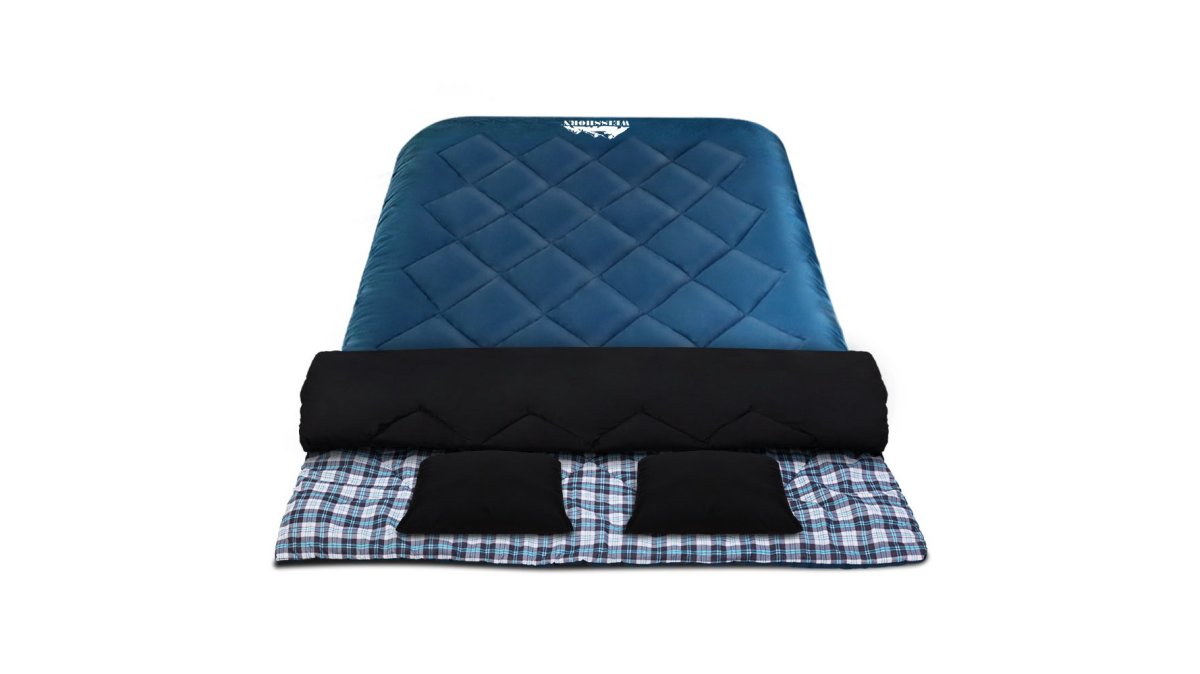
Three things move the needle more than the label: what you wear to bed, what you sleep on, and how tired you are. A mat with a solid insulating value matters as much as the bag itself, because most heat loss happens through the ground. The Weisshorn Sleeping Bag range carries a 5 degree comfort rating, which suits mild to cool nights rather than deep winter.

How Synthetic and Down Insulation Perform in the Wet
Synthetic insulation keeps working when it gets damp. Its fibres are typically treated to resist moisture and are quick to dry, so a bit of condensation or a leaky tent floor does not ruin your night. That matters because tents trap moisture, and condensation is the most common reason campers wake up cold.
Down is the opposite. Natural down clusters collapse when wet and lose their loft, which is exactly what traps warmth. Some bags use hydrophobic down, a treated version that resists moisture better, but it still does not match synthetic in genuinely wet conditions. If you camp where rain, humidity, or heavy condensation are routine, synthetic is the safer choice.
What most comparisons leave out is what happens after the bag leaves your tent. These two fills have very different environmental profiles, and that is worth weighing alongside warmth and weight.
Synthetic fills and microplastics. Most synthetic sleeping bag insulation is polyester or a polyester blend. Over years of washing, abrasion and UV exposure, these fibres shed microplastic fragments. Standard washing machines do not capture them, and wastewater treatment plants are not designed to filter them out, so a portion ends up in waterways and, eventually, in the food chain. The practical mitigation is simple: wash synthetic bags rarely, use a front-loading machine on a gentle cycle, and consider a microfibre-catching wash bag or a filter attachment if your machine supports one. Line-drying instead of tumble-drying also reduces fibre shedding.
Down and ethical sourcing. Down is a by-product of the poultry industry, and the welfare of the birds it comes from varies enormously by supply chain. The Responsible Down Standard (RDS) is the most widely recognised third-party certification for down that has been traced from farm to finished product, with independent auditing of animal welfare at each stage. Bags carrying the RDS logo have a verifiable chain of custody; bags that simply say 'responsibly sourced' or 'ethical down' without a certification mark do not. If animal welfare matters to you, look for the RDS mark on the swing tag or the brand's published certification, not just the marketing copy.
Durability of the treatment. Hydrophobic down treatments are durable but not permanent. Repeated washing with harsh detergents strips the coating, and once it is gone the down behaves like untreated down in the wet. Use a down-specific cleaner and reapply a treatment if the brand recommends it. Synthetic moisture-wicking treatments are similarly finite, though synthetic fibres retain more of their insulating ability even after the treatment fades, because the fibre structure itself does not collapse the way down clusters do.
A note on biodegradability. Neither fill is a clean win. Down will eventually biodegrade, but only in the right conditions, and the shell fabric around it usually will not. Synthetic fills are effectively non-biodegradable. The most sustainable bag is the one you keep using for a decade, which is why repairability and storage matter as much as the fill label.
Responsible Down Standard certification and traceability
Pack Size, Weight, and Warmth-to-Weight Ratio
Warmth-to-weight ratio is where down wins clearly. For the same warmth, a down bag weighs less and packs into a smaller stuff sack, which is why ultralight backpacking and long treks lean toward down. The lighter your load, the less energy you burn getting to camp.
Weisshorn Sleeping Bag Camping Hiking →
Synthetic bags carry a weight penalty. They are heavier and bulkier for equivalent warmth, so they suit car camping, short hikes, and trips where pack size is not the priority. If you are carrying your gear any real distance, that extra bulk adds up over a day.
- Down: lightest, smallest pack size, best for backpacking
- Synthetic: heavier, bulkier, best for car camping and short walks
- Both: warmth depends on loft, so protect it
Choosing a Sleeping Bag for Australian Climates
Choosing a sleeping bag for Australian climates means matching the fill to your region and season, not to a single national average. The north and coastal areas run humid, with warm nights and heavy condensation, which favours synthetic. Inland and alpine areas get genuinely cold, dry nights where down's warmth-to-weight ratio pays off.
For most casual campers, a synthetic bag in the 5 degree range covers spring, summer, and autumn comfortably. Add a sleeping bag liner for extra warmth on colder nights, and a mat with decent insulation underneath.
Durability, Cost, and Long-Term Value
Upfront price is the easy part of the comparison. The harder question is cost per season of use, and that depends on how each fill degrades and how easily it can be brought back.
A few practical checks before you buy:
- Shell fabric: a 20D to 30D ripstop nylon or polyester balances weight against puncture resistance. Ultralight 7D to 10D shells save grams but tear more easily.
- Baffle construction: on down bags, look for box-wall or trapezoidal baffles rather than simple sewn-through stitching, which creates cold spots along the seams.
- Warranty: check what the brand actually covers. Most cover manufacturing defects, not wear, and a warranty you cannot claim in this market is worth little.
- Cost per season: divide the price by the realistic number of seasons you will use it. A cheaper bag replaced every three years can cost more over a decade than a down bag that lasts eight.
Care and repair guidance for down and synthetic fills
How to Store a Sleeping Bag to Maintain Loft
How you store a sleeping bag to maintain loft decides how warm it stays. Loft is the thickness of the fill, and it is what traps air and keeps you warm. Compress it for months and it struggles to bounce back.
- Never store the bag in its stuff sack. Use the loose cotton storage bag instead.
- Hang the bag, or lay it flat, somewhere dry and out of direct sun.
- Air it out after every trip before packing it away.
- Wash sparingly, follow the care label, and dry it fully before storing.
- Check the loft each season. If it looks flat, it is losing warmth.
Conclusion
The right fill depends on where and how you camp, and getting it wrong means cold nights. If you want a bag that handles damp conditions, costs less, and takes rough use in its stride, a synthetic bag is the practical pick for most trips. Budget Roo stocks the Weisshorn Sleeping Bag range, built with a 190T polyester ripstop shell, 300g/m² hollow fibre filling, and a 5 degree comfort rating, with free shipping and a design that unzips into two single bags.
Frequently Asked Questions
What is the best type of sleeping bag for camping in humid conditions?
Synthetic insulation is the better choice for humid or damp conditions because it retains warmth even when wet, whereas down loses loft and insulating ability when moisture gets in. If you often camp in coastal or tropical areas, a synthetic bag with a durable water repellent (DWR) shell will keep you warmer and dry out faster.
How long will a synthetic sleeping bag last?
A well-cared-for synthetic sleeping bag typically lasts 5 to 10 years of regular use. The hollow fibres gradually lose loft and compressibility over time, especially if the bag is stored compressed. Storing it loosely and washing it according to the manufacturer's instructions will help maintain its warmth and extend its lifespan.
Is down insulation worth the extra cost for Australian camping?
Down is worth the investment if you prioritise a small pack size and warmth-to-weight ratio, such as for ultralight backpacking or cold-weather trips. For casual car camping or humid conditions, a synthetic bag like the Weisshorn Sleeping Bag at $101.95 offers reliable warmth and easier care at a lower price.
Do synthetic sleeping bags lose their warmth over time?
Yes, synthetic bags gradually lose loft and thermal efficiency as the fibres compress and break down with repeated use and washing. Proper storage in a large cotton sack rather than a stuff sack, plus gentle washing, helps slow this process. Down bags also lose loft over time but can often be restored with proper cleaning and re-lofting.