

Last Updated: October 22, 2026
Quick Summary
Sleeping mat vs air mattress comes down to priorities: sleeping mats offer reliability, packability, and excellent insulation through material density, while air mattresses provide softer comfort but require setup time, carry puncture risk, and poor cold-weather performance unless insulated. For backpacking and cool conditions, a sleeping mat is the practical choice; for car camping in warm weather, an air mattress works if comfort is the priority.
- Foam pads weigh 500-800g and last 10+ years; air mattresses weigh 1.5-3kg and typically last 2-5 years.
- A foam pad takes 30 seconds to set up; an air mattress requires 5-10 minutes of active pumping.
- Sleeping mats provide genuine insulation by trapping air in material; uninsulated air mattresses conduct ground cold as night temperatures drop.
- Air mattresses need an R-value of 3 or higher for cool-weather camping, or add a foam underlay underneath.
- A single puncture renders an air mattress unusable until repaired; foam pads are virtually indestructible.
Table of Contents
- Sleeping Mat vs Air Mattress: Key Differences
- Comfort and Support: Which Feels Better?
- Best Sleeping Mat for Camping
- Best Air Mattress for Camping
- Camping Sleep System for Beginners
- Portability, Weight and Packed Size
- Durability, Puncture Risk and Long-Term Reliability
- Setup, Inflation and Pack-Down: Real-World Effort
- Frequently Asked Questions
Sleeping Mat vs Air Mattress: Key Differences
Choosing between a sleeping mat and an air mattress for camping comes down to how each system works and which trade-offs suit your camping style. Both keep you comfortable and insulated from cold ground, but they approach it very differently.
What Each Sleep System Is
A sleeping mat is a cushioned layer you place directly on the ground.
An air mattress for camping is an inflatable bed, a larger, sturdier version of an indoor air bed. It relies entirely on air pressure for support and cushioning. Some are basic vinyl designs; others include built-in insulation layers to trap warmth from below.
The fundamental difference: sleeping mats work through material density and structure, while air mattresses work through air pressure and volume.
Quick Comparison Table
| Feature | Sleeping Mat | Air Mattress |
|---|---|---|
| Setup Time | 30 seconds (foam) to 2 minutes (self-inflating) | 5-10 minutes (manual pump) |
| Packed Size | Compact roll, 20-40 litres | Bulky bag, 40-80 litres |
| Weight | 500g-1.5kg | 1.5-3kg |
| Comfort (firm sleepers) | Good support, stable surface | Soft, can feel like floating |
| Insulation (cold ground) | Excellent (especially foam) | Variable; depends on design |
| Puncture Risk | Very low | High; single hole deflates bed |
| Price Range | $30-150 AUD | $50-300 AUD |
| Durability | 5-10+ years with care | 2-5 years typical |
Comfort and Support: Which Feels Better?
Comfort is personal, but the two systems feel fundamentally different. A sleeping mat provides a firm, stable surface; foam and self-inflating mats don't shift as you roll over, feeling like a thin cushion on solid ground. If you prefer consistent support, this matters.
An air mattress feels softer and more like a traditional bed, cradling your body and reducing pressure points. However, it can feel unstable, you may sink slightly, and movement from a partner transfers more easily.
For back sleepers and people with lower back pain, the firmness of a sleeping mat often provides better support. For side sleepers and those who like a softer feel, an air mattress may be more comfortable.
Best Sleeping Mat for Camping
Foam Pads and Self-Inflating Options
Closed-cell foam pads are the simplest, most reliable sleeping mats: dense foam that doesn't absorb water, won't puncture, and lasts for years.
Self-inflating pads combine a foam core with an air valve: open the valve, the foam expands and draws in air, doing most of the inflation for you. Add a few breaths to reach full firmness.
Inflatable sleeping pads use no foam, just air inside a durable shell.
When to Choose a Sleeping Mat
Choose a sleeping mat if you value simplicity, reliability, and packability. Foam pads suit casual campers and families, affordable, virtually indestructible, and requiring zero setup beyond unrolling.
Sleeping mats excel in cold weather: foam and self-inflating pads provide genuine insulation because the material traps air and blocks ground cold.
If you're backpacking or hiking to your campsite, a sleeping mat is almost always the better choice. The weight and packed size difference is significant over a multi-day trip.
Best Air Mattress for Camping
Air Mattress Insulation for Camping
Not all air mattresses are equal for camping. A basic vinyl air bed is essentially a bag of uninsulated air: it conducts heat away from your body and draws cold up from the ground, so you can feel chilled even inside a well-rated sleeping bag.
The clearest way to judge cold-weather suitability is the R-value, which measures thermal resistance. Higher values mean better insulation. As a practical guide for Australian conditions:
| R-value | Suitable conditions | What it means in practice |
|---|---|---|
| Below 1 | Warm nights only (summer, low altitude) | Basic air bed; expect to feel ground cold on cool nights |
| 1-2 | Mild nights, three-season comfort | Fine for summer and warm autumn; add a foam layer if nights dip |
| 3-4 | Cool nights, frosty mornings | Meaningful ground insulation; suitable for most three-season camping |
| 5+ | Cold conditions, alpine or winter trips | Designed for sub-zero ground; pair with a matching sleeping bag |
Most standard air mattresses sit below an R-value of 1, making them unsuitable for anything but warm-weather camping. In cool conditions, choose an insulated air mattress rated 3 or higher, or add a closed-cell foam pad underneath, a cheap, effective fix common among experienced campers.
When to Choose an Air Mattress
Choose an air mattress for car camping in warm weather, or when comfort is the top priority. Air mattresses are wider and longer than most sleeping mats and feel more like a traditional bed.
They also suit group camping where multiple people share a large surface, and campers with mobility issues or joint pain who find a firmer mat uncomfortable.
The trade-offs are setup time, packability, and reliability.
Camping Sleep System for Beginners
If you're new to camping, match the sleep system to how you camp and how you sleep, not to the most comfortable-looking option. Use this decision guide as a starting point.
Weisshorn Swag King Single Camping Swags Canvas Free Standing Dome Tent Dark →
By camping style
| Camping style | Best starting point | Why |
|---|---|---|
| Backpacking or hike-in | Closed-cell foam pad or lightweight inflatable pad | Lowest weight and packed size; foam is indestructible and needs no pump |
| Car camping (warm weather) | Self-inflating pad or basic air mattress | Space and weight matter less; comfort can take priority |
| Car camping (cool conditions) | Insulated air mattress (R-value 3+) or self-inflating pad | Ground insulation matters more than surface softness |
| Family camping with children | Self-inflating pad or insulated camping air mattress | Softer surface suits children; insulation prevents cold nights |
| Semi-permanent base camp | Air mattress with a foam underlay | Bed-like comfort with a cold barrier underneath |
By sleeper needs
- Side sleepers: A thicker surface (air mattress around 20-25 cm, or an inflatable pad 7 cm or more) reduces hip and shoulder pressure. Thin foam pads can leave side sleepers sore.
- Back sleepers: A firmer, stable surface, foam or self-inflating pad, supports the lower back better than a soft air bed.
- Joint or back pain: Test firmness before committing; many campers find a self-inflating pad a better balance of support and cushioning than either extreme.
- Couples: An air mattress reduces pressure transfer between sleepers compared with a thin mat, but movement still transfers more than on a firm foam surface.
A simple beginner path
Start with a closed-cell foam pad or basic self-inflating pad paired with a season-rated sleeping bag. This combination is affordable, reliable, and teaches you what comfort level you need before investing in premium gear.
For family camping with children, consider a self-inflating pad or a camping-specific air mattress with insulation, children often sleep better on a slightly softer surface. Always check the R-value against the season, and add a foam layer under any uninsulated air bed.
Budget Roo Pty Ltd stocks the Weisshorn Swag King Single Camping Swags in both dark blue and red, which includes a 70mm high-density foam mattress. This is an excellent entry point, the swag combines shelter and sleeping comfort in one unit, eliminating the need to choose between separate systems.

Portability, Weight and Packed Size
A foam sleeping pad weighs 500-800 grams and rolls to the size of a water bottle. A self-inflating pad weighs 1-1.5 kilograms and packs to roughly 20-30 litres.
For car camping, weight and size are minor concerns. For backpacking, the difference is substantial: a foam pad saves 1-2 kilograms and several litres of pack space, adding up to real fatigue reduction over multiple days.
Packed size also matters for storage at home. A foam pad hangs on a hook or leans in a corner. An air mattress needs a dedicated storage box or bag.
Durability, Puncture Risk and Long-Term Reliability
Foam pads are nearly indestructible: they don't puncture, leak, or degrade significantly over years of use. They may compress slightly over a decade but remain functional.
Self-inflating pads are durable but have a valve that can fail and foam that can eventually compress. They typically last 5-10 years with normal use.
Air mattresses are the fragile option.
If durability and long-term value matter, a sleeping mat wins decisively. You'll replace an air mattress multiple times in the lifespan of a single foam pad.
Setup, Inflation and Pack-Down: Real-World Effort
A foam pad requires no setup. Unroll it, place it on flat ground, and you're done. Thirty seconds, zero effort.
A self-inflating pad takes 1-2 minutes. Open the valve, let it expand for 30 seconds, then add a few breaths of air by mouth or pump until firm. Simple and reliable.
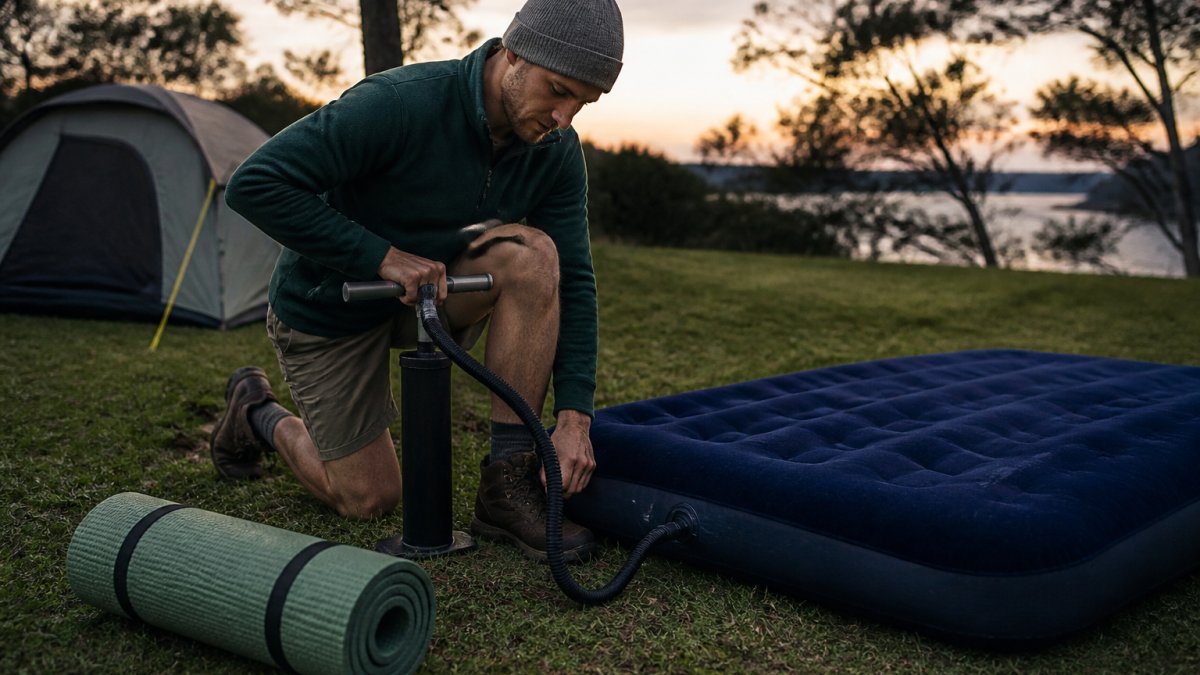
An air mattress requires 5-10 minutes of active pumping, depending on pump type. Manual hand pumps are slow and tiring; battery pumps are faster but add weight and need charging. Even with a good pump, inflation is a noticeable task at the end of a long day.
Deflation and packing follow the same pattern.
In practice, many campers avoid air mattresses because setup friction, especially when tired, becomes annoying over multiple nights. A sleeping mat removes that friction entirely.
The sleeping mat vs air mattress choice hinges on your camping style and priorities. For reliability, weight, and cold-weather performance, a sleeping mat is the practical choice.
At Budget Roo Pty Ltd, we recommend starting with a quality foam or self-inflating sleeping mat. Explore our range at Budget Roo Pty Ltd and find the gear that matches your adventure.
Frequently Asked Questions
What are the pros and cons of a sleeping mat and an air mattress?
Sleeping mats excel at insulation, packability, and durability. They resist punctures and perform well in cold weather but offer less cushioning on uneven ground. Air mattresses provide superior comfort and support on flat terrain, but they're heavier, bulkier, and vulnerable to leaks. Air mattresses also lose insulation value as ground temperature drops, making them less suitable for winter camping. Your choice depends on camping style: backpacking favours sleeping mats, while car camping and casual trips suit air mattresses.
Which is more comfortable for camping: a sleeping mat or an air mattress?
On flat, prepared ground, air mattresses typically feel more comfortable because they offer deeper cushioning and conform to your body shape like a home mattress. However, sleeping mats provide better support on uneven terrain and won't deflate overnight. Modern self-inflating pads with memory foam layers bridge the gap, offering reasonable comfort with the reliability of a mat. Comfort is personal, test both if possible before committing to a camping sleep system.
Are sleeping mats easier to carry than air mattresses?
Yes. Closed-cell foam pads roll or fold to the size of a small bag and weigh 300-600 grams. Self-inflating pads are slightly heavier but still compact. Air mattresses, even compact ones, typically weigh 1-2 kg and pack into larger bags. For backpacking and multi-day trips where every gram counts, sleeping mats are significantly easier to transport. For car camping, weight and size matter less, so an air mattress is practical.
How do I keep an air mattress warm while camping in cold weather?
Place an insulating layer beneath the air mattress: a sleeping mat, blanket, or foam sheet reduces heat loss to the ground. Use a high-tog sleeping bag rated for the temperature. Avoid inflating the mattress with cold air from outside; let it warm indoors first if possible. Consider an air mattress with built-in insulation or higher R-value. For sustained cold camping, a sleeping mat alone outperforms an air mattress because it provides consistent ground insulation without relying on trapped air, which loses effectiveness as temperature drops.
