

Table of Contents
- Why Camping Mattress Choice Matters for Back Pain
- How to Choose a Camping Mattress for Spinal Support
- Self-Inflating vs Air Mattresses for Back Support
- Camping Mattress R-Value Guide for Thermal Comfort
- Key Features That Prevent Back Pain While Camping
- Practical Setup Tips for Better Spinal Alignment
- Frequently Asked Questions
Last Updated: October 1, 2026
Why Camping Mattress Choice Matters for Back Pain
Camping mattress back pain transforms a camping trip from adventure into ordeal. The wrong sleeping surface aggravates existing discomfort and creates new problems that follow you home. A quality camping mattress for back pain isn't luxury, it's the difference between waking refreshed and waking worse than when you went to sleep.
Most campers struggle to balance portability and comfort.
Your mattress must distribute body weight evenly, support your spine's natural curve, and prevent pressure points that disrupt sleep. This guide covers how to evaluate camping mattresses specifically for back support.
How to Choose a Camping Mattress for Spinal Support
Selecting a camping mattress for back pain requires understanding your spine's specific needs. The right choice depends on your sleeping position, body weight, climate, and camping frequency.
Identify your primary sleeping position. Side sleepers need cushioning at hips and shoulders to prevent sideways sag. Back sleepers need firm lumbar support. Stomach sleepers should be avoided for back pain as they risk hyperextension.
Assess your body weight. Heavier users benefit from thicker, higher-density foam that resists compression. Weight capacity directly affects longevity.
Thickness and Firmness for Lumbar Alignment
For camping mattress back pain relief, mattress thickness directly correlates with spinal support. A minimum of 7 centimetres is necessary for meaningful lumbar support; 10 centimetres provides superior comfort for users with existing back pain.
Firmness affects spinal alignment. Overly soft mattresses cause sinking and misalignment; overly firm ones create pressure points. Medium to medium-firm firmness supports natural curve without excessive sinking.
High-density foam offers better support. A density of 35-50 kg/m³ provides good balance between support and comfort for back pain sufferers.
Material Quality and Pressure Point Relief
Closed-cell foam resists moisture and maintains firmness longer than open-cell foam.
The Weisshorn Swag King Single from Budget Roo Pty Ltd includes a 70mm high-density foam mattress, which provides solid lumbar support for most users. This thickness sits in the sweet spot for back pain relief, substantial enough to prevent compression against hard ground, yet packable for transport.

Self-Inflating vs Air Mattresses for Back Support
Two main camping mattress types compete for back-pain sufferers: self-inflating and air mattresses. Each has distinct advantages and limitations for spinal support.
Self-inflating mattresses combine open-cell foam with an air chamber, offering consistent firmness and pressure relief. The foam layer provides inherent support even if air leaks, making them forgiving of minor punctures.
Air mattresses are lighter and compact but offer minimal cushioning and feel unstable. For back pain, air mattresses alone are inadequate unless paired with a quality topper.
For back pain specifically, self-inflating mattresses can offer good cushioning and pressure relief. If you prefer an air mattress, adding a foam topper can help achieve proper spinal support.
Camping Mattress R-Value Guide for Thermal Comfort
R-value measures thermal insulation. Temperature swings and humidity create muscle tension that aggravates back pain, making proper insulation important.
R-value ranges from 1 to 8+. Values of 2-4 suit mild climates; above 4 for cold weather.
Rocky ground creates air gaps that reduce insulation; sand and soft earth improve contact. A ground sheet under your mattress improves insulation performance by 0.5-1 R-value equivalent.
In humid regions, prioritising mattresses with closed-cell construction can help prevent moisture absorption that reduces R-value effectiveness.
Check product specifications for R-value before purchasing.
Key Features That Prevent Back Pain While Camping
Several specific features separate mattresses that support backs from those that merely provide a place to lie down.
Ergonomic design distributes pressure evenly and prevents pressure points. Look for contouring or pressure relief descriptions.
Weisshorn Swag King Single Camping Swags Canvas Free Standing Dome Tent Dark →
Baffle construction prevents foam shifting that creates lumps and uneven support.
Valve systems should be reliable and easy to operate.
Puncture resistance extends mattress life. Multi-layer construction with reinforced bases is essential.
Cot compatibility is critical for users with chronic back pain. A quality mattress must work effectively on a cot, not just on bare ground.
When pairing a mattress with a cot, several factors determine success. First, mattress dimensions must match the cot surface. Standard camping cots measure approximately 190cm long by 70cm wide; ensure your mattress fits these dimensions without overhang, which creates instability and pressure points. Second, the mattress must not slide on the cot fabric. Cots have smooth canvas or nylon surfaces; a mattress with a textured base or non-slip coating prevents shifting during sleep. If your mattress slides, place a non-slip mat between the cot and mattress, or use corner straps to secure the mattress to the cot frame.
Third, mattress thickness affects cot performance. Thicker mattresses (10cm+) provide better support on a cot than thin options (under 5cm) because they bridge the cot's fabric sag. A cot's canvas naturally sags slightly under body weight; a thicker, firmer mattress resists this sag and maintains spinal alignment. Thin mattresses conform to the cot's sag, reducing support quality. For cot use, prioritise mattresses 10cm or thicker with density above 40 kg/m³.
Fourth, ventilation matters on a cot more than on ground camping. Cots allow air circulation beneath the mattress, which is beneficial in humid conditions but can reduce insulation. If you're using a cot in cool weather, add a ground sheet or reflective mat under the cot to reduce heat loss. The mattress alone won't provide sufficient insulation when air flows beneath it.
Fifth, weight distribution on a cot differs from ground camping. Cots concentrate support at frame points rather than distributing weight across a broad ground surface. A mattress with excellent pressure relief becomes even more important on a cot. Look for mattresses with layered foam construction, softer foam at contact points, firmer foam at the core, to prevent pressure concentration at the cot's frame edges.
If you're choosing between ground camping and cot camping for back pain, cots can offer advantages such as elevated sleeping. However, cot camping may require a mattress specifically suited to cot use. A standard ground-camping mattress may not perform adequately on a cot.
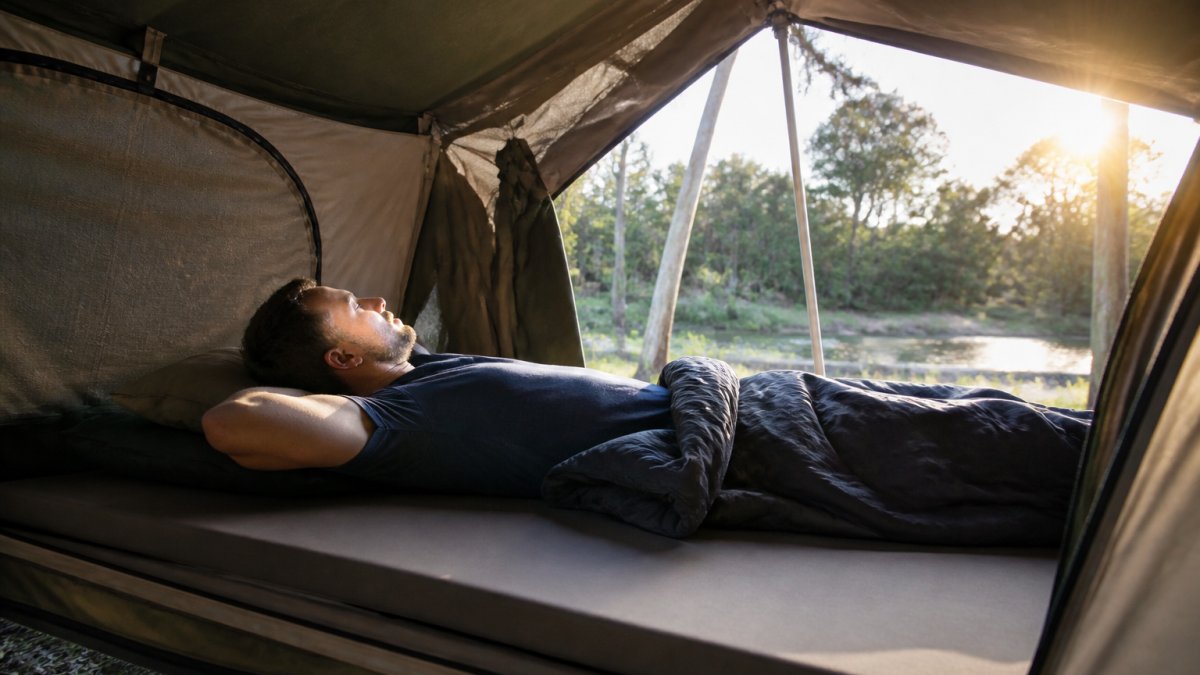
Ergonomic Design for Side Sleepers with Chronic Pain
Side sleepers with back pain face a specific challenge: the hip and shoulder create pressure points that pull the spine out of alignment. Standard flat mattresses fail to address this. Ergonomic designs with contouring or zoning provide targeted support where side sleepers need it most.
The ideal side-sleeping setup includes extra cushioning at the hip and shoulder while maintaining firm support at the waist. This prevents the "hammock effect" where your body sags and your spine curves sideways. Some mattresses achieve this through foam layering, softer foam at contact points, firmer foam at the core.
If your mattress is flat, add a foam topper designed for side sleepers. A 5-7cm topper can transform an adequate mattress into one that properly supports side sleeping.
Weight Capacity and Durability for Heavier Users
Heavier users, generally those over 100kg, need mattresses with higher weight capacity and thicker foam. Standard camping mattresses compress significantly under sustained weight, reducing support over time. This accelerates back pain development.
Look for specifications listing weight capacity. Quality mattresses state this clearly. If weight capacity isn't listed, contact the supplier. Heavier users benefit from mattresses with 10cm+ foam thickness and density above 40 kg/m³.
Durability directly affects value. A mattress that maintains support for five years costs less per use than one that compresses after one season. Invest in quality materials if you camp regularly.
Practical Setup Tips for Better Spinal Alignment
How you set up your mattress affects the support it provides. Ground preparation matters as much as mattress quality.
Clear the ground before placing your mattress. Remove rocks, sticks, and sharp objects that create pressure points. A smooth surface allows the mattress to make full contact with earth, distributing weight evenly.
Use a ground sheet under your mattress.
| Feature | Why It Matters for Back Pain | What to Look For |
|---|---|---|
| Thickness | Prevents compression against hard ground | 7cm minimum; 10cm+ for heavier users |
| Foam Density | Determines support durability | 35-50 kg/m³ for balanced support |
| R-Value | Prevents cold-induced muscle tension | 2-3 for mild climates; 4+ for cold weather |
| Material Type | Affects moisture resistance and lifespan | Closed-cell foam or self-inflating preferred |
| Pressure Relief | Prevents pain points during sleep | Look for contouring or ergonomic design |
| Puncture Resistance | Extends mattress life in outdoor settings | Multi-layer construction with reinforced base |
Frequently Asked Questions
What makes a camping mattress suitable for back pain?
A camping mattress for back pain needs adequate thickness (70mm or more), high-density foam construction, and firmness that supports spinal alignment. Look for mattresses that distribute body weight evenly, reduce pressure points, and maintain lumbar support throughout the night. The mattress should prevent your hips from sinking too far, which causes misalignment.
Is a self-inflating mattress better than an air mattress for back pain?
Self-inflating mattresses typically offer superior support for back pain because they combine foam core with air chambers, providing consistent firmness and better pressure distribution. Air mattresses alone can feel unstable and allow your body to sink unevenly. For spinal support, a quality self-inflating option with high-density foam layers is generally the better choice.
What R-value should I look for in a camping mattress?
R-value measures thermal resistance and ground insulation. For back pain sufferers, an R-value of 2-3 is suitable for mild climates, while 3-5 works for cooler conditions. Higher R-values provide better ground insulation, which reduces heat loss and helps maintain consistent firmness.
Can I use a camping mattress topper with my swag for extra support?
Yes, a quality mattress topper can enhance support and comfort. Look for toppers with high-density foam or memory foam that add 5-10cm of cushioning without reducing firmness. This works well if your swag's built-in mattress lacks adequate thickness or if you need extra pressure point relief. Ensure the topper fits securely inside your swag to prevent shifting during sleep.