

Table of Contents
- What is R-value in Sleeping Pads and Why It Matters
- How to Choose a Sleeping Pad for Cold Weather
- Inflatable vs Closed-Cell Foam Sleeping Pads
- Key Features of the Best Insulated Sleeping Pads
- Sleeping Pad Dimensions and Sizing for Your Needs
- Sleeping Pad Maintenance and Field Repair
Last Updated: September 22, 2026
What is R-value in Sleeping Pads and Why It Matters
R-value measures how well a sleeping pad resists heat loss. The higher the R-value, the warmer the pad performs in cold conditions. This metric matters because it directly determines whether you'll stay comfortable on a freezing night or wake up shivering.
R-value is calculated using standardised testing methods. R-5 works for mild conditions; R-8 or higher handles serious cold. Understanding this number prevents buying a pad that won't keep you warm enough for your climate.
Pair sleeping pads with sleeping bags carefully. A sleeping bag rated for -5°C performs worse on a low-R-value pad because ground cold transfers through the bottom.
How to Choose a Sleeping Pad for Cold Weather
Match the pad's R-value to your expected temperatures: R-5 or higher for alpine winter camping, R-3-4 for shoulder seasons. Camping presents unique challenges that generic guides overlook.
Climate Considerations
In tropical and subtropical regions, humidity reduces a pad's effective insulation by 10-15% without a moisture barrier. Closed-cell foam pads or self-inflating pads with waterproof base layers resist moisture wicking better than pure air mats.
Desert camping presents extreme temperature swings: daytime over 35°C, dropping to near freezing at night. Use R-3-4 pads with ventilation options, or pair a thin foam pad with an air mat for adjustable insulation.
Alpine camping requires serious insulation. Winter temperatures regularly drop below 0°C, and snow camping demands R-value 5 or higher. The combination of altitude, wind exposure, and moisture from snow melt means a single-layer pad is insufficient. Experienced alpine campers in these regions use two-pad systems: a closed-cell foam pad underneath for reliability and an air mat on top for comfort and additional insulation.
Noise Levels and Sleep Quality
Noise is often overlooked in pad selection. Inflatable and self-inflating pads produce rustling sounds that disrupt sleep and disturb tent mates. Noise levels vary significantly by material and construction.
Thin nylon shells (20-30 denier) exceed 70 decibels; thicker shells (75+ denier) reduce noise to 55-65 decibels. Self-inflating pads are quieter (50-60 decibels) due to foam dampening. Closed-cell foam pads are nearly silent (under 45 decibels).
Light sleepers should prioritise quieter pad types. Test pads in-store by shifting your weight to gauge noise. Some manufacturers market "quiet" pads with specialised fabric weaves, though these cost 10-15% more.
Weight and packed size matter equally. Self-inflating pads balance warmth and weight better than pure air mats for most cold-weather campers. Tapered shapes reduce packed size without cutting sleeping surface area.
Valve systems that open easily with gloved hands matter in cold temperatures. Sack valves inflate quickly; twist valves require more dexterity. Dual-valve designs let you control inflation speed and fine-tune firmness.
Consider your sleeping bag's temperature rating alongside the pad's R-value. A 4-season sleeping bag paired with an R-3 pad leaves you vulnerable because ground insulation fails.
Inflatable vs Closed-Cell Foam Sleeping Pads
Air mats offer the best warmth-to-weight ratio for backpackers, packing small and inflating quickly. The downside is puncture risk without repair supplies.
Closed-cell foam pads are always ready and nearly impossible to damage. They weigh more and pack larger than air mats, but never fail. Many experienced campers carry them as backup.
Self-inflating pads use foam cores with air chambers, partially inflating when you open the valve. This hybrid design offers reasonable weight, good insulation, and more durability than pure air mats, with R-values between 3 and 6.
The choice depends on your priorities. Ultralight backpackers choose air mats and accept puncture risk. Car campers favour self-inflating pads for balance. Serious winter mountaineers often bring foam pads because reliability matters more than weight.
Key Features of the Best Insulated Sleeping Pads
Thermal resistance and loft
Loft is the pad's thickness. Greater loft means better insulation because more air gets trapped. A 10-centimetre pad insulates better than a 5-centimetre pad of the same material.
Baffle construction determines air distribution inside the pad. Better baffle design prevents warm air pooling and cold spots. Look for overlapping or crosshatch baffle patterns.
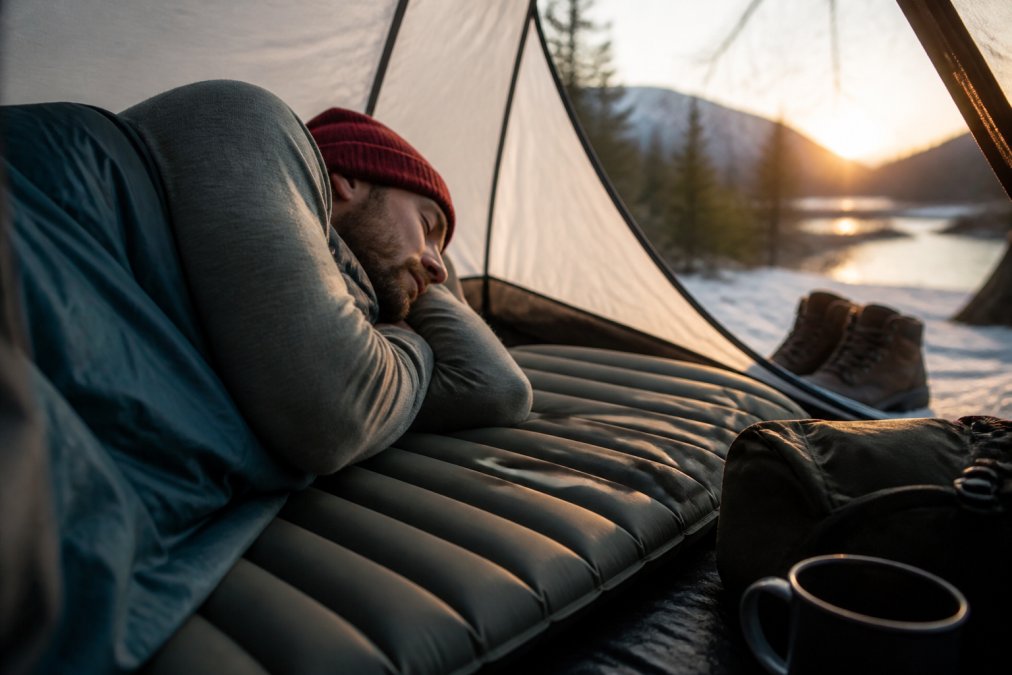
Thermal efficiency combines loft with material quality. Some pads use reflective layers; others use foam that resists heat transfer more effectively. Budget Roo Pty Ltd offers a range of pads with varying loft and insulation technologies.
Packed size and weight
Packed size matters for backpacking. Ultralight pads compress to water-bottle size; standard pads take up roughly the space of a rolled sleeping bag.
Weight directly affects hiking comfort. A 2-kilogram pad feels heavy after 20 kilometres; a 700-gram ultralight pad barely registers. Lighter pads sacrifice durability or insulation.
Tapered shapes reduce packed size without cutting sleeping surface area, saving weight and space while keeping you comfortable.
Durability and denier ratings
Denier measures fabric thickness. Higher denier fabrics resist punctures better. A 75-denier or higher fabric handles rough ground and repeated use.
Bottom material takes the most abuse. Use 75-denier or stronger bottoms for rocky ground. Top materials can be lighter.
Seam quality determines longevity. Sealed seams prevent air leaks. Budget Roo Pty Ltd offers pads with reinforced seams.
Inflation methods and valve systems
Dual-valve designs let you control inflation speed and fine-tune firmness, which matters when temperature changes overnight.
Sack valves are simple, reliable, and work with gloved hands. Twist valves are lighter but slower and require more dexterity.
One-way valves prevent accidental deflation. They let air in but not out. This feature matters on multi-night trips where you need consistent firmness throughout.
Sleeping Pad Dimensions and Sizing for Your Needs
Standard sleeping pads measure 183 centimetres long and 51 centimetres wide, fitting most adults. Width directly affects insulation and comfort more than length.
Width and Sleeping Bag Compatibility
Width is critical for thermal performance. A 51-centimetre-wide pad is standard; a 66-centimetre-wide pad provides better shoulder insulation and measurable warmth benefits.
Mummy Sleeping Bags are tapered to minimise air space. A mummy bag works best with a 51-centimetre-wide pad. Pairing a mummy bag with a 66-centimetre-wide pad wastes width and reduces the pad's effective R-value by 5-10%.
Rectangular Sleeping Bags have straight sides and more interior space. A 51-centimetre-wide pad leaves your sides exposed to cold air. A 66-centimetre-wide pad provides full-body coverage without gaps.
Semi-Tapered or Hybrid Bags fall between these two extremes. They're wider than mummy bags but narrower than rectangular bags. A 58-61-centimetre-wide pad is the ideal match, though these widths are less common in the market. If you own a hybrid bag, a 66-centimetre pad is a safer choice than a 51-centimetre pad.
Before buying a pad, measure your sleeping bag's width at the shoulder. If your bag is 75+ centimetres wide, a 51-centimetre pad will leave you cold. If your bag is 60 centimetres or narrower, a 51-centimetre pad is sufficient.
Thickness and Comfort vs. Insulation
Thickness ranges from 5 to 13 centimetres. Thinner pads pack smaller and weigh less. Thicker pads feel more comfortable and insulate better. Most campers find 7-10 centimetres strikes the right balance. However, thickness interacts with pad type.
Air mats at 10 centimetres feel firmer and more responsive than self-inflating pads at the same thickness because air compresses more than foam. If you prefer a softer feel, a 10-centimetre self-inflating pad will feel more cushioned than a 10-centimetre air mat.
Length Considerations
Tapered vs. Rectangular Pad Shapes
Sleeping Pad Maintenance and Field Repair
Regular cleaning extends pad life. Wipe the surface with a damp cloth after each trip. Dry it completely before storage. Dirt and moisture damage materials over time.