

Table of Contents
- Comparison Table: Top 5 Hiking Backpacks for Long Distance Trekking
- How to Fit a Hiking Backpack for Multi-Day Comfort
- Hiking Backpack Capacity Guide: Litres for Every Trek Length
- How to Pack a Backpack for Weight Distribution on the Trail
- 1. Osprey Atmos AG 65: Best for Ventilation and Heavy Loads
- 2. Gregory Baltoro 75: Best for Maximum Capacity and Durability
- 3. Deuter Aircontact Core 60+10: Best for Adjustability and Load Transfer
- 4. Osprey Exos 58: Best Ultralight Option for Thru-Hiking
- 5. Budget Roo Trek Series 65: Best Value for Multi-Day Trekking
- Frequently Asked Questions
Last Updated: September 27, 2026
Comparison Table: Top 5 Hiking Backpacks for Long Distance Trekking
The best hiking backpacks for long distance trekking balance load-bearing comfort, capacity, and weight. This guide cuts through the spec sheets to show you which packs work on multi-day trails, and how to fit, load, and choose one that carries well from the first kilometre to the last.
| Pack | Capacity | Weight | Frame Type | Best For |
|---|---|---|---|---|
| Osprey Atmos AG 65 | 65L | ~2.1kg | Anti-Gravity suspension | Ventilation with heavy loads |
| Gregory Baltoro 75 | 75L | ~2.5kg | FreeFloat suspension | Maximum capacity and durability |
| Deuter Aircontact Core 60+10 | 60+10L | ~2.4kg | Contact back system | Adjustability and load transfer |
| Osprey Exos 58 | 58L | ~1.2kg | ExoForm frame | Ultralight thru-hiking |
| Budget Roo Trek Series 65 | 65L | ~2.0kg | Adjustable alloy frame | Value-focused multi-day trekking |
How to Fit a Hiking Backpack for Multi-Day Comfort
Fitting a hiking backpack starts with torso length, not height. Measure from your C7 vertebra, the bony bump at the base of your neck when you tilt your head forward, to the top of your hip bones (the iliac crest). Most adults fall between 40cm and 56cm, which maps to the pack's harness or sizes.
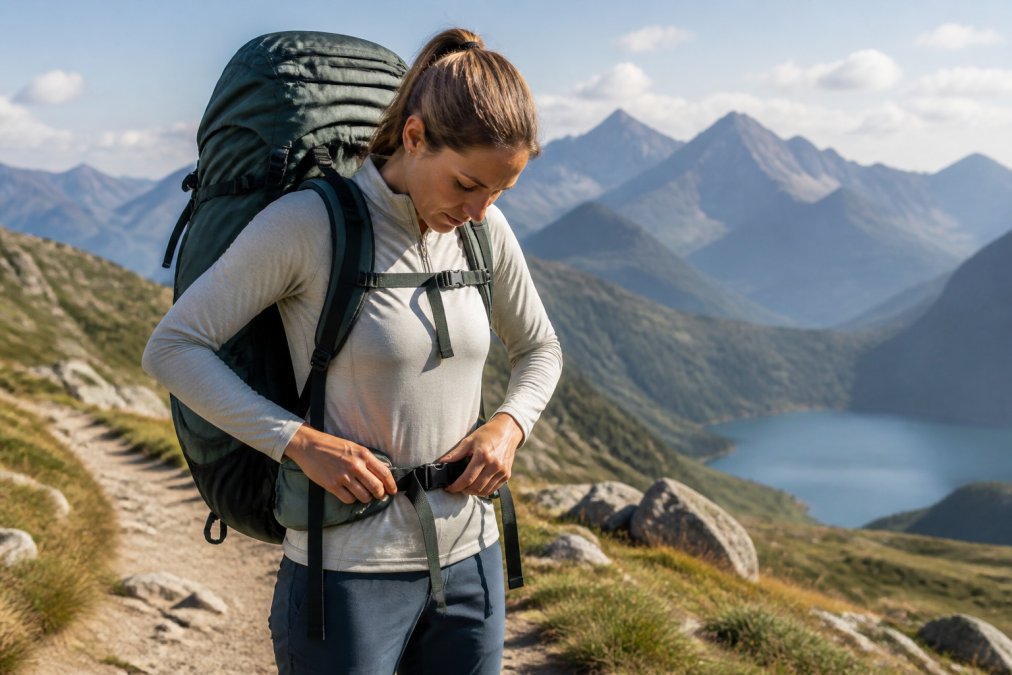
Work through the fit in this order:
- Loosen all straps, then load the pack with roughly your expected gear weight, 12kg to 15kg for a multi-day trek
- Set the hip belt so the centre of the padding sits on the iliac crest, not the waist. The belt should cup the hip bones, not float above them
- Tighten shoulder straps until they wrap without gapping, but stop before they take weight
- Adjust load lifters to a 45-degree angle. If they pull straight down, the torso length is wrong
- Fasten the sternum strap across the upper chest, not the throat, and keep it loose enough to breathe deeply
Torso length and pack sizing
| Torso Length | Pack Size | Typical Harness Range |
|---|---|---|
| 40-45cm | Small | 38-46cm |
| 45-51cm | Medium | 43-51cm |
| 51-56cm | Large | 48-56cm |
Some packs, like the Deuter Aircontact Core 60+10, use a continuously adjustable harness rather than fixed sizes, ideal if you fall between sizes or share a pack. Fixed-size packs often fit more precisely because the harness geometry is tuned to one torso length.
Women's specific fit
Women's packs are not simply smaller men's packs. They typically have a shorter torso range, a narrower shoulder harness, a hip belt shaped for a different pelvic angle, and sometimes a different lumbar curve. If a unisex pack fits well, keep it, but if the straps gape or the hip belt rides up, try a women's specific model.
Field repair and maintenance for long-distance treks
On a long-distance trek, a broken buckle or torn mesh can end your trip. Carry a small repair kit: spare side-release buckles (20mm and 25mm), 2mm cord, Tenacious Tape or similar patch, a needle and heavy thread, and a multi-tool with pliers.
Common failures and fixes:
- Broken buckle: Thread the webbing through a spare buckle of the same width. If you lack a spare, tie the two strap ends with a sheet bend and tension it by hand.
- Torn mesh pocket: Clean the area, apply a repair patch on both sides if possible, and avoid overstuffing the pocket for the rest of the trip.
- Broken zip slider: Pinch the slider with pliers to tighten it, or sew the zip closed and access the compartment through the top.
- Cracked frame stay: Remove the stay if it is removable, straighten it as best you can, and reinforce with tape. If it is not removable, redistribute weight and reduce your load.
Integration with other gear
How a pack interacts with the rest of your kit matters as much as the pack itself. Bear canisters fit horizontally in most 60L+ packs but are awkward in ultralight models. Sleeping pads strapped outside snag on scrub, and trekking poles belong in dedicated loops or strapped diagonally. Test your full kit in the pack before you leave home.
Hiking Backpack Capacity Guide: Litres for Every Trek Length
Capacity is the single biggest decision, and it maps directly to trip length:
| Trek Length | Recommended Capacity | Notes |
|---|---|---|
| Overnight | 30-45L | Minimal gear, shared tent |
| 2-3 days | 45-60L | Standard multi-day kit |
| 4-7 days | 60-75L | Food and fuel for a week |
| Thru-hiking | 50-65L | Light gear, frequent resupply |
How to Pack a Backpack for Weight Distribution on the Trail
Pack heavy items close to your spine at mid-back height, between your shoulder blades and your hip belt. This keeps the load centred over your hips and stops the pack pulling you backwards.
The layering system that works:
- Bottom: sleeping bag and light items you won't touch until camp. A sleeping bag in a compression sack at the base acts as a cushion for the rest of the load
- Middle: heaviest gear (food, water, stove, fuel) against your back, centred between the shoulder blades and the hip belt
- Top: rain shell, first aid, layers you may need during the day
- Outside pockets: water bottle, snacks, map
- Lid: headlamp, sunscreen, small essentials
Weight distribution by load type
| Load Type | Where to Pack | Why |
|---|---|---|
| Water (heaviest) | Against your back, mid-height | Keeps centre of gravity close to spine |
| Food | Against your back, above water | Accessible and balanced |
| Tent | Bottom or strapped outside | Bulky but not dense |
| Sleeping bag | Bottom | Light, compressible, cushions load |
| Fuel canister | Upright, mid-pack | Prevents leaks and keeps weight centred |
| Rain gear | Top or lid | Quick access without unpacking |
Packing for a long-distance trek
On a multi-day trek, your pack changes shape as you eat and drink. Pack so it still carries well when half empty, using compression straps to shrink it as food disappears and a floating lid to lower the top. A common pattern is to pack food in a stuff sack against your back, then move it to the top as the trip progresses.
Packing for different trip types
- Overnight (30-45L): Sleeping bag at the bottom, food and water against your back, rain gear in the lid. No room for luxuries.
- 2-3 days (45-60L): Same layering, but you can carry a small camp chair or extra layer. Keep the heaviest items centred.
- 4-7 days (60-75L): Food volume dominates. Pack food in two stuff sacks, one for the first half, one for the second, and swap them as you eat. Keep the heavier sack against your back.
- Thru-hiking (50-65L): Light gear, frequent resupply. Pack so the pack carries well when it is half full, because it often will be.
Testing your pack before you leave
Load your pack with your full kit, including food and water, and walk around the block for 20 minutes, adjusting the hip belt, shoulder straps, and load lifters until it feels stable. If it sways, the hip belt is too loose or the load too tall; if it pulls you backwards, the heavy items are too far from your spine.
1. Osprey Atmos AG 65: Best for Ventilation and Heavy Loads
The Atmos AG 65 is the pack to beat for hot-weather trekking with a heavy load. Its Anti-Gravity suspension wraps a continuous mesh panel from hip belt to shoulders, keeping the pack off your back and letting air move. On long climbs in humid conditions, the difference in sweat and comfort is noticeable by the second hour. The load-bearing hip belt transfers weight cleanly, and the adjustable harness covers a wide torso range.
Pros:
- Excellent mesh ventilation across the whole back
- Comfortable with loads at the upper end of its range
- Wide torso adjustability
Cons:
- Heavier than ultralight options
- The mesh panel can feel warm against the body in cold conditions
Osprey's official pack fitting guide
2. Gregory Baltoro 75: Best for Maximum Capacity and Durability
When you need to carry a week of food and fuel, the Baltoro 75 is built for it. The FreeFloat suspension moves with your hips as you walk, and tough fabrics shrug off rock and scrub. The 75L capacity suits long resupply gaps and cold-weather gear, and durability is the real story: reinforced base, strong zips, and a frame sheet that holds its shape under load.
Pros:
- Large capacity for extended trips
- Durable materials and construction
- Suspension that moves naturally with your stride
Cons:
- Heavier than most packs in this list
- Overkill for overnight trips
3. Deuter Aircontact Core 60+10: Best for Adjustability and Load Transfer
The Aircontact Core 60+10 earns its place through fit flexibility. The Contact back system and adjustable harness let you dial in torso length precisely, and the +10L expansion handles extra food or gear on longer legs. Load transfer is where it shines: weight sits firmly on the hips and the harness holds steady on technical descents.
Pros:
- Highly adjustable torso and harness
- Strong load transfer to the hips
- Expandable capacity for longer legs
Cons:
- Contact back panel offers less airflow than mesh systems
- Slightly fiddly to adjust the first time
4. Osprey Exos 58: Best Ultralight Option for Thru-Hiking
For thru-hikers counting every gram, the Exos 58 is the pick. At roughly 1.2kg, it strips weight without giving up a proper frame, so it carries a multi-day load better than a frameless pack. The ExoForm frame and mesh back panel keep it light and breathable, but push it past its comfort rating and the suspension shows its limits.
Pros:
- Very light for its capacity
- Breathable mesh back panel
- Carries better than most frameless ultralight packs
Cons:
- Comfort drops sharply above moderate loads
- Thinner fabrics need more care
5. Budget Roo Trek Series 65: Best Value for Multi-Day Trekking
Pros:
- Adjustable frame suits a range of torso lengths
- Padded hip belt and load lifters for real weight transfer
- Mesh ventilation back panel
- Strong value for the features
Cons:
- Not as light as dedicated ultralight packs
- Fewer trim details than premium models
Frequently Asked Questions
What kind of backpack is best for long distance hiking?
For long distance trekking, look for a pack with a supportive suspension system, a hip belt that transfers weight to your hips, and a capacity between 50 and 75 litres. Internal frame packs with adjustable torso length and load lifters work best. Prioritise comfort and fit over ultralight weight, especially if you carry more than 12 kilograms. The packs discussed in this guide all meet these criteria.
What features are essential for a long-distance trekking backpack?
Essential features include a padded hip belt, load lifters, a sternum strap, and a frame sheet or internal frame for load distribution. Look for mesh ventilation on the back panel, water resistance (denier and ripstop fabrics), and compression straps to stabilise your load. A hydration bladder sleeve and trekking pole attachments add convenience. Adjustability for torso length ensures the pack fits your body, reducing fatigue on multi-day hikes.
How do I choose the right backpack size for multi-day hikes?
Use a hiking backpack capacity guide: 30-45 litres for overnight trips, 50-65 litres for 3-5 day treks, and 65-80 litres for extended trips or winter gear. Your torso length, not your height, determines pack size. Measure from your C7 vertebra to your iliac crest. Most brands offer adjustable or multiple torso sizes. Try the pack on with weight to ensure the hip belt sits on your hip bones, not your waist.
Are lightweight backpacks durable enough for long-distance trekking?
Ultralight packs (under 1.5 kg) can be durable if made from high-denier ripstop nylon or Dyneema. They sacrifice some padding and load capacity, so they suit trekkers with a base weight under 9 kilograms. For heavy loads or rough terrain, traditional packs with thicker fabrics and stronger frames last longer. Repairing minor tears with patches extends any pack's life. Choose based on your gear weight and trekking style, not just the number on the scale.
Choosing the right pack comes down to matching capacity, fit, and load-bearing comfort to the trips you actually take. At Budget Roo Pty Ltd, we stock outdoor gear built for real trail conditions, from trekking packs to camping and cooking essentials. Explore our range of durable, weather-resistant gear and get kitted out for your next multi-day trek. Shop now with Budget Roo Pty Ltd and carry your load comfortably from the first step to the last.