

Table of Contents
- Quick Comparison: Top Picks for Senior Hikers
- How to Choose Hiking Boots for Older Feet
- Best Trekking Poles for Joint Support
- Packs, Tents, and Sleep Systems for Comfort
- Hiking Safety Tips for Seniors
- Layering Systems and Weather Protection
- Conclusion
- Frequently Asked Questions
Last Updated: September 23, 2026
Quick Comparison: Top Picks for Senior Hikers
The best hiking gear for seniors in Australia prioritises joint support, stability, and low weight over technical features. At Budget Roo, our range is built around that idea: comfort on the trail without the fortune.
| Item | Price | Key Benefit | Best For |
|---|---|---|---|
| Weisshorn 4-5 Person Pop-Up Tent | $216.95 | Sets up in under a minute | Solo setup, no bending |
| Weisshorn 4 Person Tent | $102.95 | Light, simple cross-pole frame | Weekend trips |
| Weisshorn 6 Person Cabin Tent | $259.95 | 200cm headroom, shade awning | Couples wanting space |
| Weisshorn Double Sleeping Bag | $101.95 | 300g/m² hollow fibre fill | Cold sleepers |
| Camping Hammock with Mosquito Net | $69.95 | Weighs 0.7kg, holds 200kg | Rest stops and overnighters |
| KILIROO Travel Pillow | $14.95 | Neck support, packs to 6.5cm | Travel and camp comfort |
| KILIROO Camping Table | $98.95 | Adjustable 55/62/70cm height | Cooking without stooping |
| Heated Jacket | $79.95 | 21 heated zones, USB powered | Cold mornings |
| CHOETECH 14W Solar Charger | $89.95 | Charges devices off-grid | Multi-day treks |
How to Choose Hiking Boots for Older Feet
The right hiking boot for older feet has a wide toe box, firm heel counter, and deep tread, not the stiffest boot on the shelf. Foot shape changes with age, so a boot that fit at 40 may now pinch or slip.

Three things matter most:
- Traction. Look for a lugged rubber outsole. On loose gravel and wet rock, deep lugs are the difference between a confident step and a slide.
- Ankle support. Mid-height boots reduce the roll risk on uneven ground. Full-height boots suit rougher terrain but take longer to break in.
- Weight. Every 100g on your foot costs more energy than 100g in your pack. Lighter boots reduce fatigue over a full day.
Traction and Stability on Australian Trails
Australian trails vary more than most gear guides admit: slick clay after rain, loose granite scree, sand, and exposed rock. No single outsole handles all of it, so pick for the terrain you actually walk.
Best Trekking Poles for Joint Support
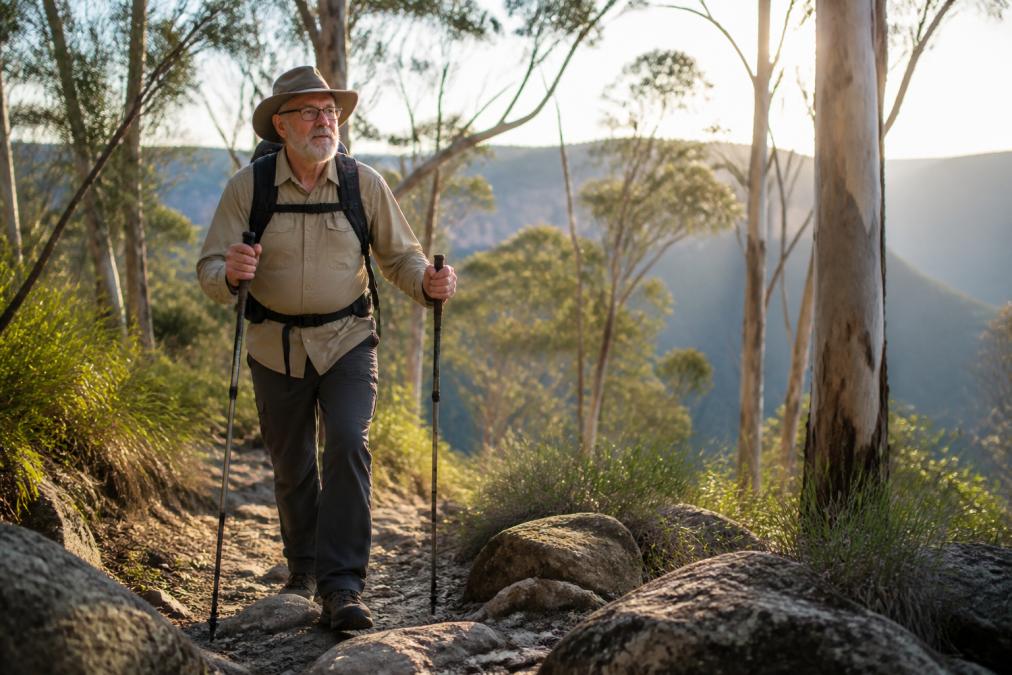
Trekking poles are the single biggest comfort upgrade for most older hikers. Research consistently shows using them on descents can reduce compressive force through the knee by roughly 20-25%, because the poles transfer weight and momentum through your arms rather than your joints. Over thousands of downhill steps, that compounds.
How Poles Actually Reduce Joint Load
When you plant a pole ahead of you on a descent, three things happen:
- Weight redistribution. Your arms take load otherwise absorbed by the quadriceps and patellofemoral joint.
- Balance recovery. A third point of contact turns a slip on loose gravel into a stumble rather than a fall.
- Cadence control. Poles encourage a shorter, more deliberate stride, reducing peak impact per step.
What to Look For
- Adjustable length. Set the pole so your elbow sits at roughly 90 degrees on flat ground. Shorten 5-10cm for climbs, lengthen 5-10cm for descents.
- Locking mechanism. Flip locks adjust faster with cold or stiff hands than twist locks, which can seize if grit gets into the thread, common on dusty inland tracks.
- Grip material. Cork moulds to your hand and stays comfortable when you sweat; foam is lighter and cheaper but less forgiving over a full day.
- Weight. Ultralight carbon saves grams but flexes under load. Aluminium is heavier, more forgiving, and bends rather than shatters on rock.
- Tip and basket. Carbide tips grip rock and hard-packed clay; rubber tips suit paved sections and rock platforms. A small basket stops the tip sinking into sand or soft soil.
If you have wrist or grip issues, a padded strap takes pressure off your hands. Use the strap to carry the load, not your fingers, slide your hand up through the loop from below and rest your palm on top of the grip.
Matching Poles to Australian Trail Surfaces
Different surfaces change what you want from a pole:
- Wet clay in the ranges. Slick and unpredictable, a carbide tip with a moderate basket gives purchase without skating.
- Loose granite scree. A slightly longer pole helps you probe ahead before committing weight.
- Sand and coastal tracks. A wider basket stops the tip sinking; without one, every plant leaks energy.
- Rock platforms and boardwalks. Switch to rubber tips, carbide scars the surface with no advantage on smooth, hard ground.
- Bush scrub with roots. A shorter, quicker pole action beats a long reach when you're stepping over obstacles rather than striding.
A Note on Grip and Hand Comfort
As grip strength declines with age, strap and grip diameter matter more than pole weight. Too thick forces you to squeeze harder; too thin concentrates pressure on a small palm area. Most people find 2-3cm comfortable, if your hands ache after a walk, try a thinner grip or padded strap before blaming the poles. Similar attention to detail regarding your footwear comfort can prevent unnecessary strain, particularly when you switch to no-tie laces to simplify your trail preparation.
Packs, Tents, and Sleep Systems for Comfort
Comfort at camp comes down to three things: how much you carry, how well you sleep, and how easily you get up again. The goal is a pack that carries 8-10kg comfortably rather than 15kg badly.
Choosing the Right Backpack Size and Fit
Most day hikers need 20-30 litres; overnight trips need 40-60. Buy for your longest regular trip, not your biggest ambition.
Weisshorn Instant Up Camping Tent 4-5 →
Fit matters more than capacity:
- Measure torso length from the base of your neck to your hip bones.
- Match it to the pack's adjustable range.
- Load 70% of the weight at hip level, close to your spine.
- Tighten the hip belt first, then shoulder straps, then load lifters.
Hiking Safety Tips for Seniors
Hiking safety for seniors starts with three habits: tell someone your route, carry more water than you think you need, and turn back earlier than you want to. Most trail incidents involve fatigue and dehydration, not dramatic accidents, and the margin for error shrinks with age.
Before You Leave
- Check fire danger ratings. In most states and territories, park closures follow the rating, not the day's weather. A total fire ban means no solid-fuel stoves, no open flames, and often no access to high-risk parks. Check the relevant rural fire service or parks agency website the morning you leave.
- Tell someone your plan. Give them your route, expected return time, and the number to call if you're not back. A text is enough, but be specific: "Doing the Three Falls circuit from the car park, back by 3pm, call 000 if you haven't heard from me by 4pm."
- Carry a personal locator beacon (PLB). If you walk solo or remote, a PLB is the single most important safety item you can carry, mobile coverage drops fast outside towns, and a PLB works where a phone doesn't. In Australia, PLBs must be registered with the Australian Maritime Safety Authority (AMSA); registration is free and tells rescuers who you are and who to contact (Registration information). An unregistered beacon still triggers a response, but wastes time.
- Pack a solar charger. A CHOETECH 14W Solar Charger ($89.95) keeps your phone and beacon charged on multi-day treks. A flat phone is a safety problem, not just an inconvenience.
- Know your turnaround time. Set an alarm on your phone and honour it. Fatigue builds quietly, and the walk out is always longer than the walk in.
On the Trail
- Start early. Avoid midday heat, especially in summer, in arid areas the temperature can climb 15°C between 8am and 2pm.
- Drink before you're thirsty. Thirst is a late, less reliable signal with age. Drink every 20-30 minutes rather than waiting for a break.
- Watch your footing on descents. Most falls happen on the way down, when joints are tired and concentration slips.
- Take breaks before you need them. A five-minute stop every hour keeps legs fresher than a twenty-minute stop when exhausted.
Senior-Specific Emergency Planning
A few things change with age and are worth planning for explicitly:

- Medication. Carry a few days' worth of essentials, not just today's dose, delays happen.
- Medical information. Carry a card or phone note with conditions, medications, and emergency contact. If you're unconscious, that's what rescuers need.
- Communication. A PLB is for life-threatening emergencies; for a twisted ankle or missed turn, a charged phone and known contact usually suffice. Don't rely on either alone.
- Group size. Walking with at least one other person is safer at any age, but matters more when a fall could leave you unable to self-rescue.
Layering Systems and Weather Protection
The layering system keeps you comfortable when conditions change mid-walk. Three layers cover almost everything: a moisture-wicking base, an insulating mid-layer, and a water-resistant outer shell.
- Base layer: polyester or merino. Cotton stays wet and chills you.
- Mid-layer: fleece or a light insulated jacket. This is your warmth.
- Outer shell: windproof and water-resistant. It blocks the weather so the other layers work.
Conclusion
The real challenge for older hikers isn't finding gear, it's finding gear that still works when your knees ache, your hands are cold, and the trail turns rough. Most of the range at Budget Roo is built for exactly that: the Weisshorn pop-up tent pitches in under a minute, the double sleeping bag unzips into a blanket, and the KILIROO table adjusts to three heights so you're not stooping over a camp stove.
Frequently Asked Questions
What are the best hiking shoes for seniors to prevent falls?
Look for boots with deep tread and a firm heel counter. Footwear traction is critical on loose gravel and wet rocks. Features like a wide toe box and cushioning help with stability. The Weisshorn range focuses on durable construction, but always prioritise a secure fit and ankle support when selecting your footwear.
How do trekking poles improve stability for older hikers?
Trekking poles provide two extra points of contact, which significantly improves balance on uneven ground. They reduce the load on your knees and hips, especially on descents. Using poles helps with weight distribution and can prevent falls. Adjust them so your elbows are at a 90-degree angle when standing.
What should a 60-year-old hiker pack for a day trip?
Pack light but include essentials: water, snacks, sun protection, and a basic first-aid kit. A hydration bladder is easier to drink from than bottles. Bring a light rain jacket and a map or GPS. For comfort, consider an inflatable pillow for rest stops. Keep your daypack under 10kg to protect your joints.
How can seniors reduce pack weight for better joint health?
Choose lightweight gear and only bring what you need. Use compression bags to save space. A sleeping bag like the Weisshorn Double Sleeping Bag is lightweight and compact. Look for ultralight options where possible. Every kilogram saved reduces stress on your knees and back during a multi-day trek.
What features should seniors look for in a hiking backpack?
Prioritise a padded hip belt to transfer weight off your shoulders. Look for adjustable straps and a breathable back panel. Multiple compartments help with organisation. An ergonomic design that fits your torso length is essential. Try the pack on before buying to ensure it sits correctly on your hips.