

Table of Contents
- Camping Stove Fuel Types Explained
- Match the Stove to Your Cooking Style
- Key Features That Decide Your Choice
- Camping Stove Safety Tips for Every Trip
- How to Maintain a Camping Stove for Years of Use
- Budget and Value: What to Spend
- Your Final Checklist Before You Buy
- Frequently Asked Questions
Last Updated: September 4, 2026
Choosing the wrong camping stove is the fastest way to ruin a trip. Understanding how to choose camping stove options that match your actual needs comes down to three things: fuel type, cooking style, and the features that matter in the field. This guide from Budget Roo Pty Ltd breaks down the decision so you can buy with confidence the first time.
The market is full of technical jargon like BTU output, canister stoves, and heat exchangers. Most of it distracts from the real question: what will you cook, where, and with whom? A solo hiker needs something radically different from a family caravanning with a full kitchen setup.
Camping Stove Fuel Types Explained
A camping stove is a device that burns a portable fuel source to cook food outdoors. The fuel you choose dictates everything else: weight, cost, cold weather performance, and how easy the stove is to operate.
The three main fuel categories dominate the market, and each suits a different camper. Canister stoves run on pre-pressurised isobutane or propane blends. They screw onto the stove, ignite instantly, and require zero priming. Their weakness shows in cold weather, where the fuel loses pressure and the flame weakens.
Liquid fuel stoves burn white gas or similar fuels from a refillable bottle. They are heavier and need priming before use, but they perform reliably in freezing temperatures and at altitude. Alcohol stoves are the lightest option, burning denatured alcohol quietly with no moving parts, though they boil water slowly and offer little flame adjustment.
For Australian campers, fuel availability matters as much as performance. Gas canisters are easy to find at most outdoor retailers and servos, while specialised liquid fuels may require planning ahead.
The Cold Weather Chemistry Most Guides Ignore
Here is the mechanism behind canister stove failure that most guides skip. The classic canister blend is 70% butane and 30% propane. Butane has a boiling point of approximately -0.5°C (pubchem.ncbi.nlm.nih.gov). When the ambient temperature drops below that, the butane stops vaporising and stays as liquid in liquid in the canister, producing a weak, sputtering flame.
Propane, by contrast, boils at approximately -42°C, so it keeps vaporising in the cold. However, a standard 70/30 mix will start to lose performance noticeably below 0°C and becomes nearly useless at -5°C to -10°C. This is why a stove that roars to life on a 20°C summer evening will barely simmer on a frosty morning in the Victorian High Country.
Three practical mitigations exist for cold-weather canister use:
- Invert the canister. Some stoves, such as the MSR Reactor or the Jetboil MiniMo, allow you to run the canister inverted. This feeds liquid fuel to the burner, which vaporises it before combustion. Inverted operation maintains full power in sub-zero conditions but requires a stove specifically designed for it.
- Keep the canister warm. Sleeping with the canister in your sleeping bag overnight, or placing it in a jacket pocket for 20 minutes before cooking, raises its temperature and restores pressure. A simple foam coozie around the canister base also helps retain heat during use.
- Use a four-season blend. Some manufacturers sell a winter blend with a higher propane ratio, typically 30% to 40%. This performs better in cold but costs more and is less widely stocked in Australian retailers.
Fuel Availability in Australia
Australian fuel availability follows a clear pattern. Isobutane canisters from brands like Gasmate, Primus, and Kovea are stocked at BCF, Anaconda, and most camping stores in capital cities and regional towns. Servos and smaller general stores in remote areas often stock only the universal screw-thread canisters, not proprietary cartridges. Before a trip to a remote area, call ahead to confirm availability, or carry enough fuel for the entire journey.
Liquid white gas is less common. It is typically sold in 1-litre bottles at specialist outdoor retailers rather than general camping stores. Methylated spirits for alcohol stoves is available at hardware stores and some supermarkets, but the denatured formula varies by state, which can affect burn characteristics.
| Fuel Type | Best For | Weight | Cold Weather Performance |
|---|---|---|---|
| Canister (isobutane) | Weekend car camping, quick meals | Light | Weak below 0°C |
| Liquid fuel | Winter trips, high altitude | Heavy | Excellent |
| Alcohol | Ultralight hiking | Very light | Poor, slow boil |
| LPG (large bottle) | Caravanning, family camps | Bulk | Strong, consistent |
Match the Stove to Your Cooking Style
Honest self-assessment beats spec sheets. A solo backpacker who eats freeze-dried food needs a tiny canister stove that boils 500 ml in a few minutes. A family camped for a week wants a two-burner unit that handles a frying pan and a kettle at once.
The common mistake is buying the lightest stove for car camping or the biggest stove for hiking. Think about who cooks and how many people you feed. Car camping and hot-tenting demand a stable base and generous pot support, not pack weight savings.
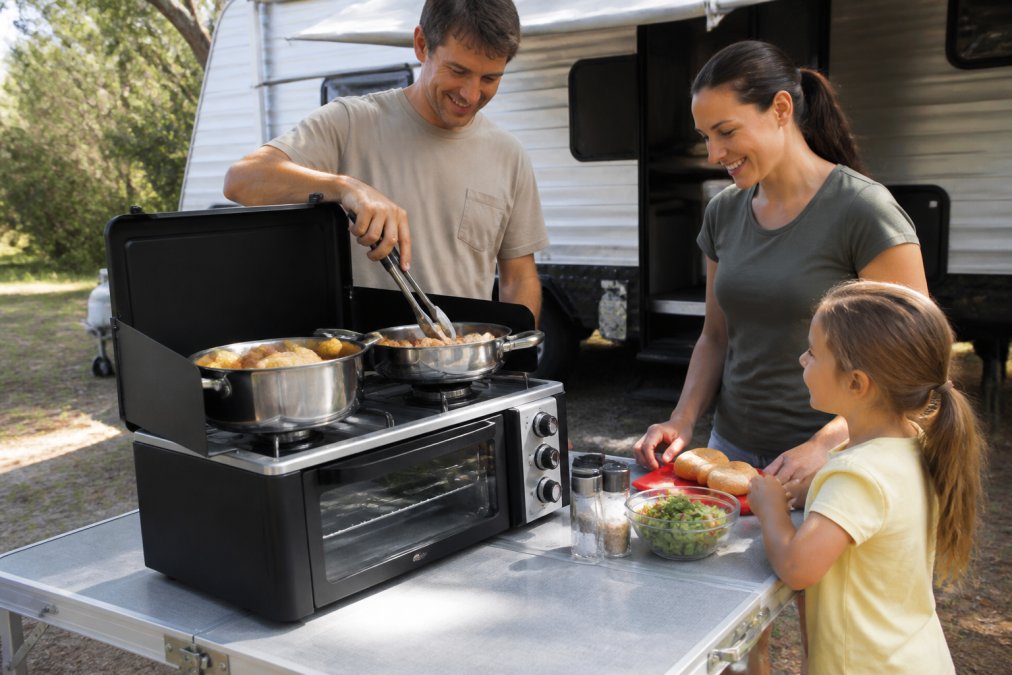
Cooking style also dictates fuel consumption. Slow-cooked stews and baked goods burn through fuel far faster than simple boils. For families who want home-style meals at the campsite, a 2 burner gas camping oven combo offers the versatility to fry, simmer, and bake without juggling multiple devices.

Key Features That Decide Your Choice
Boil Time and Simmer Control
Two numbers tell you most of what you need to know: how fast it boils water and whether the flame adjusts finely enough to simmer. Many stoves that boil quickly have terrible simmer control, with a valve that goes from roaring flame to nothing.
Look for a valve assembly that allows precise flame adjustment. This matters if you cook anything beyond boiled water. A stove that only boils is a kettle with a flame; a stove with real simmer control expands what you can cook outdoors. Integrated canister systems with heat exchangers improve both wind resistance and fuel efficiency, though they add bulk and cost.
Stability, Wind Resistance, and Ignition
A stove that tips over with a full pot is dangerous. Wide pot supports and a low centre of gravity prevent the most common campsite accidents. Test the stability before you buy by placing your largest pan on the burner and giving it a gentle push. coffee for hiking.
Wind is the silent enemy of outdoor cooking. A breeze steals heat and wastes fuel, turning a five-minute boil into fifteen. Many stoves include built-in wind resistance or accept a dedicated windscreen. The piezo igniter removes the need to carry matches or a lighter.
Camping Stove Safety Tips for Every Trip
Safety starts with reading the manufacturer's instructions and following them. The Product Safety Australia guidelines on camping gas appliances outline the standards for regulators, hoses, and gas bottles. Always check for gas leaks by applying soapy water to connections and watching for bubbles before lighting.
Set up your stove on a stable, level, non-flammable surface away from tents, dry grass, and overhanging branches. Never operate a stove inside a tent or enclosed space, as gas appliances produce carbon monoxide. Keep a fire extinguisher or a bucket of water nearby, and know how to shut off the fuel supply quickly in an emergency.
How to Maintain a Camping Stove for Years of Use
A well-maintained stove lasts for decades, while a neglected one fails on its second trip. After each use, allow the stove to cool completely, then wipe down the burners and pot supports to remove food residue and soot. For canister stoves, keep the valve threads clean and free of debris.
Liquid fuel stoves require more attention. The fuel bottle, pump, and generator need periodic cleaning and occasional replacement of o-rings and seals. Clogged jets are the most common field failure. Carrying a spare jet and a cleaning needle lets you fix the problem without ending your trip. Check the Australian Competition and Consumer Commission guidance on gas appliance recalls to see if your model has any active safety notices.
Before every trip, test the stove at home. Light it, check the flame pattern, and confirm the valve adjusts smoothly. A stove that fails in the backyard is an inconvenience; a stove that fails at a remote campsite is an emergency.
Field Repair: Fixing the Three Most Common Failures
Most stove failures in the field are simple to diagnose and fix if you carry the right spares.
Clogged jet. A yellow, lazy flame or a burner that will not light usually means the jet is partially blocked. Remove the jet with a small spanner, hold it up to the light, and look for a blocked orifice. Pass a cleaning needle through the orifice. Do not use a pin or wire that might break off inside. Carry at least one spare jet sized for your stove model.
O-ring leak. If you smell gas at the canister-to-stove connection, the o-ring is likely perished or pinched. Apply soapy water to the connection and watch for bubbles. If bubbles appear, replace the o-ring. Carry a small o-ring kit with assorted sizes. A tiny smear of silicone grease on the o-ring before fitting extends its life and helps create a proper seal.
Pump failure on liquid fuel stoves. A pump that will not pressurise or leaks fuel usually has a worn leather or rubber cup. Most manufacturers sell replacement pump cups that install in under a minute. Carry a spare pump cup and a small tube of pump oil. If the pump fails completely, some stoves can still run by pouring fuel directly into the tank and lighting it with a match, but this is a last resort and requires extreme caution.
The Spare Parts Kit That Saves a Trip
A small repair kit weighs under 100 grams and fits in a pocket. Carry these items on every trip:
- Spare jet sized for your stove
- Cleaning needle or wire
- Assorted o-rings (at least two sizes)
- Small adjustable spanner or multi-tool
- Tube of silicone grease
- Spare pump cup for liquid fuel stoves
When to Retire a Stove
A stove with a cracked burner head, a deformed pot support, or a valve that no longer turns smoothly should be retired. These failures compromise safety and cannot be reliably repaired in the field. Check whether your model is subject to a recall via the ACCC product safety website before each season, and replace any stove that shows signs of structural damage.
Budget and Value: What to Spend
Stove prices span from budget-friendly to serious investments. The right amount to spend depends on how often you camp and what you cook. A casual camper heading out a few times a year does not need the most expensive integrated system. A family that camps monthly will appreciate the durability and cooking power of a premium unit.
The sweet spot for most families is a mid-range two-burner stove that offers even cooking performance across both burners. At Budget Roo Pty Ltd, the THERMOMATE 2 Burner Gas Portable Camping Oven Stove Combo delivers home-style cooking power at $899.00, with two brass burners and a full oven for baking while you cook on the stove. When you consider the cost of takeaways at a holiday park, this kind of unit pays for itself quickly.

For budget-conscious campers who prefer grilling, the Grillz Charcoal BBQ Grill Smoker Portable Barbecue at $67.95 offers a lightweight, foldable option for classic Aussie BBQs without the expense of gas.
Your Final Checklist Before You Buy
Before you commit to a purchase, run through this checklist to confirm you have the right stove for your trips:
- Fuel type: Confirm the fuel is easy to source where you camp.
- Boil time: Check the manufacturer's claimed boil time for a standard pot.
- Simmer control: Test whether the valve allows fine flame adjustment.
- Stability: Place your largest pan on the stove and check for tipping.
- Wind resistance: Assess how the stove performs in breezy conditions.
- Ignition: Confirm the piezo igniter works reliably.
- Pack size and weight: Verify it fits your camping setup and vehicle.
- Maintenance: Know what spares you need and how to clean it.
- Safety: Check for gas leaks and read the safety instructions.
The best camping stove is the one that fits your cooking style, your typical destinations, and your budget. For most Australian families, that means a versatile two-burner gas stove that can boil, fry, and bake without fuss.
Frequently Asked Questions
What factors should I consider when choosing a camp stove?
Start with your cooking style and trip type. For quick boils on solo hikes, a lightweight canister stove is ideal. For family car camping, a two-burner stove with an oven offers more cooking power. Fuel availability, pack weight, boil time, simmer control, and stability are the next key factors. Match the stove size and fuel type to where you camp and how many people you cook for.
Which is better for a portable stove: propane or butane?
In Australia, most portable stoves run on LPG, which is a propane and butane mix. Canister stoves using isobutane-propane blends perform well in most conditions. Pure butane performs poorly below 5°C. For cold weather camping, choose a stove that accepts a propane canister or a liquid fuel stove. Check the fuel type your stove is designed for before buying.
Are liquid fuel stoves better than canister stoves for cold weather?
Yes. Liquid fuel stoves pressurise the fuel before it reaches the burner, so they perform consistently in freezing temperatures. Canister stoves lose pressure as the canister cools, which weakens the flame. If you camp in alpine conditions or winter, a liquid fuel stove is the more dependable choice. They also let you refill from bulk fuel bottles, reducing waste.
How do I maintain my camping stove for longevity?
Clean the burner ports after each trip to prevent blockages. Wipe down the stove body and dry it thoroughly before storage. Check the fuel line and connections for cracks or leaks regularly. For gas stoves, test the seal by applying soapy water to the connection and watching for bubbles. Store the stove in a dry place with the fuel canister detached. Regular servicing helps keep valves working smoothly.
What is the best type of camping stove for family car camping?
A two-burner gas stove with a built-in oven suits family car camping best. It offers the cooking power to boil water, fry food, and bake meals at the campsite. Connect it to a standard 4kg or 9kg LPG bottle for long burn times. Look for sturdy pot supports, wind protection, and easy ignition. This setup replaces most home cooking needs while outdoors.
Choosing the right camping stove comes down to matching the fuel and features to how you actually cook outdoors. Whether you are a weekend car camper or a dedicated caravan cook, the right equipment makes every meal easier and safer. Budget Roo Pty Ltd stocks a curated range of camping stoves and outdoor cooking gear designed for Australian conditions, with even cooking performance and durable construction. Shop the full range today and find the stove that fits your next adventure.
This article was written using GrandRanker