

Table of Contents
- Braided vs Monofilament Fishing Line: What Beginners Need to Know
- How Monofilament and Braided Line Differ
- Braided Fishing Line Pros and Cons
- Monofilament Line: Strengths and Weaknesses
- Best Fishing Line for Beginners
- How to Spool Braid on a Spinning Reel
- Braid to Mono Leader Knot Setup
- Common Beginner Mistakes and How to Fix Them
- Frequently Asked Questions
Last Updated: October 17, 2026
Braided vs Monofilament Fishing Line: What Beginners Need to Know
When you're starting out, choosing between braided and monofilament fishing line feels overwhelming, and understanding the differences between braided vs monofilament fishing line is essential.
At Budget Roo Pty Ltd, we help anglers find gear that matches their fishing style, not just their budget. The right line depends on where you fish, what you're targeting, and what you're willing to learn.
Monofilament is forgiving and cheap. Braided line is sensitive and strong. Neither is universally "better"; context decides everything.
How Monofilament and Braided Line Differ
Monofilament is a single strand of nylon polymer. It's been the standard for decades because it works reliably in most conditions. Braided line, by contrast, is multiple strands of polyethylene woven together. That construction difference creates almost every advantage and disadvantage you'll encounter.
Construction and materials
Monofilament starts as raw polymer pellets melted and extruded into a single continuous filament, producing a smooth, uniform line with consistent diameter. It's simple to manufacture, which keeps costs low.
Braided line requires more steps: manufacturers weave multiple thin polyethylene strands into a single cord, creating a line that's thinner for its strength.
Polyethylene (braid) is slicker and denser than nylon (mono), which is why braided line cuts through water differently and handles so differently on your reel.
Strength and breaking strain
Braided line is significantly stronger than monofilament at the same diameter. A 20-pound braid might have the diameter of 8-pound mono, and thinner line casts further and sinks faster.
Breaking strain tells you the load a line handles before snapping.
The trade-off is complexity. Braided line requires different knots and setup because its slippery surface behaves differently than mono. We'll cover that later.
Stretch and sensitivity differences
Monofilament stretches, so when a fish pulls hard the line gives a little, cushioning the impact and reducing break-offs on light tackle.
Braided line barely stretches, transmitting every movement directly to your rod. That sensitivity is powerful for experienced anglers but overwhelming for beginners who haven't learned to filter signal from noise.
The lack of stretch also means more shock on the hook set, with your rod and reel absorbing the force instead of the line.
Braided Fishing Line Pros and Cons
The downsides are real: braid shows in clear water and spooks fish, requires special knots, costs more, and demands a smooth drag and a rod with enough backbone to handle the lack of stretch.
Common beginner mistakes with braid include using it without a leader, tying knots that slip, and overestimating their ability to handle the sensitivity.
Monofilament Line: Strengths and Weaknesses
Monofilament is the forgiving choice. It stretches to absorb shock and reduce break-offs, it's cheaper, easier to tie knots with, and works on any reel without special setup. Beginners can fish with confidence immediately.
Monofilament also develops memory, holding the coils of your spool and creating loops that tangle, so after a few months it becomes difficult to work with.
Best Fishing Line for Beginners
Start with monofilament. It's the obvious choice for learning because it removes obstacles to success, letting you focus on casting, retrieving, and reading the water instead of fighting your equipment.
But 'start with mono' is only useful if you know what to spool and what reel to pair it with. Here are concrete starting points.
Starter line strengths by situation
For most beginners fishing estuaries, dams, and calm coastal water, a 6-10 lb monofilament mainline covers bream, flathead, bass, and small trevally. If you're chasing larger species such as barramundi, mulloway, or kingfish around structure, step up to 15-20 lb mono or move to 20-30 lb braid with a mono leader.
These are starting points, not rules. Match line strength to the fish you expect and the cover you fish, not the maximum your rod can handle.
Reel pairings that work
A 2500-size spinning reel spooled with 8 lb mono is the classic beginner setup for light estuary and freshwater work. A 4000-size reel with 15-20 lb mono or 20 lb braid suits heavier estuary and inshore saltwater. For bait fishing from shore or a boat, a 4000-6000-size reel with 20-30 lb mono handles most bottom-fishing situations. Match the reel to the rod's line rating, not just the fish.
Example beginner setups
- Estuary bream and flathead: 7 ft light spinning rod, 2500 reel, 8 lb mono mainline, 6-8 lb mono leader, soft plastics and small hardbody lures.
- Freshwater bass and yellowbelly: 7 ft medium spinning rod, 2500-3000 reel, 10 lb braid with 8 lb mono leader, or 10 lb mono for simplicity.
- Inshore saltwater around structure: 7 ft medium-heavy rod, 4000 reel, 20 lb braid with 20 lb mono leader, heavier jigheads and larger lures.
- Bottom fishing with bait: 7 ft medium rod, 4000-6000 reel, 20-30 lb mono, running sinker rig and circle hooks.
Once you've caught fish on mono, landed a few decent-sized ones, and understand how your reel and rod work together, you're ready to experiment with braided line. At that point, the learning curve becomes manageable because you already understand the fundamentals.
Casting distance and line handling
Monofilament casts well on spinning reels, and its thickness forgives loose drag and inconsistent technique. Braid casts further because it's thinner, but demands better technique to avoid tangles and wind knots.
Line handling is where monofilament wins decisively for beginners: it doesn't tangle as easily, doesn't create wind knots from backcasts, and doesn't slice through your fingers if something goes wrong.
Visibility in clear and stained water
Clear water demands invisible line. Braid is visible to fish, especially in shallow, bright conditions, so in gin-clear water a monofilament mainline or fluorocarbon leader becomes essential even with braid.
Stained or murky water is more forgiving because fish rely more on vibration than sight, so braid's visibility matters less and its sensitivity becomes an advantage.
Monofilament sits between these extremes: not invisible, but less obvious than braid. For beginners fishing mixed conditions, mono's compromise works well.
Abrasion resistance around cover
Braided line resists abrasion better than monofilament. If you're fishing around rocks, logs, or vegetation, braid's durability advantage is real. A single piece of sharp cover can fray mono in seconds.
But this advantage only matters if you're actually fishing dense cover. Most beginners fish open water or light cover where abrasion isn't the limiting factor. Don't choose braid just for abrasion resistance if you're not fishing the conditions that demand it.
How to Spool Braid on a Spinning Reel
If you decide to use braided line, spooling it correctly prevents frustration. Braided line slips on smooth reel spools, so you need backing, a layer of monofilament underneath.
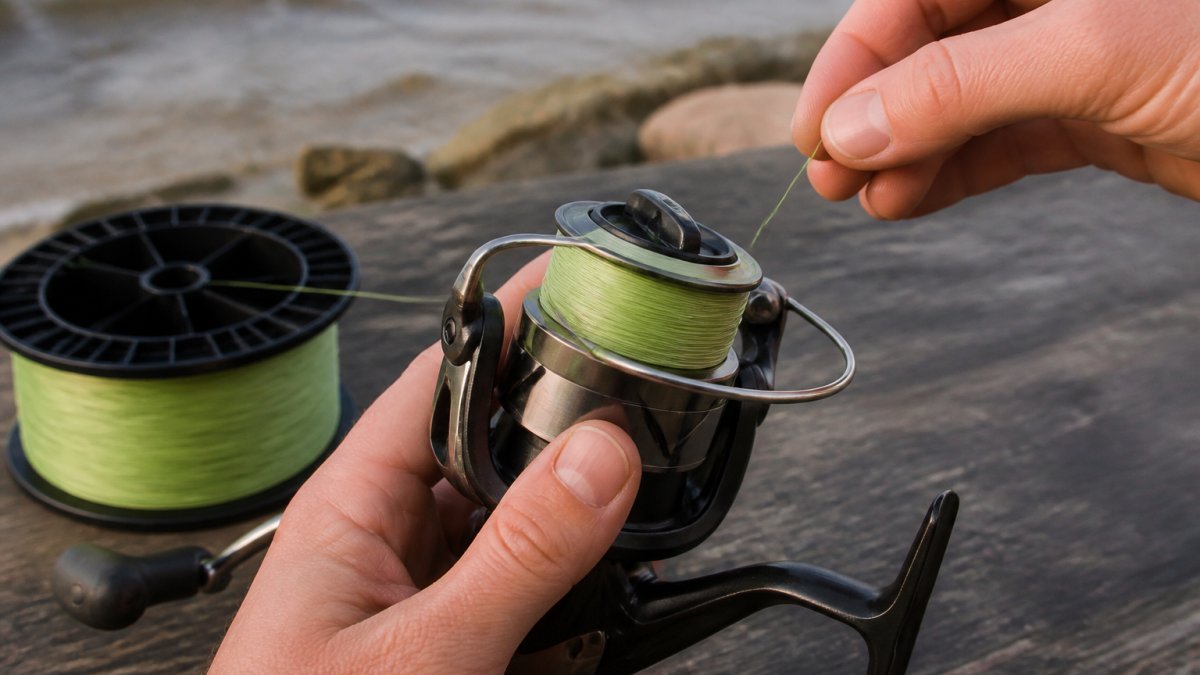
Here's the process:
First, tie monofilament backing to your reel spool using an arbor knot. Fill the spool about one-third full with mono. This gives the braid something to grip.
Next, tie your braided line to the mono backing using a double uni-knot or an improved clinch knot. Wind the braid onto the spool with firm, even tension.
Fill the spool to about 1/8 inch from the rim. Overfilling causes line to slip off during casts. Underfilling reduces casting distance.
Braid to Mono Leader Knot Setup
Using braided line without a leader is a mistake. The leader solves visibility problems and gives you a sacrificial section that takes damage instead of your mainline.
Why use a leader with braided line
A leader serves three purposes. First, it hides the visible braided line from fish in clear water.
Monofilament or fluorocarbon leaders work well. Fluorocarbon is nearly invisible and more abrasion-resistant. Monofilament is cheaper and easier to tie. For beginners, monofilament is the practical choice.
Make your leader 2-3 feet long. This length balances visibility improvement with practicality. Too short and it doesn't hide enough line. Too long and it becomes cumbersome.
Best knots for connecting braid and mono
The double uni-knot is the most reliable connection between braided and monofilament line.
The Albright knot is stronger but more complicated. If you're comfortable with knots, it's worth learning because it's more reliable under extreme loads.
Never use a simple clinch knot to connect braid and mono. The slippery nature of braid causes it to slip through standard knots. You'll lose fish and lures to knot failure.
Common Beginner Mistakes and How to Fix Them
Most beginner problems stem from choosing the wrong line or using it incorrectly.
Mistake: Using braided line without a leader. Fish see the bright line and refuse to bite in clear water.
Mistake: Overfilling your spool with braided line. Line slips off during casts, creating tangles and reducing distance.
Mistake: Assuming one line type works everywhere. The best anglers match their line to conditions.
Wind knots, line twist, and digging in
Wind knots appear when loose line loops off the spool and wraps around itself, usually from overfilling, closing the bail by hand incorrectly, or casting into wind with light lures. Fix by filling to the correct level, closing the bail manually, and checking the line for loops after each cast. Line twist comes from reeling against a slipping drag or using a lure that spins; a swivel or a better drag setting reduces it.
Hook-setting and landing fish with low-stretch line
Braid's lack of stretch means the hook set transfers almost instantly. Beginners often strike too hard and tear the hook hold or snap light leaders. Use a shorter, sharper strike and let the rod load rather than swinging for the fences. With mono, the stretch cushions the strike, so a slightly firmer sweep is fine. When landing fish, braid demands a smoother drag because there's no line stretch to absorb last-second runs.
A quick decision guide by scenario
- Shallow, clear water, light lures: mono mainline or braid with a longer mono leader.
- Deep water or strong current: braid for sink rate and sensitivity.
- Heavy cover, rocks, or timber: braid mainline with a heavier mono leader.
- Bait fishing from shore or boat: mono mainline for forgiveness and stretch.
- Learning to cast and tie knots: mono first, then braid once comfortable.
Frequently Asked Questions
Should beginners use braided or monofilament fishing line?
Monofilament is generally better for beginners. It's forgiving on casting, creates less line twist, costs less, and works well with standard spinning reels straight out of the box. Braided line requires more setup knowledge, including backing and leader knots, but offers superior sensitivity and casting distance once you master it. Start with mono to build fundamentals, then experiment with braid as you progress.
Is 20lb braided line stronger than 20lb monofilament?
Yes. Braided line at 20lb breaking strain is significantly thinner and stronger in practice than 20lb mono. The pound test refers to breaking strain, but braid's tighter construction means 20lb braid feels more like 30lb mono in real-world use. This is why many anglers downsize braid diameter; 10lb braid often performs like 15-20lb mono while remaining thin enough for longer casts.
Do you need a leader when using braided fishing line?
Yes, a leader is recommended. Braided line's high visibility can spook fish in clear water, and its lack of stretch means sudden jerks can break the line. A 0.3-0.5 metre fluorocarbon or mono leader hides the braid from fish and absorbs shock. Use an Albright knot or Uni knot to connect braid to leader. In murky water, a leader is less critical but still improves durability around snags and vegetation.
Which fishing line is easier to tie and manage for beginners?
Monofilament is easier. It ties standard knots reliably, resists wind knots better, and doesn't require backing or leader setup. Braided line demands more knot knowledge, spools awkwardly without backing, and creates wind knots if your reel tension is loose. Once you learn braid's quirks, especially the Arbor knot and backing technique, it becomes manageable, but mono gets you fishing faster with fewer complications.
Choosing between braided and monofilament line doesn't have to be complicated. Start with monofilament, learn the fundamentals, then experiment with braid once you understand what you're doing. Budget Roo Pty Ltd stocks both options with the backing, knots, and reels you need to set up correctly. The right gear makes learning faster and more enjoyable, and that's what fishing should be.