

Table of Contents
- Affordable Camping Gear vs Expensive Brands: The Quick Comparison
- The Camping Gear Essentials Checklist: What Actually Matters
- Where Budget Gear Wins: Real Specs, Real Prices
- When to Invest in Premium Camping Gear (And When Not To)
- How to Maintain Camping Equipment So It Lasts
- Cost-Per-Use and Repairability: The Numbers Brands Don't Show You
- Common Mistakes When Buying Affordable Camping Gear
- Conclusion: Buy for the Trip You Actually Take
- Frequently Asked Questions
Last Updated: September 20, 2026
Affordable Camping Gear vs Expensive Brands: The Quick Comparison
Affordable camping gear vs expensive brands is really a question about where your money buys a measurable difference and where it buys a logo. At Budget Roo, we sell budget gear every day, so we will not pretend a $900 fridge and a $1,400 fridge are the same object. What we will tell you is that the gap is narrower than the price tags suggest, and it is widest in exactly the places the marketing never mentions.
Here is the short version: spend on anything that keeps you dry, warm, or safe. Save on anything that only makes the trip more comfortable. That single rule decides most purchases, and it is the throughline for everything below.
| Category | Spend or Save | Why |
|---|---|---|
| Shelter and sleeping | Spend | Weather protection and warmth are non-negotiable |
| Cooking and cooling | Mixed | Buy on specs, not brand |
| Seating, tables, lighting | Save | Comfort items, easy to replace |
| Safety gear | Spend | Failure has real consequences |
Below, we break down where budget gear genuinely wins, when premium is worth it, and how to make cheap gear last.
The Camping Gear Essentials Checklist: What Actually Matters
A camping gear essentials checklist should separate the items you cannot do without from the items you merely want, because that distinction is what protects your budget. Most guides sort gear by category, shelter, cooking, sleeping, which tells you nothing about where to spend. A more useful sort is by consequence of failure.
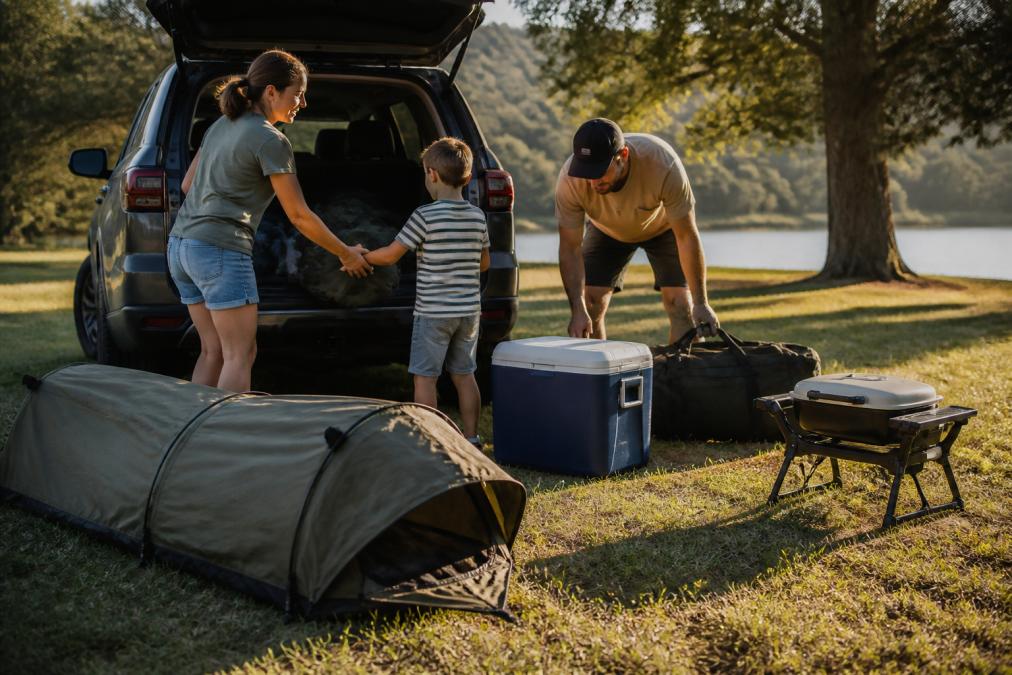
Safety-critical: shelter, sleeping insulation, first aid, navigation, and anything that keeps you warm in a cold snap. These are the items you cannot afford to have fail. A tent that wets out in sustained rain, or a sleeping bag rated for the wrong temperature, turns a weekend into an emergency. There is no budget version of a dry night.
Trip-critical: cooking, water storage, and cooling. You can improvise, but a failed fridge ruins a week of food and a failed stove means cold dinners. These items justify mid-range spending because the cost of failure is high but not dangerous.
Comfort: chairs, tables, lighting, and camp kitchen extras. Nice to have, never essential. A $90 camp chair and a $400 camp chair both fold, both hold a person, and both get left in the shed between trips.
The Australian Competition and Consumer Commission product safety guidance is worth a read if you are buying anything that burns fuel or holds pressure, because safety standards are not optional extras. For the rest, buy the cheapest item that meets the spec you actually need.
A simple test before any purchase: ask what happens when the item fails mid-trip. If the answer is "the trip is over", buy the better version. If the answer is "we sit on the ground", buy the cheap one.
Where Budget Gear Wins: Real Specs, Real Prices
Budget gear wins wherever the specification is simple and the brand premium is pure marketing. Look at the numbers rather than the badge.
The Grillz Charcoal BBQ Grill costs $67.95 and weighs 2.7kg, with a stainless steel grill rack, a steel body, foldable legs, and a removable ashtray. A premium folding grill does the same job for several times the price. The difference is finish quality, not cooking ability.

The Weisshorn Instant Up Camping Tent is $216.95, sleeps four to five, uses heavy-duty 190T polyester with a 3000mm PU coating, and pops up in about a second. That waterproof rating is the number that matters, and it is printed on the box, not hidden behind a brand story.
The Glacio Camping 80L Portable Fridge is $749.95, runs a 50W compressor, holds temperatures from -5°C to +5°C, and draws about 1.2kWh over 24 hours. Compare that to a premium fridge drawing similar power and you are paying for trim, not cooling.
When to Invest in Premium Camping Gear (And When Not To)
Invest in premium camping gear when the item is safety-critical, when you use it more than a handful of times a year, or when a failure would end the trip. Everything else can wait.
The honest answer to "when should I spend more" is narrower than most guides admit. Premium earns its price in three situations:
- High-frequency use. Fifty nights a year wears gear in ways ten nights never will.
- Extreme conditions. Sub-zero nights and sustained rain expose weak stitching and thin coatings.
- Safety-critical items. Ropes, harnesses, and fuel systems are not places to save.
Where premium rarely pays off is in comfort gear. A $400 camp chair folds no flatter than a $90 one, and it still gets left in the shed.
Glacio 100L Portable Fridge Bar Freezer →
How to Maintain Camping Equipment So It Lasts
Maintaining camping equipment properly is the cheapest upgrade you will ever make, and it costs nothing but an afternoon. Most gear failure is storage failure, not manufacturing failure.
Canvas swags and tents should be completely dry before they go away. Pack a damp swag and you will find mildew within a week, and mildew eats the waterproof coating from the inside. The Weisshorn Swag uses 380gsm ripstop canvas with a 500gsm PVC floor, and that floor is the part that suffers most from being stored wet.
A short maintenance routine covers most of it:
- Air and dry all canvas and fabric after every trip
- Wipe down fridge seals and leave the door ajar in storage
- Check zips for grit and clear them with a soft brush
- Re-tension guy ropes and inspect pegs for bends
- Store fuel-burning gear empty and ventilated
The Australian government guidance on safe storage of flammable liquids is a useful reference if you keep fuel canisters between trips.
Cost-Per-Use and Repairability: The Numbers Brands Don't Show You
Cost-per-use is the only price comparison that matters, and almost no brand publishes it. Divide the purchase price by the number of nights you will realistically use the item, then add the repair cost. That second half is where the real gap between budget and premium gear shows up.
A swag bought for $383.95 and used twenty nights a year for five years works out to under four dollars a night. A premium swag at three times the price needs three times the nights to justify itself, and most casual campers never get there. But the calculation changes once you add repairs.
Total cost of ownership over five years is the number to run before you buy.
Run the five-year sum, not the shelf price. That is the comparison brands avoid publishing.
Common Mistakes When Buying Affordable Camping Gear
Three errors show up again and again:
Buying on headline price alone. A $40 tent and a $216.95 tent are not the same product. Check the waterproof rating, the floor material, and the pole type before you compare numbers.
Conclusion: Buy for the Trip You Actually Take
The challenge with affordable camping gear vs expensive brands is that the internet rewards extremes. You get told to buy once and cry once, or to buy cheap and replace often. Neither fits the camper who goes out six weekends a year.
Frequently Asked Questions
Is expensive camping gear actually better quality?
Not automatically. Price often reflects brand marketing, distribution and retail margins rather than better materials. The specs that matter are measurable: denier fabric, waterproof rating, seam sealing, compressor efficiency and warranty coverage. A 380gsm ripstop canvas swag with 500gsm PVC flooring and a 70mm mattress does the same job as a premium equivalent at a fraction of the price. Compare specifications line by line before assuming a higher price means better camping gear.
Which camping items should you never buy cheap?
Treat anything safety-critical or load-bearing as a priority spend: tent poles and pegs, stove fittings and gas connections, and tie-down straps for roof loads. Comfort items such as chairs, tables and lighting can safely be budget buys. A practical middle ground is to spend on structure and save on convenience. For example, a 190T polyester PU3000mm tent with a strong steel frame covers weather resistance without premium pricing.
How can I find reliable camping gear on a budget?
Start with a camping gear essentials checklist and buy only what your trip needs. Check the technical specifications rather than the marketing copy: waterproof ratings, fabric weight in gsm or denier, power draw and temperature range. A 100L portable fridge freezer with a 72W compressor and auto low battery protection delivers the same core function as higher-priced units. Cost-per-use matters more than sticker price for gear you will use repeatedly.
Is it worth buying second-hand camping equipment?
Sometimes, but inspect carefully. Canvas, zippers, seams and compressor seals degrade with use, and a second-hand tent with failing seam sealing will leak on the first wet trip. Second-hand works best for hard goods such as steel frames, cast iron cookware and aluminium poles. For soft goods, buy new so you know the waterproofing and warranty history. Repair and maintenance costs on worn canvas often exceed the savings.
How do I maintain camping equipment so it lasts longer?
Dry canvas and tents fully before storage to prevent mildew, and re-proof seams annually with a suitable sealant. Wipe down steel frames and BBQ bodies after each trip to stop rust, and empty the removable ashtray on a folding grill. For portable fridges, keep vents clear and check the auto cut-off voltage is working. Simple maintenance routines routinely double the working life of budget camping gear.