

Table of Contents
- Portable camping fridge vs esky: which makes sense for weekend trips
- Temperature control and food safety: what actually matters
- 12V camping fridge power consumption and battery drain
- How to power a camping fridge without a dual battery system
- Capacity, weight and portability for casual campers
- Cost-benefit analysis: when a portable fridge pays for itself
- Durability and long-term value for the money
- Frequently Asked Questions
Last Updated: September 25, 2026
Portable camping fridge vs esky: which makes sense for weekend trips
A portable camping fridge isn't always the better choice. For monthly campers, a compressor fridge pays for itself through convenience and food safety. For occasional campers, an esky remains simpler and cheaper.
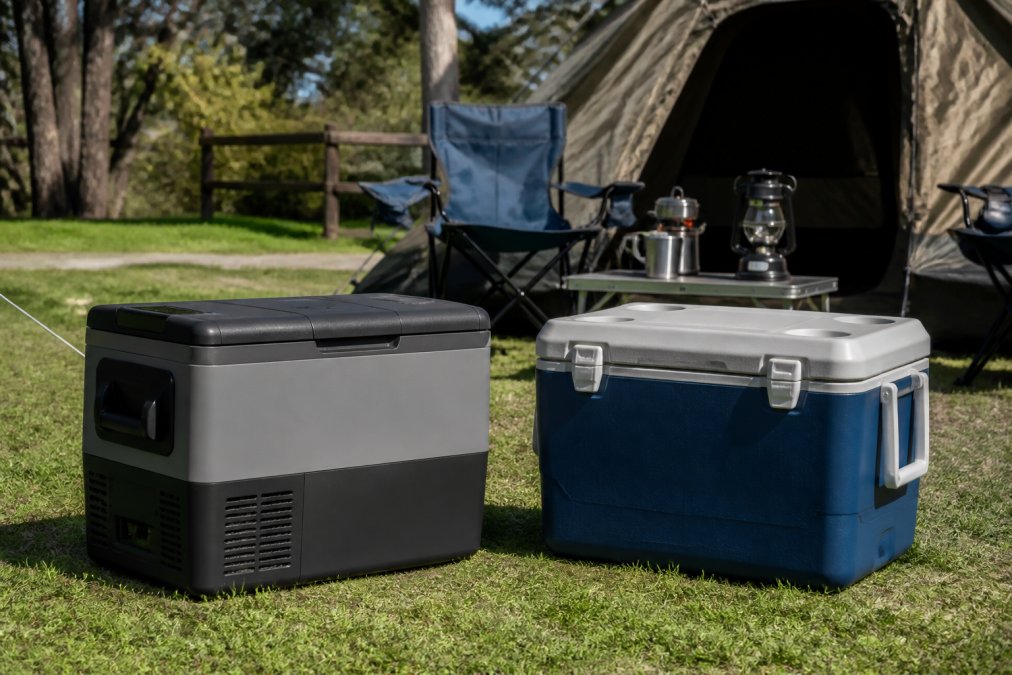
An esky relies on ice that melts over time; a compressor fridge maintains consistent temperature using 12V or 240V power. An esky costs $50-$150 and keeps food cold for 2-3 days with ice. A portable camping fridge starts around $408.95 and keeps food at precise temperatures indefinitely.
Budget Roo Pty Ltd stocks Glacio compressor fridges from 35-litre ($616.95) to 100-litre ($933.95), each with a 3-stage battery protection system to prevent vehicle battery drain.
The real question is which fits your trip frequency and power setup. Annual trips? An esky works fine. Monthly trips with adequate vehicle power? A portable camping fridge becomes practical.
Temperature control and food safety: what actually matters
A compressor fridge's biggest advantage is consistent temperature control. Food safety requires keeping perishables below 4°C; an esky with melting ice drifts upward throughout the day, especially in warm weather.
A portable camping fridge maintains a set temperature range. Glacio models allow temperatures between -20°C and 10°C, with some models enabling separate compartment temperatures, eliminating ice management guesswork.
On a 30°C day, an esky's ice melts faster, risking spoilage. A compressor fridge maintains temperature but consumes more power, a trade-off between food safety and energy use.
Melting ice in an esky creates condensation and pooling water, breeding bacteria and soaking food. A portable fridge's sealed compartments prevent this; the difference is noticeable after 48 hours.
12V camping fridge power consumption and battery drain
A Glacio 50L fridge with a 60W compressor uses approximately 1.44 kWh per 24 hours. These figures are manageable with a deep-cycle auxiliary battery, but dangerous on a standard starter battery.

A 60W compressor fridge draws roughly 5 amps at 12V, 120 amp-hours over 24 hours, exceeding most starter batteries' safe capacity and risking a dead engine battery.
Without a dual-battery system, you must run the fridge only when the engine is on, use a portable power station, or accept jump-starts, none ideal for weekend trips.
Glacio fridges include 3-stage battery protection, but a standard car battery cannot sustain a compressor fridge for 48 hours.
How to power a camping fridge without a dual battery system
If you're unwilling or unable to install a dual battery, four practical workarounds exist, but each has hidden costs that deserve scrutiny.
Run the fridge while driving. Pre-cool before arriving at camp, then run only during travel days. This works for road trips but fails for stationary camps: a 60W fridge draws 5 amps at 12V, giving a standard 50 amp-hour battery only 5 hours of runtime. This only works if you're driving 4-6 hours daily.
Use a portable power station. A 1000Wh station ($800-$1,000) paired with a 50L fridge ($400) costs $1,200-$1,400 upfront and runs the fridge roughly 24 hours. Recharge takes 8-12 hours, requiring a full day at home between trips. Back-to-back weekends require two stations, doubling costs.
Add solar panels. A 100W panel ($300-$600) plus controller ($50-$150) offsets fridge consumption on sunny days but drops to 20-30W output on overcast days, still draining your battery. This is weather-dependent and least reliable for consistent trips.
Glacio 50L Portable Fridge Freezer →
Accept ice as a backup. Keep a small esky in your vehicle; use it on night two while the fridge runs 12 hours on night one. A 60W fridge running 12 hours draws 60 amp-hours, manageable if you run the engine 2-3 hours daily. Cost: $80-$150 for esky plus $10-$15 per trip for ice ($200-$330 yearly), avoiding $800-$2,000 dual-battery installation.
Without auxiliary power, a portable camping fridge is inconvenient for weekend trips. True cost of ownership is $1,200-$2,600 (fridge plus power station or dual-battery system). You need 15-20 camping trips yearly to break even against ice costs. This significant investment in gear often serves as the first step toward upgrading camping comfort, a pursuit that extends to evaluating whether high-end sleeping surfaces are worth it.
Capacity, weight and portability for casual campers
A portable camping fridge's weight, size, noise level, and environmental footprint all matter for casual campers.
The 35L Glacio weighs 18 kg; the 100L weighs 35 kg. An esky weighs 3-5 kg. Two adults for two nights need 15-20 litres of cooled storage. A 35L or 40L fridge provides comfortable margin; 50L+ models are overkill for weekend trips.

Weight matters if you're loading frequently. A 35kg fridge in a vehicle is fine; carrying it into a campervan or tent is impractical.
Dimensions also matter. A 100L upright fridge occupies floor space, roughly 45cm wide, 46cm deep, 100cm tall. In a small campervan or vehicle with limited storage, this is a genuine constraint. A compact 35L model at 65cm × 37cm × 41cm is more flexible.
Compressor fridges operate at 40-50 decibels, roughly a quiet office. On a silent campsite at night, that hum is noticeable and can disrupt light sleepers.
Rotary compressors run quieter than reciprocating types. In quiet campgrounds, 50dB is audible; 40dB is barely noticeable.
Practical capacity guide for weekend trips:
| Capacity | Weight | Best For | Noise Level | Trade-off |
|---|---|---|---|---|
| 35L | ~18kg | Couples, 2 nights | 40-42dB | Tight for families |
| 40L | ~19kg | Couples, 2-3 nights | 40-42dB | Minimal size gain |
| 50L | ~22kg | Families, 3 nights | 42-45dB | Heavier, less portable |
| 60L | ~24kg | Families, 4+ nights | 42-45dB | Noticeably bulky |
| 100L | ~35kg | Extended trips | 45-50dB | Requires vehicle space |
Cost-benefit analysis: when a portable fridge pays for itself
A portable camping fridge is a long-term investment that only makes financial sense if you camp regularly. The calculation is straightforward.
Durability and long-term value for the money
A quality compressor fridge like the Glacio models is built to last 5-10 years with proper maintenance. The heavy-duty exterior handles rough camping conditions, bumps, vibrations, temperature swings, better than an esky, which can crack or lose seal integrity over time.
Frequently Asked Questions
Is a portable camping fridge worth it for short weekend trips?
For weekend trips, the answer depends on frequency and trip length. If you camp most weekends, a portable camping fridge pays for itself within a season through reduced ice purchases and better food safety. For occasional trips (fewer than four per year), an esky remains more economical. A compressor fridge like the Glacio 50L ($408.95) offers consistent temperature control that keeps perishables safe longer, whereas ice melts unpredictably. Calculate your annual ice costs and compare to fridge depreciation over 5 years.
How long will a portable camping fridge run off a 12V battery?
A 12V camping fridge's runtime depends on battery capacity and fridge power draw. The Glacio 50L uses 1.44kWh per 24 hours (60W compressor), which equals roughly 120 amp-hours daily at 12V. A standard vehicle battery (60Ah) would drain completely in about 12 hours of continuous running. However, fridges cycle on and off, so actual runtime extends to 24-36 hours before your vehicle battery reaches unsafe discharge levels. A deep-cycle auxiliary battery (100Ah+) is recommended for reliable weekend operation without risking vehicle battery failure.
Do I need a dual battery system to run a camping fridge?
Not necessarily. A single deep-cycle battery (100Ah minimum) can power a portable fridge for 2-3 days of weekend camping. Many weekend campers use a portable power station (2000W+) charged at home before departure instead. The Glacio fridges include 3-stage battery protection that stops charging at a safe voltage, preventing damage to your vehicle battery if you're running off a standard car battery. For frequent trips or longer expeditions, dual batteries make sense; for occasional weekends, one quality deep-cycle battery or a portable power station works fine.
What are the main advantages of a compressor fridge over an esky?
Compressor fridges maintain consistent temperatures (0-10°C for fridge mode) regardless of ambient heat, whereas esky temperatures rise as ice melts. A portable camping fridge eliminates ice runs, reduces food spoilage, and frees space that ice would occupy. Some Glacio models offer dual-zone temperature control, so you can freeze items in one section and refrigerate in another. Compressor fridges also consume less energy per day than you'd spend replacing melted ice weekly. The trade-off is upfront cost and power dependency, but for regular campers, the convenience and food safety justify the investment.
How much does it cost to run a portable camping fridge on mains power?
Running a portable camping fridge on 240V mains power is very cheap. The Glacio 50L draws 60W, consuming about 1.44kWh per 24 hours. At an average Australian electricity rate of 30 cents per kWh, that's roughly 43 cents per day. Over a weekend trip (two nights), mains operation costs less than one dollar. This makes caravan parks with powered sites ideal for portable fridge users. Even off-grid, the compressor fridge's energy efficiency (comparable to a conventional fan) means a modest solar setup can keep it running indefinitely during daylight hours.