

Last Updated: October 29, 2026
Quick Summary
Effective caravan security in Australia comes from layers, not one device: a hitch lock and wheel clamp stop movement, an alarm with remote alerts adds noise and detection, and a GPS tracker handles recovery. Start with physical deterrents, then detection, then recovery, and check fit and compatibility before buying.
- A hitch lock and wheel clamp defeat the two most common theft methods: towing and rolling.
- Choose a hardened steel clamp with a shielded, drill-resistant lock cylinder and a snug fit.
- Add up three years of tracker subscription cost, not just the device price.
- Pick an alarm with adjustable sensitivity and combined motion and entry detection to avoid false alarms.
- Immobilisers and hardwired alarms are best fitted by an auto electrician.
Table of Contents
- Why Caravan Security Deserves a Proper Budget
- The Layers of a Caravan Security Setup
- Caravan Wheel Clamp Reviews: What Separates a Good One From a Bad One
- Caravan GPS Tracker Options and What They Really Cost
- Choosing a Caravan Alarm System That Won't Cry Wolf
- Caravan Security Cameras: Useful or Overkill?
- Compatibility, Installation and Privacy Trade-offs
- Building Your Security Kit at Budget Roo
- Frequently Asked Questions
Why Caravan Security Deserves a Proper Budget
Caravan security devices in Australia are not a niche purchase for the paranoid. They are a practical response to a real risk, and most owners underinvest in them until something goes wrong.
Here is the uncomfortable truth. A caravan parked in a storage yard or on a suburban street is a slow, obvious, high-value target.
The good news is that caravan security is not about one magic device. It is about layers. A thief who defeats a hitch lock still has to deal with a wheel clamp, then an alarm, then a tracker.
Below, we break down what actually works, what is worth the money, and where owners waste it. We will cover physical deterrents, alarms, trackers, cameras, and the compatibility and privacy questions most reviews skip.
The Layers of a Caravan Security Setup
A caravan security system works best as a stack of independent layers, not a single product. The principle is simple: if one layer fails, the next one still slows the thief down. Physical deterrents stop or delay movement. Alarms and sensors create noise and attention.
A quality hitch lock is excellent, but it does nothing once a determined thief decides to drag the van onto a flatbed. A tracker is useless if the thief finds and removes it before the owner reacts. Layers cover each other's blind spots.
Physical Deterrents: Hitch Locks and Wheel Clamps
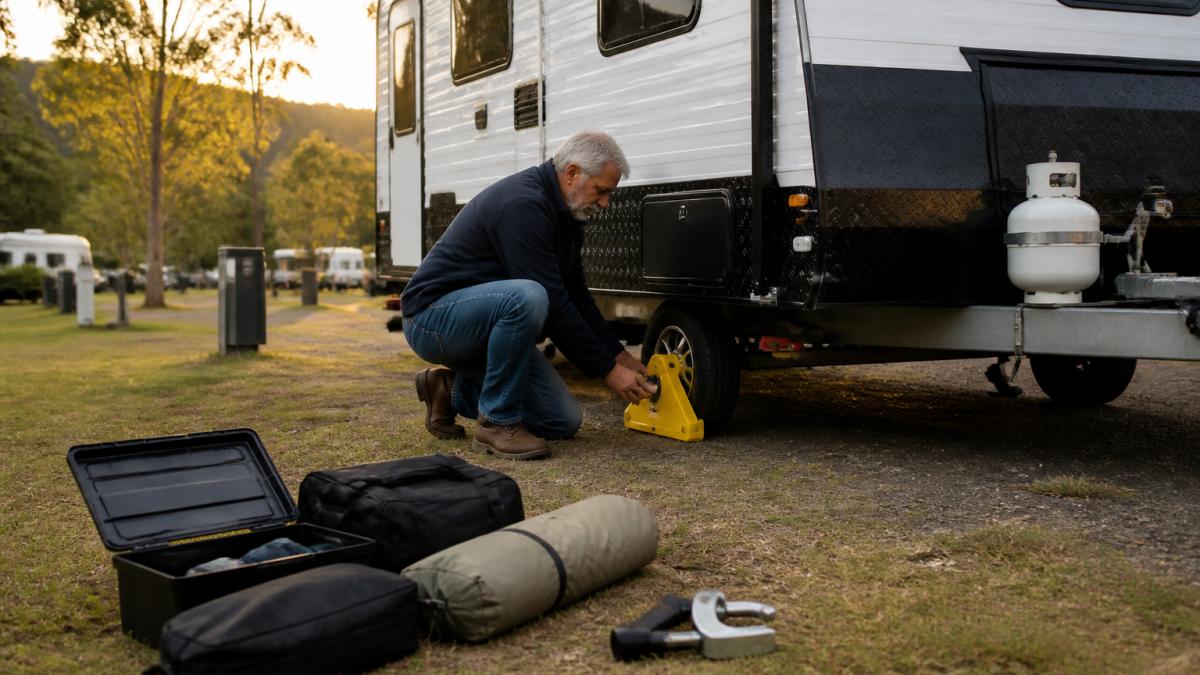
Physical deterrents are the first and most cost-effective layer. A hitch lock secures the coupling so the van cannot be hitched to a tow vehicle. A wheel clamp locks a wheel so the van cannot be rolled. Together they defeat the two most common theft methods: towing it away and rolling it away.
A loose lock can be pried or drilled. Look for a hardened steel construction, a close fit to the coupling, and a lock cylinder that resists drilling. A wheel clamp should cover the wheel nut and be sized to your wheel, not a universal fit that rattles.
Alarms, Immobilisers and Detection Sensors
Alarms and immobilisers add the noise and delay layer. A caravan alarm system typically combines a siren with door, window and motion sensors. An immobiliser goes further by preventing the van from being towed or driven, often through a brake immobilisation system that locks the wheels electronically.
Detection sensors matter just as much. Motion detection, intrusion sensors and towing detection catch the moment someone tries to move or enter the van. The best systems send a remote alert to your phone, so you know something is happening even when you are away from the van.
Caravan Wheel Clamp Reviews: What Separates a Good One From a Bad One
A good caravan wheel clamp is one that fits your wheel snugly, resists cutting and drilling, and cannot be removed without the key. A bad one is a universal clamp that wobbles, uses soft metal, or has a lock that a screwdriver defeats in seconds.
When you read caravan wheel clamp reviews, ignore the star rating alone and look for these signals:
- Fit: Does the reviewer confirm it fits their wheel size, or complain it is loose?
- Build: Hardened steel and a shielded lock cylinder are the markers of a serious clamp.
- Lock quality: A pick-resistant, drill-resistant cylinder is the difference between a deterrent and a decoration.
- Weight and bulk: Heavier clamps are harder to cut but harder to store. Balance matters.
- Long-term reliability: Reviews that mention rust, seized locks or failed keys after a season are a warning.
Look for owners who report how the clamp performed through dust, salt air and winter storage. A clamp that locks solidly on day one but seizes after a wet season is a liability. Investing in high quality locks remains the most reliable way to ensure that your security hardware functions reliably under the same environmental pressures that degrade lesser components.
Check the clamp against your actual wheel before you buy, and store it somewhere dry so the lock does not seize.
| Specification | What to look for | Why it matters |
|---|---|---|
| Fit | Snug to your wheel size and offset | A loose clamp can be pried |
| Material | Hardened steel | Resists cutting and drilling |
| Lock | Shielded, drill-resistant cylinder | Defeats quick attacks |
| Finish | Powder-coated or rust-treated | Survives wet storage |
| Keys | Spare key available | Avoids cutting the clamp off |
| Weight | Heavy enough to resist, light enough to store | Practical daily use |
Caravan GPS Tracker Options and What They Really Cost
A caravan GPS tracker is the recovery layer.
Cost has two parts: the device and the ongoing subscription. The device price is a one-off, but most trackers need a data plan or monitoring subscription to work, and that recurring cost is what owners forget. A cheap tracker with an expensive plan can cost more over three years than a pricier unit with a modest plan.
Connectivity is the next trade-off. Most trackers rely on mobile coverage, so check the coverage map for the areas you tour. A tracker that only works near cities is little help on an outback trip.
Privacy matters too. Trackers collect location and movement data, and that data lives with the provider. Read the privacy terms, check where data is stored, and prefer providers with clear policies.
Watch out: a tracker hidden in an obvious spot is the first thing a thief removes. Mount it somewhere concealed and hard to reach, and test that it still reports after installation.
| Tracker type | What it does | Best for | Main trade-off |
|---|---|---|---|
| Basic on-demand | Reports location when queried | Low-cost recovery layer | No live alerts |
| Movement-detection | Alerts when the van moves | Storage and street parking | Subscription cost |
| Geofenced | Alerts when the van leaves a set area | Touring and remote storage | Setup complexity |
| Cellular camera combo | Records and tracks | Unattended storage | Data cost and privacy |
Choosing a Caravan Alarm System That Won't Cry Wolf
The best caravan alarm system is the one that alerts you to a real threat and stays quiet otherwise. False alarms are the fastest way to make an alarm useless, because owners start ignoring it, and neighbours stop caring.
Look for adjustable sensitivity, so you can tune out wind and passing traffic. Prefer sensors that combine motion and entry detection rather than a single trigger that fires on any vibration.
A common mistake is buying the loudest siren and ignoring the detection logic. Noise without accuracy is just annoyance. The right setup gives you a clear, reliable alert and a siren loud enough to draw attention, without firing every time a gust hits the van.
Caravan Security Cameras: Useful or Overkill?
Caravan security cameras are useful, but they are the layer most owners overbuy. A camera does not stop a thief. It records, deters a little, and gives you evidence. For some owners that is exactly what they need. For others, it is money better spent on a better clamp or tracker.
Cameras earn their place when the van is stored somewhere you cannot easily check, or when you want a record of activity around it. They are less useful for a van kept at home where you can see it.
Privacy matters too. A camera pointed at a neighbour's property or a shared storage area can create friction. Point it at your own van and entry points, and check the storage facility's rules before mounting anything.
Compatibility, Installation and Privacy Trade-offs
Compatibility and installation are where good intentions fall apart. A hitch lock must match your coupling type. A wheel clamp must match your wheel size and offset.
Installation is the other half. Some devices are simple bolt-on jobs an owner can fit in minutes. Others, especially immobilisers and hardwired alarms, are best fitted by an auto electrician. Getting this wrong can void a warranty or leave a device that does not work when it matters.
Privacy is the trade-off nobody mentions. Trackers and cellular cameras collect location and movement data, and that data lives with the provider. Read the privacy terms, check where data is stored, and prefer providers with clear policies.
| Device | What it does | Best for | Main trade-off |
|---|---|---|---|
| Hitch lock | Secures the coupling | Every van, first purchase | Does not stop flatbed theft |
| Wheel clamp | Locks a wheel | Storage and street parking | Bulk and storage |
| Alarm system | Noise and alerts | Deterrence and notification | False alarms if poorly tuned |
| GPS tracker | Location and recovery | Remote and high-risk storage | Subscription cost |
| Immobiliser | Prevents towing or driving | High-value vans | Professional installation |
| Security camera | Records and deters | Unattended storage | Connectivity and privacy |
Building Your Security Kit at Budget Roo
Start with the layers that stop movement, then add detection, then add recovery. That order gets you the most protection for the least money. A hitch lock and a wheel clamp come first. An alarm with remote alerts comes next. A tracker and camera come last, once the basics are covered.
Budget Roo offers a range of caravan and outdoor accessories, and you can check the current range on our website for what fits your setup and budget.
Measure your coupling and wheel first, check compatibility, and read reviews for long-term reliability, not just the unboxing.
Frequently Asked Questions
What are the best security devices for a caravan?
There is no single best device, which is why layering matters. A hitch lock and wheel clamp slow a thief down, an alarm system draws attention at the van, and a GPS tracker helps with recovery if it is moved. Most owners get the most value from a physical deterrent plus one detection device. Start with what protects the hitch and wheels, then add tracking if you store the van away from home.
Do caravan wheel clamps actually deter thieves?
A wheel clamp makes a caravan much harder to tow away quietly, so it works as a visible deterrent rather than a guarantee. When comparing caravan wheel clamp reviews, check the steel thickness, whether the clamp is pick-resistant, how it fits your wheel size and whether it carries a recognised security rating your insurer accepts. A cheap clamp that wobbles or rusts after one season is false economy.
Are GPS trackers worth fitting to a caravan?
A caravan GPS tracker is worth it if your van sits in storage, on a street or at a remote campsite for long stretches. Trackers help with recovery after a theft rather than preventing one, so pair them with a physical deterrent. Check whether the tracker needs a subscription, how it reports movement and whether it works in areas with patchy mobile coverage before you buy.
Can a caravan security system work without mobile coverage?
Partly. Alarms with sirens and motion sensors still sound locally without mobile coverage, but any remote alert or GPS tracking feature depends on a mobile signal. If you tour remote areas, choose a system with a loud on-site alarm and consider a tracker with satellite or multi-network options. Test the alert function at home before relying on it on the road.
Securing a caravan is a series of small, sensible decisions, not a single purchase. If you want gear that is durable, weather-resistant and priced for real families, Budget Roo Pty Ltd is built for exactly that. We stock camping, cooking, fishing and caravan products with a focus on value, and our range includes practical accessories to help you protect your setup. Get started with Budget Roo Pty Ltd and build a security kit that fits your van and your budget.
