

Table of Contents
- What Makes Budget Caravan Awning Lights Worth Buying
- 12V LED Caravan Awning Lights: Key Specifications That Matter
- Caravan Awning Lighting Installation Guide: Hardwired vs Solar-Powered
- Waterproof LED Strip Lights for Caravans: Materials and Durability
- Light Colour Temperatures: Warm White vs Cool White for Ambiance
- Budget-Friendly Lighting Solutions: What to Avoid
- Maintenance and Troubleshooting Common Issues
- Frequently Asked Questions
What Makes Budget Caravan Awning Lights Worth Buying
Budget caravan awning lights transform your outdoor setup from functional to genuinely liveable. Decent lighting lets you cook safely, socialise comfortably, and navigate your site after dark. The difference between cheap, unreliable lights and well-designed budget options is significant.
Many budget caravan awning lights fail within a season because they're poorly sealed, use low-quality LEDs, or rely on inadequate power systems. The sweet spot exists: lights using proven 12V LED technology, proper waterproofing, and secure mounting that requires no professional installation.
What separates genuinely good budget options from false economy is understanding what matters: IP ratings for weather resistance, lumen output scaled to your space, power consumption that won't drain your battery, and construction materials that survive temperature swings.
12V LED Caravan Awning Lights: Key Specifications That Matter
The foundation of any reliable caravan awning light is 12V LED technology. This low-voltage system integrates seamlessly with your caravan's existing electrical setup and delivers consistent brightness without the heat generation of older halogen systems.
Waterproof and IP Ratings Explained
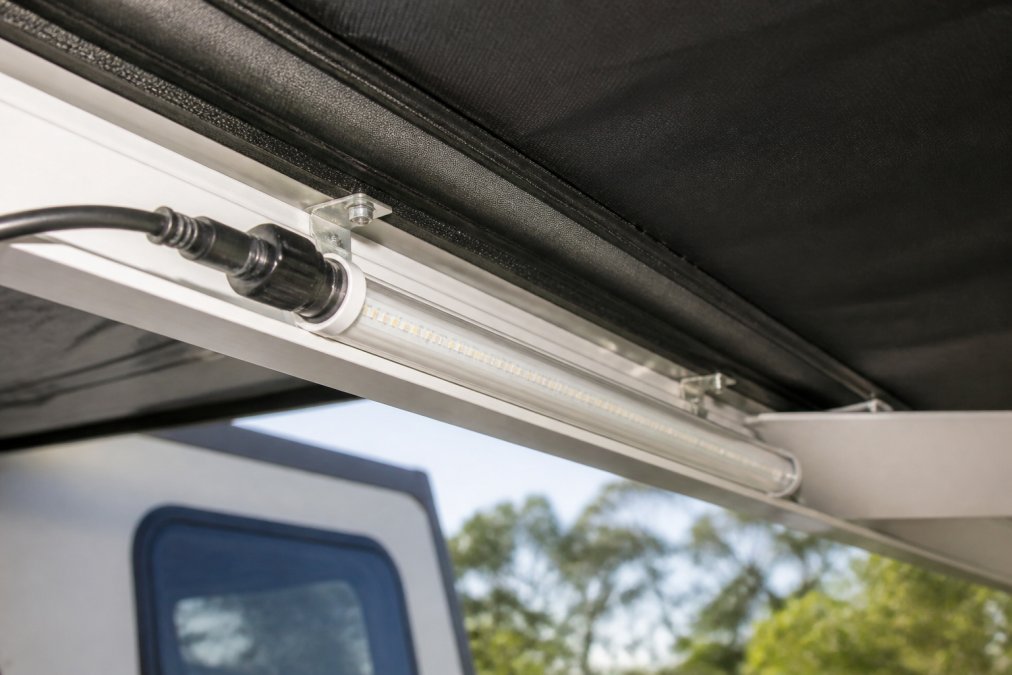
IP ratings define how well a light resists water and dust ingress. The first digit rates dust protection (0-6), the second rates water resistance (0-8). For caravan awning lights, IP67 or IP68 minimum is essential (iec.ch).
IP67 means the light is dust-tight and can handle temporary immersion in water up to 1 metre for 30 minutes, covering heavy rain and accidental splashing. IP68 handles continuous immersion and deeper water exposure. If you're camping near water or in high-rainfall regions, IP68 is worth the modest premium.
Many budget options claim waterproofing but use silicone sealants that degrade after 12-18 months of UV exposure. Solid construction matters more than the rating itself. Look for lights with integrated gaskets rather than applied sealant, and aluminium housings that won't corrode.
Lumen Output and Beam Angle for Outdoor Spaces
Lumen output measures brightness. For caravan awnings, 300-500 lumens creates comfortable ambient lighting without glare (peer-reviewed research). Below 200 lumens, you're squinting to read. Above 800 lumens, you're running a work site.
Beam angle determines spread. A narrow beam (30-45 degrees) concentrates light in a focused pool for task lighting. A wide beam (120+ degrees) spreads light across your seating area. Most caravan setups benefit from 90-120 degree beam angles.
The interaction matters: a 400-lumen light with a 60-degree beam feels dimmer than a 350-lumen light with a 120-degree beam. Check both specs before comparing performance.
Energy Efficiency and Power Consumption
A typical 12V LED caravan awning light draws 5-12 watts. Run it for 8 hours nightly, and you're consuming 40-96 watt-hours per night. Over a week's camping trip, that's 280-672 watt-hours from your auxiliary battery. For most modern caravan batteries (100-200 amp-hours), this is manageable.
Efficient LEDs deliver more light per unit of power. Budget options typically achieve 80-100 lumens per watt. The difference between a 10-watt and 8-watt light delivering the same brightness matters over a two-week trip.
Solar-powered variants eliminate battery drain entirely, though they depend on daylight hours and clear weather. Hardwired options give you full control and consistent performance regardless of weather.
Caravan Awning Lighting Installation Guide: Hardwired vs Solar-Powered
Your installation choice determines reliability, convenience, and long-term maintenance.
Hardwired Installation with Wiring Harness
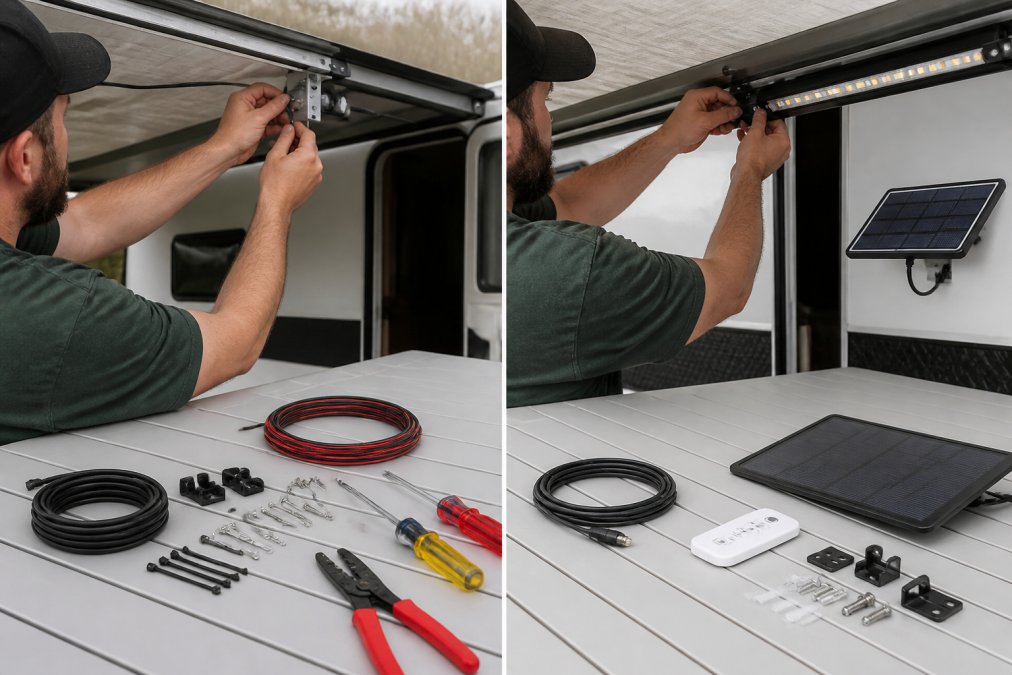
Hardwired lights connect directly to your caravan's 12V auxiliary battery or solar regulator. A wiring harness simplifies the process: it includes the correct gauge cable, inline fuses, and connectors matched to your light's specifications. Installation typically takes 30-45 minutes.
Run the positive cable from your battery through an inline fuse holder (10-15 amp capacity) to the light's positive terminal. Ground the negative cable directly to the caravan chassis or battery negative terminal. A basic switch lets you control the light independently.
Common mistakes: undersized cable (causes voltage drop and dim lighting), missing fuse protection (risks fire), and poor grounding (causes intermittent operation). Most budget caravan awning lights come with harnesses rated for their power draw, so follow the included instructions precisely.
Hardwired lights work reliably every time you flip the switch, regardless of weather. The disadvantage is battery drain on extended off-grid trips. A single light running 8 hours nightly uses roughly 3-4% of a 150Ah battery's capacity per day.
Solar-Powered Options for Off-Grid Camping
Solar-powered caravan awning lights eliminate battery drain and suit campers who prioritise independence from electrical systems. A typical solar panel (5-10 watts) charges an integrated battery during daylight, powering the light for 6-10 hours after sunset.
Performance depends on weather. A cloudy week reduces charging significantly. In winter months with shorter daylight, you might get only 4-5 hours of light nightly. They're excellent for spring and summer camping, less reliable for autumn and winter.
Installation is simple: mount the light where it receives direct sunlight, secure it with the provided bracket, and switch it on. No wiring, no fuses, no integration with your caravan's electrical system. You can't dim solar lights or run them during the day.
Many budget solar options use small panels and cheap battery cells that degrade quickly. Expect 2-3 years of reliable service before brightness drops noticeably. Hardwired lights last 8-10 years if the LED itself doesn't fail.
Mounting Brackets and Surface Mount Methods
Surface mounting is standard for caravan awnings. Most lights use aluminium or stainless steel brackets that attach via screws or adhesive tape. Screw mounting is stronger; adhesive is faster and leaves no holes.
Check your awning material before choosing. Canvas and vinyl awnings can't support heavy lights via adhesive alone. Use screw mounting with washers to distribute load. Aluminium awning frames handle both methods.
Mount lights at the outer edge of your awning, roughly 300-400mm from the corner, so they illuminate the seating area rather than the awning fabric itself. Avoid mounting directly above where you sit, which creates glare.
Most budget caravan awning lights include a mounting kit with brackets, screws, and adhesive strips. Verify the kit matches your awning type before purchasing.
Waterproof LED Strip Lights for Caravans: Materials and Durability
LED strip lights offer flexibility: you can run them along the awning perimeter, under the canopy edge, or along the caravan body. They're modular, so you can extend or reconfigure as needed.
Rigid Aluminium vs Flexible Strip Construction
Rigid aluminium housings provide superior durability and heat dissipation. The metal channel protects the LED strip, reflects light forward, and allows mounting screws without risking the strip itself. Rigid lights survive impacts, temperature extremes, and repeated flexing without degradation.
Flexible silicone strips mount directly to surfaces without a housing. They're lighter, cheaper, and easier to install on curved surfaces. The downside: silicone degrades under UV exposure, LED solder joints are exposed to moisture, and they don't dissipate heat effectively. Budget flexible strips typically last 2-3 years before the silicone hardens and cracks.
For caravan awning use, rigid aluminium is worth the modest premium. It's the difference between replacing lights every 2-3 years and having them last 8-10 years.
Weather Resistance and Long-Term Durability
Quality budget lights use marine-grade silicone sealant, stainless steel fasteners, and potted electrical connections that resist moisture ingress. Cheap alternatives use standard silicone, mild steel screws that rust, and exposed solder joints.
Test durability by checking the warranty: reputable manufacturers offer 2-3 year warranties because they're confident the product will last.
UV degradation is real. Transparent covers on LED strips yellow and become opaque over 18-24 months of direct sun exposure. Frosted covers hide discolouration better but scatter light slightly. Opaque housings eliminate the problem entirely.
Thermal cycling stresses solder joints and sealant. Lights that survive 3-5 years typically fail in year 2-3 because of this stress. Rigid construction and potted connections minimise the problem.
Light Colour Temperatures: Warm White vs Cool White for Ambiance
Colour temperature, measured in Kelvin, dramatically affects the mood and perceived brightness of your awning space.
Warm white (2700-3000K) mimics traditional incandescent light. It's flattering, relaxing, and creates an inviting atmosphere. Warm white makes food look appetising and skin tones natural. Most people find it more comfortable for evening socialising. The downside: warm white appears dimmer than cool white at the same lumen output.
Cool white (4000-5000K) resembles daylight. It's brighter-feeling, better for reading or detailed tasks, and more energising. Cool white is practical for cooking or repairs, less ideal for relaxation.
The practical choice depends on how you use your awning. Evening socialising calls for warm white. If you're cooking or working, cool white is better. Many experienced campers use warm white for ambiance and add a separate cool white task light for cooking.

Budget-Friendly Lighting Solutions: What to Avoid
Genuinely cheap lights fail in predictable ways. Knowing what to avoid saves money and frustration.
Lights with non-potted electrical connections corrode within 6-12 months. If you can see exposed solder joints or bare copper, walk past. Potted connections are encased in epoxy or silicone.
Lights claiming "waterproof" without an IP rating are guesses. Manufacturers that don't specify IP67 or IP68 are hiding poor performance.
Solar lights with panels smaller than 5 watts rarely deliver reliable performance. Similarly, integrated batteries smaller than 2000mAh won't run the light for a full evening.
Lights with plastic housings degrade faster than aluminium or stainless steel. Plastic becomes brittle within 2-3 years outdoors.
Avoid lights without a switch. Some budget options are always-on, draining your battery even when you don't need light.
| Light Type | Best For | Typical Lifespan | Power Draw |
|---|---|---|---|
| Hardwired 12V LED | Reliable evening use | 8-10 years | 8-12W |
| Solar-powered strip | Off-grid camping | 2-3 years | 0W (solar-charged) |
| Rigid aluminium strip | Durable perimeter lighting | 7-9 years | 6-10W |
| Flexible silicone strip | Budget temporary setup | 2-3 years | 5-8W |
| Motion-sensor hardwired | Security and convenience | 8-10 years | 0W standby, 10-15W active |
Maintenance and Troubleshooting Common Issues
Most caravan awning light problems are preventable with basic maintenance.

Dimming over time usually indicates battery drain or corroded connections. Check your wiring first: corrosion appears as white or green deposits on terminals. Clean with a wire brush and apply dielectric grease. If brightness doesn't improve, your battery voltage might be dropping under load.
Flickering lights suggest loose connections or undersized cable. Tighten all terminal screws and verify your cable gauge matches the light's amperage requirement. A 12-watt light needs at least 2.5mm² cable; 15-watt lights need 4mm².
Water ingress appears as condensation inside the light housing. If it's minor, it'll evaporate during the day. Persistent water suggests a failed seal. Disassemble if possible, dry thoroughly, and reapply silicone sealant. If the light is potted, replacement is the only option.
Solar lights that won't charge despite sunlight suggest a failed panel or battery. Test with a multimeter: a functioning panel produces 5-10V in direct sun. If it reads zero, the panel has failed. If it reads voltage but the light won't charge, the battery or charging circuit has failed. Most budget solar lights aren't repairable; replacement is more cost-effective.
LED failure is rare because LEDs last 80,000+ hours (energy.gov). If it happens, the driver circuit has failed. Replacement is the practical solution.
Prevention beats troubleshooting. Clean light covers quarterly to remove dust and oxidation. Check wiring connections annually. Rinse lights with fresh water after camping near the coast to remove salt residue. Store lights indoors during off-season to minimise UV and temperature stress.
Finding reliable budget caravan awning lights comes down to understanding specifications, recognising quality construction, and matching the light type to your camping style. Hardwired 12V LED options deliver the best long-term value for regular campers. Solar-powered lights suit off-grid enthusiasts who prioritise simplicity. Either way, prioritise IP67+ waterproofing, rigid aluminium construction, and lights from manufacturers confident enough to offer multi-year warranties.
Budget Roo Pty Ltd offers a curated range of lighting solutions, including options like the EL608 Rechargeable Infrared Motion Sensor Wall LED Night Light Torch (Cool White) [https://budgetroo.com.au/products/el608-rechargeable-infrared-motion-sensor-wall-led-night-light-torch-cool-white] for $42.95, the EL608 Rechargeable Infrared Motion Sensor Wall LED Night Light Torch (Warm White) [https://budgetroo.com.au/products/el608-rechargeable-infrared-motion-sensor-wall-led-night-light-torch-warm-white] for $42.95, and the 54 LED Rechargeable Under Cabinet Night Lighting for Kitchen and Bedroom (Sliver and White Light) [https://budgetroo.com.au/products/54-led-rechargeable-under-cabinet-night-lighting-for-kitchen-and-bedroom-sliver-and-white-light] for $45.95. These are designed for durability and affordability. Shop our selection to find the right fit for your setup. Get started with lighting that lasts and delivers reliable performance season after season.

Frequently Asked Questions
Q: What is the best 12V LED awning light for budget caravans?
A: The best option depends on your setup, but 12V LED caravan awning lights with IP67 or IP68 waterproof ratings offer durability without excessive cost. Look for lights delivering 200-400 lumens with warm white (3000K) or cool white (6000K) options. Hardwired options cost less upfront than solar-powered alternatives, though solar saves on wiring. Budget-friendly models typically cost between $40-$150 per light, depending on brightness and installation complexity.
Q: How do I install waterproof LED strip lights for caravans?
A: Start by measuring your awning frame and purchasing the correct length. Hardwired installation requires running a 12V power line from your caravan's battery through a fused switch to the light. Surface-mount brackets secure the rigid aluminium housing to the frame. For solar-powered options, mount the panel on the awning and run the cable to the light unit. Always seal connections with waterproof silicone to prevent moisture ingress. Follow the manufacturer's wiring diagram and use appropriate gauged cable for your run length.
Q: What waterproof rating do caravan awning lights need?
A: Caravan awning lights should have at least IP65 rating for basic outdoor use, but IP67 or IP68 is recommended for durability. IP67 means the light survives temporary immersion (up to 1 metre for 30 minutes), while IP68 handles continuous submersion. Given Australian weather conditions and exposure to moisture, salt spray, and dust, investing in IP67+ rated lights prevents premature failure and reduces maintenance costs over time.
Q: Are solar-powered caravan awning lights worth the extra cost?
A: Solar-powered lights eliminate wiring hassle and battery drain, making them ideal for occasional campers or off-grid trips. However, they're typically 50-100% more expensive than hardwired options and depend on daylight hours for charging. For frequent touring where you're moving regularly, hardwired 12V LED lights offer better reliability and brightness control. Choose solar if convenience matters more than upfront cost; choose hardwired if you want consistent performance and lower initial investment.
This article was written using GrandRanker