

Last Updated: October 27, 2026
Quick Summary
The five best solar panel setups for off-grid camping are the CHOETECH SC011 200W for long trips, BigBlue 100W as the all-rounder, CHOETECH SC010 160W for van life, CHOETECH SC008 120W for camping fridges and CHOETECH SC009 100W for hikers. They are worth it if you match panel wattage to your daily watt-hours, since sizing for the shoulder season and derating for shade and cloud keeps a setup reliable.
- Size a panel by adding daily watt-hours, then doubling that number for panel wattage.
- The 200W SC011 weighs 7.9kg, the heaviest panel in the comparison.
- A 200W panel averaging 60% output over six hours gives about 720Wh.
- Connect the battery to the charge controller before connecting the panel.
- Store lithium power stations at about 50-60% charge between trips.
Table of Contents
- Quick Comparison: The 5 Best Solar Panel Setups for Off-Grid Camping
- How to Size a Solar Panel for Camping
- 1. CHOETECH SC011 200W Foldable Solar Charger: Best for Long Trips
- 2. BigBlue Portable 100W Solar Panel Charger: Best All-Rounder
- 3. CHOETECH SC010 160W Foldable Solar Charger: Best for Van Life
- 4. CHOETECH SC008 120W Foldable Solar Charger: Best Solar Panels for a Camping Fridge
- 5. CHOETECH SC009 100W Foldable Solar Charger: Best for Hikers
- Building a Portable Solar Panel and Battery Setup
- Frequently Asked Questions
Quick Comparison: The 5 Best Solar Panel Setups for Off-Grid Camping
Choosing a solar setup for off-grid camping means matching panel wattage to what you actually run each day. At Budget Roo, we stock folding solar panels for camping and other outdoor activities.
Here is how the five stack up.
| Panel | Price (AUD) | Weight | Ports | Best for |
|---|---|---|---|---|
| CHOETECH SC011 200W | $504.95 | 7.9 kg | DC, USB-C, 2x USB-A | Long trips, multiple devices |
| BigBlue 100W | $564.95 | 4.85 kg | DC, 45W USB-C PD, 2x USB-A | All-round camping |
| CHOETECH SC010 160W | $425.95 | 6.6 kg | DC, USB-C, 2x USB-A | Van life, RV batteries |
| CHOETECH SC008 120W | $267.95 | Not listed | DC, 2x USB-C, USB-A | Camping fridge |
| CHOETECH SC009 100W | $253.95 | Not listed | DC, USB-C, 2x USB-A | Hikers, caravanners |
How to Size a Solar Panel for Camping
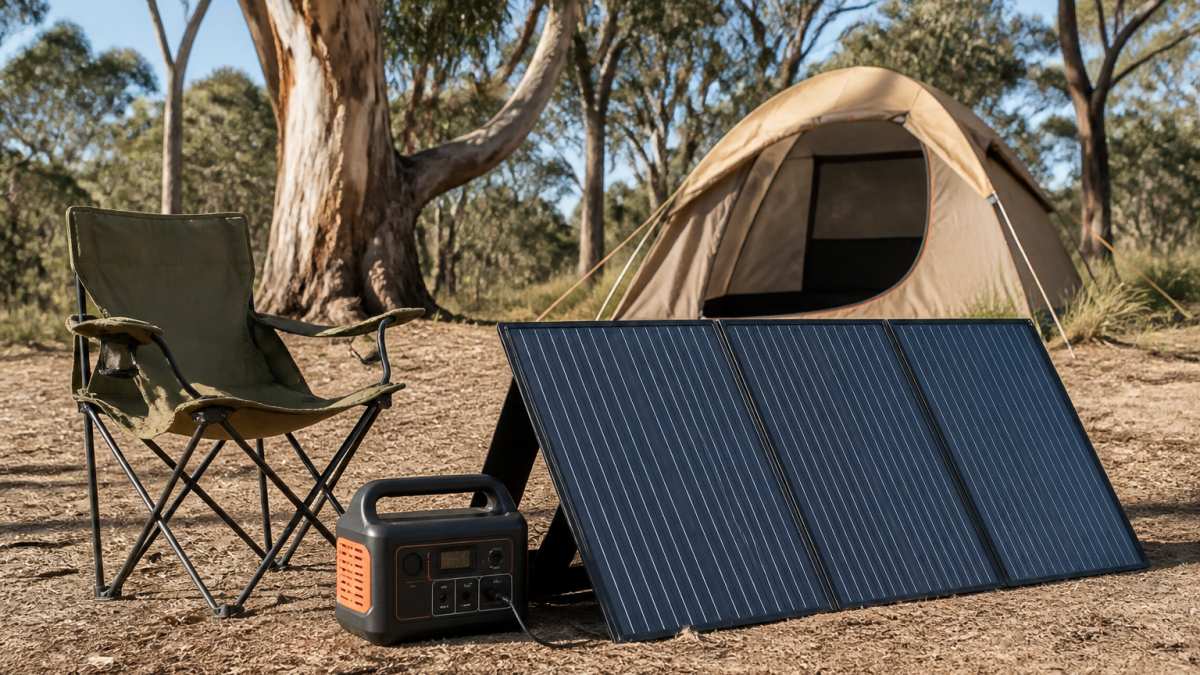
Sizing a camping panel means adding up your daily energy use in watt-hours. A 12V solar panel kit for camping is just a panel, a cable and a battery.
Work through it in this order:
- List every device and its watts (a phone charger is about 10W, a 50L fridge typically draws 40-60W while running).
- Estimate hours of actual use per day.
- Multiply watts by hours to get watt-hours.
- Double that number to find your panel wattage.
Worked Energy Budget: Two Nights Off-Grid
Picture a couple camping two nights with a 50L fridge, two phones, a laptop and a lantern.
- Fridge: 50W running about 8 hours a day in mild weather = 400Wh
- Two phones: 20Wh each = 40Wh
- Laptop: 60Wh for one charge = 60Wh
- LED lantern: 5W for 4 hours = 20Wh
That is roughly 520Wh a day. The CHOETECH SC011 is a 200W panel. Drop the fridge and the trip needs closer to 120W, covered by the SC009 or SC008.
Match Battery Capacity to Your Daily Watt-Hours
Panel watts are only half the equation. You want at least one full day of usable battery capacity so a cloudy day does not leave you dark. Rule of thumb: battery usable watt-hours should equal your daily watt-hour need. For the 520Wh example, that means roughly 520Wh usable, which is why a 500Wh-class power station pairs naturally with the 200W SC011.
Derate for Real-World Conditions
A panel's label wattage is measured under standard test conditions: 1,000W/m² of sunlight and a cell temperature of 25°C. In the field you will rarely see that, so apply these derating factors:
- Shade: even a small shadow across one cell can cut a panel's output by half or more. Assume 50-70% of rated output if you cannot keep the panel fully clear.
- Cloud: heavy overcast can drop output to 10-25% of rated watts; light cloud to 50-75%.
- Angle: a panel lying flat when the sun is low may produce only 50-60% of what it would at the correct tilt.
- Heat: panel output falls as cell temperature rises; expect a few percent loss on a hot day.
- Season: winter sun is lower and days are shorter, so a panel that keeps up in summer may fall short in June.
Size for the shoulder season, not midsummer, and carry a panel that can be angled rather than one that only lies flat. If your daily need is 520Wh, a 200W panel averaging 60% of rated output over six hours gives about 720Wh, enough headroom for a cloudy morning.
Quick Sizing Cheat Sheet by Camping Style
- Tent camping, devices only: 60-120Wh/day → 100W panel, 100-200Wh power bank.
- Vehicle camping with a fridge: 400-600Wh/day → 160-200W panel, 500-700Wh battery.
- Long off-grid stays, work and fridge: 700-1,000Wh/day → 200W+ panel, 1,000Wh+ battery, ideally with a second panel for cloudy stretches.
1. CHOETECH SC011 200W Foldable Solar Charger: Best for Long Trips
The SC011 has a maximum output of 200W, with DC, USB-C and two USB-A ports. Its folded size is 645 x 535 x 53mm.
The listing specifies IPX65 water resistance and a DC output of 12-20V at up to 5A.
Watch out: at 7.9kg, it is the heaviest panel here.
Best for: families and long-stay campers running a fridge and power station. Skip if: you are packing light or moving camp every day.
View the CHOETECH SC011 200W Foldable Solar Charger

2. BigBlue Portable 100W Solar Panel Charger: Best All-Rounder
BigBlue's 100W panel folds into a briefcase with a TPE rubber handle and has kickstands.
The package includes a DC-Anderson cable, DC-DC cable, alligator clip to DC cable and 10-in-1 connector.
The panel cannot store electricity, and cloudy weather or lack of sunlight affects its output.
Best for: campers who want one panel that handles phones, tablets and a 12V battery. Skip if: you need to run a fridge through a cloudy stretch; go bigger.
Check specs and buy the BigBlue 100W panel

3. CHOETECH SC010 160W Foldable Solar Charger: Best for Van Life
The SC010 is made from Oxford PVC fabric, has an IPX65 water-resistance rating and includes a built-in kickstand for a 45-degree angle.
BigBlue Portable 100W Solar Panel Charger →
The SC010 has a maximum output of 160W and a DC output of 12-20V at up to 5A.
The panel weighs 6.6kg.
Best for: van and RV owners recharging house batteries. Skip if: you are hiking in and need something you can carry all day.
See the CHOETECH SC010 160W Foldable Solar Charger

4. CHOETECH SC008 120W Foldable Solar Charger: Best Solar Panels for a Camping Fridge
The SC008 has a 120W output and four ports: DC, USB-C 3.0 18W, USB-C PD 60W and USB-A.
The listing says the SC008 includes 10 DC connectors and a smart IC chip in the USB port that protects devices from overcharging and overloading. Its unfolded dimensions are 177 x 53cm.
Best for: campers whose biggest draw is a 12V fridge. Skip if: you want maximum watts for the money and have room for a 200W panel.
View the CHOETECH SC008 120W Foldable Solar Charger
5. CHOETECH SC009 100W Foldable Solar Charger: Best for Hikers
The SC009 has a maximum output of 100W, with DC, USB-C and two USB-A ports. Its listing states solar conversion of up to 23.5%.
The SC009 has foldable stands and is listed for camping, caravanning and hiking.
Best for: hikers and caravanners topping up devices on the move. Skip if: you are powering a fridge or a power station daily.
Check the CHOETECH SC009 100W Foldable Solar Charger
Building a Portable Solar Panel and Battery Setup
A working off-grid camping setup is four parts: panel, cable, charge controller or power station, and battery. The panel makes power, the controller stops overcharging, and the battery stores it for night. Getting the pieces to talk to each other is where most setups succeed or fail.
Match the Pieces
- Panel to battery: keep panel voltage within your controller's input range. All five panels here output 12-20V DC, which suits most 12V systems. Check the open-circuit voltage (Voc) on the panel label against your controller's maximum input voltage, a panel rated 20V DC may read higher in cold, bright conditions.
- Cable and connectors: use the DC-Anderson or alligator clips supplied; longer runs need thicker cable to avoid voltage drop. As a rule, keep cable runs under 5m where possible, and use 10AWG or thicker for runs beyond that.
- Charge controller: needed for bare 12V batteries. Smart panels with built-in IC protection can go straight to a power station. If you are using a separate controller, match its amp rating to the panel: a 200W panel at 12V can deliver about 16A, so a 20A controller gives headroom.
- Battery capacity: size it to your daily watt-hours so one sunny day covers one night's use. See the sizing section above for the maths.
Connector Types You Will Meet
Most portable panels and power stations use one of four connectors: Anderson Powerpole (12V fridge and battery boxes), DC5521 barrel (smaller power stations), XT60 (lithium battery packs) and alligator clips (bare batteries). The panels here ship with a 10-in-1 connector set or a DC-Anderson cable, covering most. If your power station uses XT60 and your panel uses Anderson, buy a short adapter cable rather than cutting and splicing, it keeps your warranty intact and your wiring safe.
Safe Wiring Basics
- Connect the battery to the charge controller before connecting the panel, and disconnect the panel first when packing up. This order protects the controller.
- Keep positive and negative leads clearly separated and never let bare connectors touch.
- Fuse the positive lead close to the battery if you are running a bare 12V system; a 15-20A inline fuse suits most camping panels.
- Do not exceed the controller's rated amps. If you add a second panel, check the combined current against the controller label.
Troubleshooting Slow Charging
If your panel is not keeping up, check these before blaming the gear:
- Is the panel fully in sun? A single shadowed cell can halve output. Move the panel, not the camp chair.
- Is the angle right? Tilt toward the sun; a flat panel at midday in winter can lose a third of its output.
- Is the cable warm or the connector loose? A warm connector means resistance; reseat it or swap the cable.
- Is the battery nearly full? Controllers taper current near full, so slow charging at 90% is normal.
- Is the controller in the right mode? Match it to the battery chemistry (lead-acid, AGM, lithium), the wrong setting can undercharge or damage a battery.
- Is the panel hot? Output falls as cell temperature rises; a panel in direct sun on a 35°C day will underperform its label.
Maintenance and Storage Between Trips
- Wipe the panel surface with a soft damp cloth; dust and sunscreen film cut output.
- Store panels folded and dry, away from sharp edges that can scratch the cells.
- Store lithium power stations at about 50-60% charge for long breaks, topping up every few months.
- Check cables and connectors for fraying or corrosion before each trip; replace rather than repair damaged leads.
Frequently Asked Questions
What size solar panel do I need for off-grid camping?
Start by considering your intended use and the panel's listed output. Budget Roo's catalogue includes folding panels from 14W to 200W.
How many watts of solar do I need to run a camping fridge?
Budget Roo's catalogue includes the CHOETECH SC008 120W, SC010 160W and SC011 200W foldable solar chargers. Check the product listings for their specifications.
Do I need a solar charge controller for camping?
The product listings describe different ports and, for some models, smart IC or smart-chip features. Check the listing for the specific panel's details.
Can I connect a portable solar panel to a 12V battery?
The product listings describe DC outputs and included cables for some models. Check the listing for the specific panel's output and package contents.
Are folding or fixed solar panels better for camping?
The catalogue includes folding panels. Features vary by model; check each product listing for its dimensions, weight and water-resistance details.
Off-grid power rewards planning more than spending. Work out your daily watt-hours, double it, and pick the panel that fits how you camp. At Budget Roo we stock the full range of folding panels, from the 100W SC009 for hikers to the 200W SC011 for long trips, all with free shipping and prices that leave room for the rest of your kit. Get started with Budget Roo and build a solar setup that keeps your fridge cold and your devices charged, trip after trip.
